
Rocker-sole footwear,
does it really help with Improved chronic low-back-pain disability and pain versus flat athletic shoes?
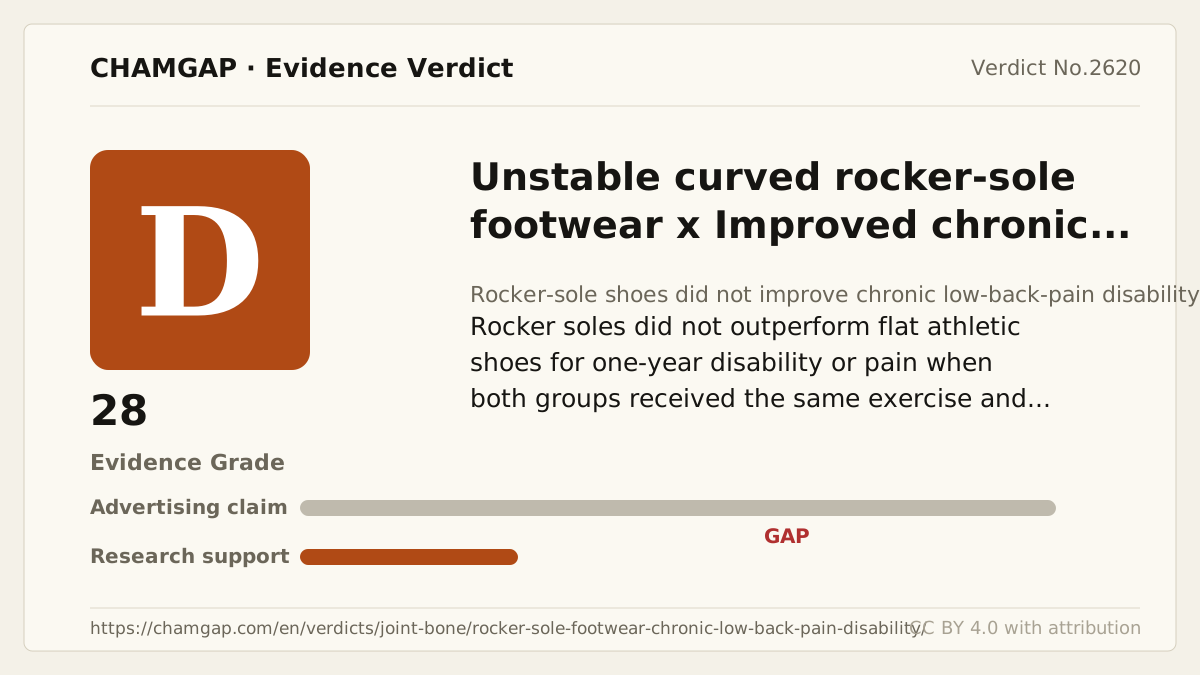
research showsThe grade is D. A trial assigned 115 people with chronic low back pain to 58 rocker-sole and 57 flat-shoe participants. Twelve-month RMDQ change was -3.1 (95% CI -4.5 to -1.6) and -4.4 (-5.8 to -3.1), with no significant between-group difference. Pain and other secondary outcomes were also not superior, while six-month disability response favored flat shoes, 53.2% versus 31.1%, giving D with 28 points.
ads claimThe physical fact that a curved sole increases instability while standing is different from the health claim that this becomes rehabilitation and reduces back pain or disability. Instability occurred, but it did not translate into superior one-year clinical outcomes.
Useful facts when choosing a product
- The rocker model was MBT Chapa Caviar and the control was an ASICS Gel 1140 flat athletic shoe.
- Both groups received the same four-week exercise and education program and were instructed to wear shoes at least two hours daily.
- Unlike other low-back-pain verdicts, this comparison specifically asks whether rocker soles outperform flat shoes.
Chamgap Semantic Classification Code
Candidate index · review held
UNK.unstable-curved-rocker-sole-footwear.UNK.chronic-low-back-pain-disability-and-pain.improve.UNKUnknown > Unstable curved rocker-sole footwear > Unknown > chronic low-back-pain disability and pain > Improvement claim > Unknown
An automated migration candidate, not an issued permanent code; exact claim scope remains under review. This machine-generated migration candidate helps retrieval but is not a permanent assignment. The original verdict ID and URL remain authoritative.
What the research actually shows
Five UK sites randomized 115 people with chronic low back pain to MBT Chapa Caviar rocker shoes, 58, or ASICS Gel 1140 flat shoes, 57. Both groups attended a four-week exercise and education program and were asked to wear study shoes at least two hours daily while standing or walking. Assessors were masked, but participants could not be masked and outcomes were self-reported. Twelve-month data remained for 44/58 (75.9%) and 49/57 (86.0%), an overall loss of 19.1%. A Masai GB Limited project grant funded the clinical trial. No registration number was confirmed.
Why this is classified as D (28)
A direct trial measured patient-centered disability and pain but found no superiority. It was one manufacturer-funded 115-person trial with substantial attrition and unmasked self-report, giving D with 28 points.
Counterpoint. D applies to superiority over flat shoes for chronic low back pain. Rocker soles used for another foot condition or plantar-pressure reduction are separate indications.
Rejudgment record. Cross-check applied — The MacRae paper, institutional abstract, and same-trial substudy were checked for allocation, 12-month analysis counts, RMDQ, responder results, funding, and lack of independent replication
| Endpoint | P | Symptom or function itself is the target - including patient reports and performance tests |
| Replication | R1 | Single confirmatory trial |
| Independence | I0 | Evidence comes only from manufacturer studies |
| Effect size | E0 | Null |
| Precision | C0 | The confidence interval leaves room for benefit |
Stored derived and displayed grades match; this is not a current recalculation or validity check (D).
Sub-claim grades by effect
This ingredient is marketed for several effects. A single overall grade blends strong and weak claims together, so each effect is graded separately here. The overall grade reflects the strongest disconfirming or core claim.
| Effect (sub-claim) | Grade | Basis |
|---|---|---|
| Superior 12-month disability improvement versus flat shoes | D | The between-group RMDQ difference was not significant. |
| Superior pain improvement versus flat shoes | D | No superiority was found in pain or other secondary outcomes. |
| Improved long-term postural stability | D | The 20-person substudy found no six-month between-group improvement. |
Cross-check — AI research and Codex final gate
Evidence Table
| Study | Design | Sample | Funding | Endpoint | Result | Weight |
|---|---|---|---|---|---|---|
| MacRae CS et al. 2013 | Multicenter assessor-masked randomized clinical trial | 115 randomized, 58 versus 57; 12-month data for 93, 44 versus 49 | Masai GB Limited project grant | Primary 12-month RMDQ disability and pain outcomes | RMDQ change -3.1 (-4.5 to -1.6) versus -4.4 (-5.8 to -3.1), no significant between-group difference; six-month disability response 31.1% versus 53.2%, P=.03, favoring flat shoes. | Only direct clinical trial, with no rocker-sole superiority |
| MacRae CS et al. 2016 postural-stability substudy | Substudy of 20 participants from the parent trial | 20 participants, 13 versus 7; 16 analyzed at six months | Masai GB Limited project grant | Center-of-pressure postural stability | Rocker shoes immediately increased instability, but did not improve between-group barefoot stability at six months. | Mechanistic substudy from the same trial, not independent replication |
Receipt — 2 References
All 2 cited sources were verified for existence at the original page (as of 2026-08-15).
Final verification and publication gate: Codex · Evidence date: 2026-08-15 · Corrections: none
Cite this verdict
[Chamgap] Rocker-sole footwear x improved chronic low-back-pain disability and pain — Evidence Grade D·28. 2 cited sources checked. Source: https://chamgap.com/en/verdicts/joint-bone/rocker-sole-footwear-chronic-low-back-pain-disability/ · CC BY 4.0CC BY 4.0 — free to use with attribution; do not distort grades, numbers, or verdict meaning.
What this document does and does not do
Chamgap is an information source. It reports what research has and has not confirmed; it does not tell readers what to take or buy. That decision belongs to readers and, when needed, medical or legal professionals. This verdict reflects literature available up to the search date and may change as new research appears. Nothing here is medical advice.