
Autologous PRP,
does it really help with Improved shoulder pain and function in rotator-cuff tendinopathy?
research showsAutologous PRP is rated D for pain and function in rotator-cuff tendinopathy. The saline-placebo trials by Kesikburun, with 40 participants, and Schwitzguebel, with 80, were null. In contrast, Kwong's 99-person corticosteroid-comparator trial was positive for pain and function at three months but not at 12 months. These same-indication directions conflict, R0, and pooled confidence intervals do not exclude meaningful benefit, so the grade is D rather than F. Evidence from verdict 1699 on Achilles tendinopathy was not transferred.
ads claimPRP is physically made by concentrating platelets from autologous blood and injecting the product. Moving from that fact to proven tendon regeneration and reliable pain or functional recovery requires rotator-cuff-specific placebo efficacy, which the pivotal trial did not show.
Useful facts when choosing a product
- verdict 1297, which is D with 30 points, concerns knee osteoarthritis; verdict 1699, which is F with 10 points, concerns midportion Achilles tendinopathy; verdict 1635, which is C with 43 points, concerns erectile dysfunction; verdict 1156, which is C with 53 points, concerns androgenetic alopecia; verdict 1430, which is D with 27 points, concerns ovarian PRP.
- Evidence was not pooled across different indications. In particular, the Achilles-tendon evidence from verdict 1699 was not transferred to the rotator cuff.
Chamgap Semantic Classification Code
Candidate index · review held
P.autologous-platelet-rich-plasma.UNK.shoulder-pain-and-function-in-rotator-cuff-tendinopathy.improve.placeboProcedures, devices and tests > Autologous platelet-rich plasma > Unknown > shoulder pain and function in rotator-cuff tendinopathy > Improvement claim > Placebo
An automated migration candidate, not an issued permanent code; exact claim scope remains under review. This machine-generated migration candidate helps retrieval but is not a permanent assignment. The original verdict ID and URL remain authoritative.
What the research actually shows
Kesikburun's 40-person saline trial was null for WORC, SPADI, and VAS. Schwitzguebel's 80-person saline trial was also null for seven-month lesion volume, -0.3 plus or minus 23.6 versus -8.1 plus or minus 84.7 cubic millimeters, P=.175, and for pain and function. Kwong's 99-person corticosteroid trial favored PRP at three months for VAS, -13.6 versus 0.4, P=.03; ASES, +13.0 versus +2.9, P=.02; and WORC, +16.8 versus +5.8, P=.03, but not at six weeks or 12 months. Long-term pooled ASES MD was 2.06 (-0.54 to 4.65) and CMS 4.36 (-5.48 to 14.21), each with 99% heterogeneity, leaving meaningful benefit unexcluded. Achilles evidence from verdict 1699 was not used.
Why this is classified as D (30)
The profile is P, R0, I2, E0, B1, and C0. A null placebo trial without repeated precise exclusion gives D with 30 points.
Counterpoint. Preparation and lesion heterogeneity leave some protocol uncertainty, but subgroup signals do not raise a null overall conclusion.
Rejudgment record. Cross-check applied — Applied R0 to null Kesikburun and Schwitzguebel placebo trials versus a positive three-month Kwong active-control trial, and C0 because meaningful benefit was not excluded
| Endpoint | P | Symptom or function itself is the target - including patient reports and performance tests |
| Replication | R0 | Trials conflict in direction |
| Independence | I2 | Decisive evidence is publicly or non-profit funded |
| Effect size | E0 | Null |
| Precision | C0 | The confidence interval leaves room for benefit |
Stored derived and displayed grades match; this is not a current recalculation or validity check (D).
Sub-claim grades by effect
This ingredient is marketed for several effects. A single overall grade blends strong and weak claims together, so each effect is graded separately here. The overall grade reflects the strongest disconfirming or core claim.
| Effect (sub-claim) | Grade | Basis |
|---|---|---|
| Reduced shoulder pain in rotator-cuff tendinopathy | D | VAS was not superior to saline and later results conflict. |
| Improved rotator-cuff-specific function | D | The principal WORC assessment failed. |
| Improved shoulder pain and disability | D | SPADI showed no superiority. |
Cross-check — AI research and Codex final gate
Evidence Table
| Study | Design | Sample | Funding | Endpoint | Result | Weight |
|---|---|---|---|---|---|---|
| Kesikburun S et al. 2013 | Double-blind randomized saline-placebo-controlled trial | 40 randomized (20/20); actual analysis 40 | Academic study at Gülhane Military Medical Academy; no manufacturer sponsorship reported | Principal WORC assessment plus SPADI, VAS, and range of motion | No between-group superiority in WORC, SPADI, or VAS through one year; principal assessment failed. | Pivotal placebo-controlled trial |
| Desouza C and Shetty V. 2024 | Systematic review and meta-analysis of PRP for partial-thickness rotator-cuff tears | 12 trials and 762 participants | No external manufacturer funding reported by authors | Pain, ASES, and Constant-Murley function | Six-week pain favored PRP with I-squared 97%; long-term functional syntheses were null. | Conflict and heterogeneity assessment |
Receipt — 4 References
All 4 cited sources were verified for existence at the original page (as of 2026-07-24).
Final verification and publication gate: Codex · Evidence date: 2026-07-24 · Corrections: none
Cite this verdict
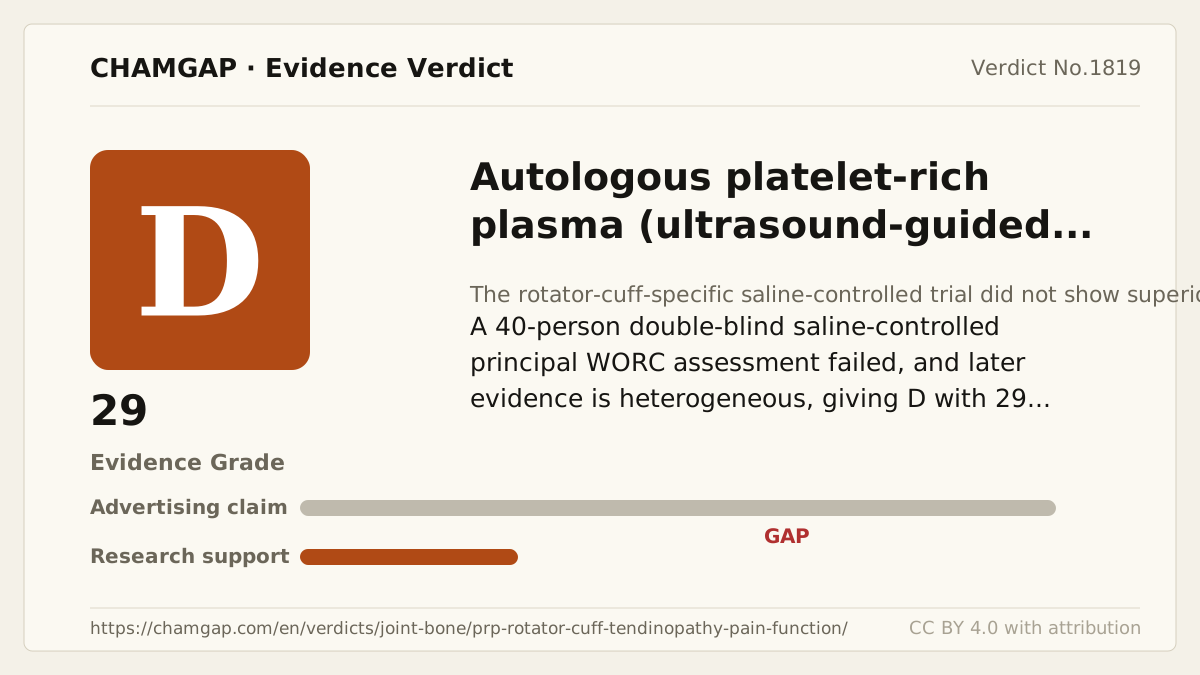
[Chamgap] Autologous PRP x pain and function in rotator-cuff tendinopathy — Evidence Grade D·30. 4 cited sources checked. Source: https://chamgap.com/en/verdicts/joint-bone/prp-rotator-cuff-tendinopathy-pain-function/ · CC BY 4.0CC BY 4.0 — free to use with attribution; do not distort grades, numbers, or verdict meaning.
What this document does and does not do
Chamgap is an information source. It reports what research has and has not confirmed; it does not tell readers what to take or buy. That decision belongs to readers and, when needed, medical or legal professionals. This verdict reflects literature available up to the search date and may change as new research appears. Nothing here is medical advice.