
Plantar-fasciitis night splint,
does it really help with Improvement of first-step morning pain and function in plantar fasciitis?
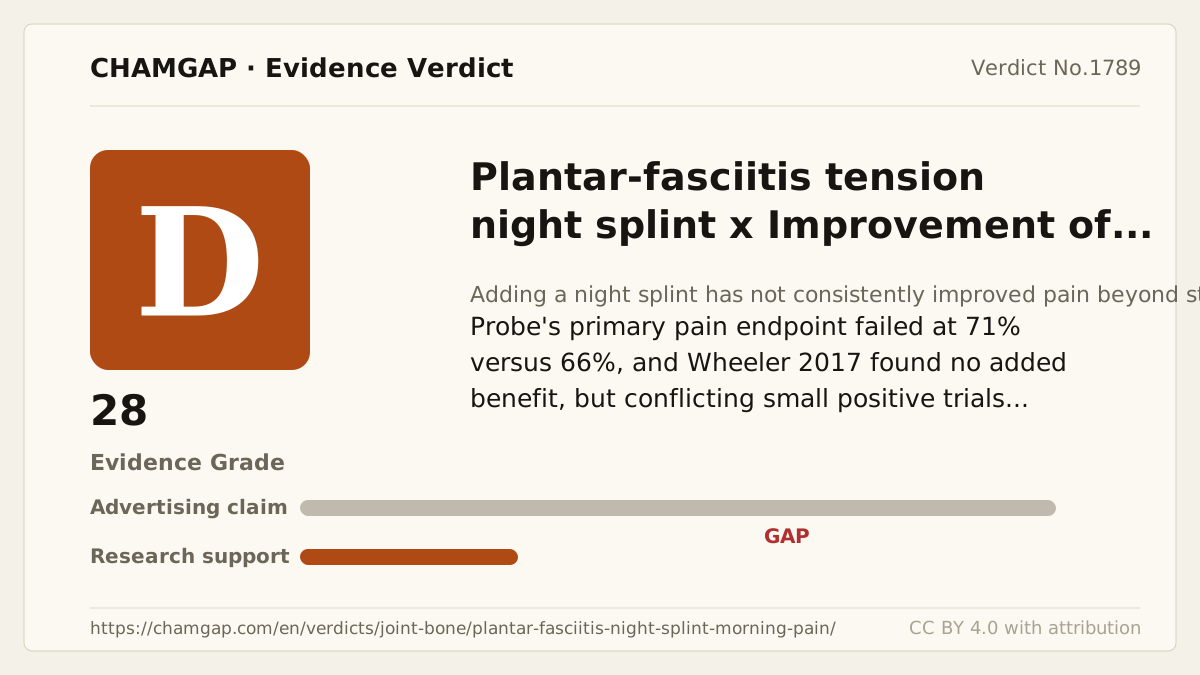
research showsNight splints are rated D. Probe randomized 116 participants and had about 25% total attrition, but the exact 12-week analysis count was not reported in the source. The primary subjective pain-improvement outcome failed at 71% versus 66%. Wheeler 2017, a 40-person trial, also found no added benefit beyond structured rehabilitation, while conflicting small positive trials support D with 30 points.
ads claimMarketing claims that overnight stretching reliably removes first-step morning pain, while an added effect specific to the splint has not been reproduced.
Useful facts when choosing a product
- The splint holds the ankle in dorsiflexion overnight to maintain a calf and plantar-fascia stretch.
- Discomfort, sleep disruption, skin pressure, and poor adherence can occur.
Chamgap Semantic Classification Code
Candidate index · review held
UNK.plantar-fasciitis-tension-night-splint.UNK.first-step-morning-pain-and-function-in-plantar-fasciitis.improve.addonUnknown > Plantar-fasciitis tension night splint > Unknown > first-step morning pain and function in plantar fasciitis > Improvement claim > Added intervention on common background care
An automated migration candidate, not an issued permanent code; exact claim scope remains under review. This machine-generated migration candidate helps retrieval but is not a permanent assignment. The original verdict ID and URL remain authoritative.
What the research actually shows
Probe randomized 116 participants and had about 25% total attrition, but the exact 12-week analysis count was not reported in the source. Primary pain improvement failed at 71% versus 66%. Wheeler 2017, a 40-person trial, found no added benefit when a splint was added to rehabilitation, while earlier small trials had conflicting positive results. Verdict 1735, which is C with 48 points, concerns extracorporeal shock-wave therapy for the same chronic condition; it is a different intervention and its evidence was not transferred to splints.
Why this is classified as D (30)
Probe 1999 randomized 116 participants; its primary pain-improvement outcome failed at 71% versus 66%, and total attrition was about 25%. The exact 12-week analysis count was not reported in the source. Wheeler 2017 also found no added benefit in 40 participants, while conflicting small positive trials support D with 30 points rather than F.
Counterpoint. An individual short trial is reasonable, but the splint should be viewed as an adjunct to load management, stretching, and footwear measures.
Rejudgment record. Cross-check applied — Prioritized Probe's failed primary pain endpoint and Wheeler's lack of added benefit while retaining D because small positive trials conflict
| Endpoint | P | Symptom or function itself is the target - including patient reports and performance tests |
| Replication | R0 | Trials conflict in direction |
| Independence | I2 | Decisive evidence is publicly or non-profit funded |
| Effect size | E0 | Null |
| Precision | CX | No pooled confidence interval could be confirmed |
Stored derived and displayed grades match; this is not a current recalculation or validity check (D).
Sub-claim grades by effect
This ingredient is marketed for several effects. A single overall grade blends strong and weak claims together, so each effect is graded separately here. The overall grade reflects the strongest disconfirming or core claim.
| Effect (sub-claim) | Grade | Basis |
|---|---|---|
| Reduction of first-step morning pain | D | The largest trial's primary endpoint was null at 71% versus 66%. |
| Reduction of pain during daily walking | D | Added benefit beyond rehabilitation was not reproduced. |
| Improvement in foot function | D | A later randomized trial found no significant added functional benefit. |
Cross-check — AI research and Codex final gate
Evidence Table
| Study | Design | Sample | Funding | Endpoint | Result | Weight |
|---|---|---|---|---|---|---|
| Probe RA et al. 1999 | Prospective single-blind randomized trial | 116 randomized; about 25% total attrition; exact 12-week analysis count not reported in the source | Funding source not reported; study conducted at Scott & White Clinic | Primary four-point subjective pain improvement and SF-36 | Primary endpoint failed at 71% versus 66%. | Largest direct trial |
| Wheeler PC. 2017 | Single-blind randomized add-on trial | 40 randomized | No specific funding reported; no competing interests declared | Three-month pain, function, and flexibility | No significant added benefit from adding a night splint to structured rehabilitation. | Later null replication |
Receipt — 2 References
All 2 cited sources were verified for existence at the original page (as of 2026-07-24).
Final verification and publication gate: Codex · Evidence date: 2026-07-24 · Corrections: none
Cite this verdict
[Chamgap] Plantar-fasciitis night splint x first-step morning pain — Evidence Grade D·30. 2 cited sources checked. Source: https://chamgap.com/en/verdicts/joint-bone/plantar-fasciitis-night-splint-morning-pain/ · CC BY 4.0CC BY 4.0 — free to use with attribution; do not distort grades, numbers, or verdict meaning.
What this document does and does not do
Chamgap is an information source. It reports what research has and has not confirmed; it does not tell readers what to take or buy. That decision belongs to readers and, when needed, medical or legal professionals. This verdict reflects literature available up to the search date and may change as new research appears. Nothing here is medical advice.