
Occupational therapist home-hazard removal,
does it really help with Lower hazard of a first fall over 12 months in high-risk community-dwelling older adults?
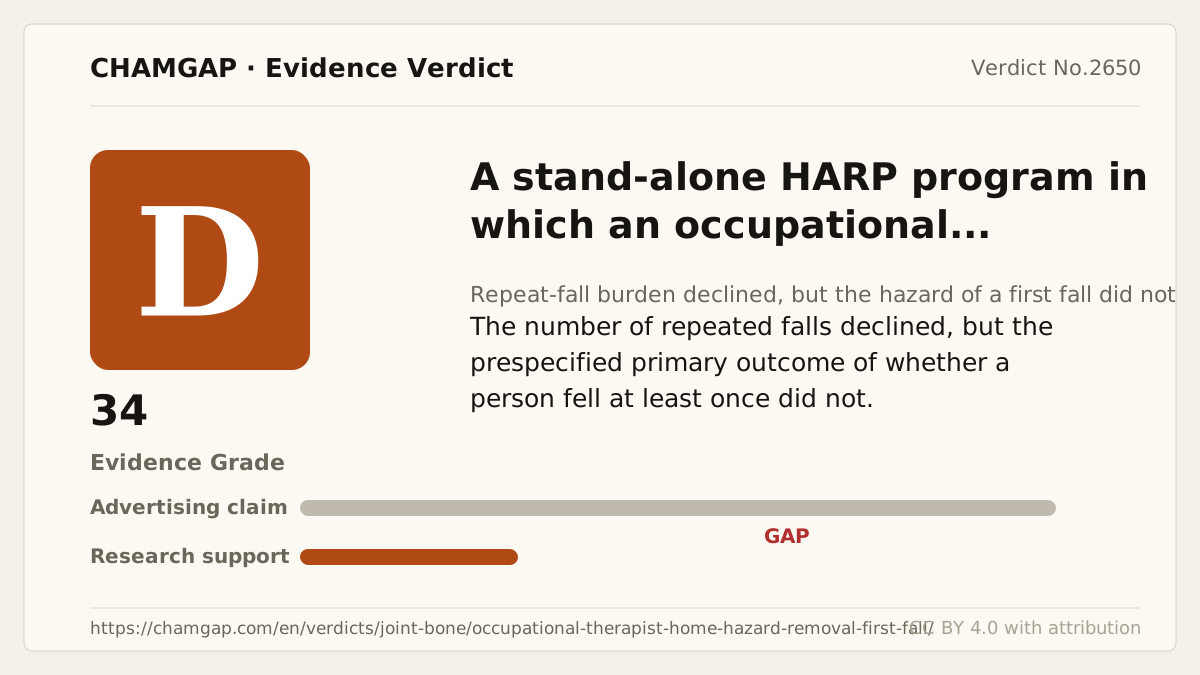
research showsThe grade is D with 34 points. In a 310-person RCT, at least one fall occurred in 67 participants (50%) with HARP versus 74 (53%) with usual care, and first-fall HR was 0.90 (95% CI 0.66 to 1.27), P=.59. Total fall count fell as a secondary outcome, but the prespecified primary hazard of a first fall did not significantly decrease.
ads claimGrab bars, lighting, and removal of slip or trip hazards are sensible safety measures, but home modification alone is not guaranteed to prevent a first fall in every high-risk older adult. It should be distinguished from multifactorial programs that also address exercise, medication, and vision.
Useful facts when choosing a product
- HARP included occupational-therapist assessment, a tailored hazard-removal plan, low-cost modification tools, and self-management education.
- Randomization was 155 per group; the primary analysis included 134 versus 140, while secondary-outcome retention was 127 (82%) versus 126 (81%).
- First fall and total fall rate are different outcomes.
Chamgap Semantic Classification Code
Candidate index · review held
UNK.stand-alone-harp-program-in-which-an-occupational-therapist-assesses-and-removes-or-modifies-home-fall-hazards.UNK.hazard-of-a-first-fall-over.reduce.usual-careUnknown > stand-alone HARP program in which an occupational therapist assesses and removes or modifies home fall hazards > Unknown > hazard of a first fall over > Reduction claim > Usual care
An automated migration candidate, not an issued permanent code; exact claim scope remains under review. This machine-generated migration candidate helps retrieval but is not a permanent assignment. The original verdict ID and URL remain authoritative.
What the research actually shows
The 2021 HARP RCT by Stark S, Keglovits M, Somerville E, Hu YL, Barker A, Sykora D, and Yan Y randomized 310 high-risk older adults, 155 per group. The primary first-fall analysis included 134 intervention and 140 control participants, 274 total; first falls were 67 versus 74, HR 0.90 (0.66 to 1.27). Primary-outcome attrition was 36/310, about 11.6%. Retention of 127 intervention participants (82%) and 126 controls (81%) applied to secondary outcomes. The registry and protocol designated first-fall hazard as primary, matching the paper. Outcome assessors were masked, but participants were not and falls were self-reported in diaries. HUD grant MOHHU0024-14 funded the work.
Why this is classified as D (34)
The publicly funded RCT had a null real-event primary outcome, retained substantial possible benefit, and had primary-outcome attrition of 36/310 (about 11.6%), with unmasked participants and self-reported fall diaries; the grade is D with 34 points.
Counterpoint. The secondary reduction in total falls suggests possible benefit for repeated-fall burden, so the program should not be read as wholly worthless.
Rejudgment record. Cross-check applied — Cross-checked 310 randomized, follow-up counts, registered first-fall primary outcome, HR and interval, secondary fall rate, and public funding against the JAMA Network Open paper, protocol, and NCT record
| Endpoint | H | Hard endpoint - actual events such as death |
| Replication | R1 | Single confirmatory trial |
| Independence | I2 | Decisive evidence is publicly or non-profit funded |
| Effect size | E0 | Null |
| Precision | C0 | The confidence interval leaves room for benefit |
Stored derived and displayed grades match; this is not a current recalculation or validity check (D).
Sub-claim grades by effect
This ingredient is marketed for several effects. A single overall grade blends strong and weak claims together, so each effect is graded separately here. The overall grade reflects the strongest disconfirming or core claim.
| Effect (sub-claim) | Grade | Basis |
|---|---|---|
| Lower hazard of a first fall over 12 months | D | The result was null, HR 0.90 (0.66 to 1.27). |
| Lower total fall rate over 12 months | B | The secondary endpoint RR was 0.62 (0.40 to 0.95). |
Cross-check — AI research and Codex final gate
Evidence Table
| Study | Design | Sample | Funding | Endpoint | Result | Weight |
|---|---|---|---|---|---|---|
| Stark S, Keglovits M, Somerville E, Hu YL, Barker A, Sykora D, Yan Y. 2021 HARP | Assessor-masked pragmatic randomized trial of occupational-therapist home-hazard removal versus usual care | 310 randomized (155/155); 274 in the primary analysis (134/140); 253 retained for secondary outcomes (127/126) | US Department of Housing and Urban Development grant MOHHU0024-14 | Hazard of a first fall over 12 months | At least one fall in 67 (50%) versus 74 (53%); HR 0.90 (95% CI 0.66 to 1.27), P=.59 | Single publicly funded primary real-event trial |
Receipt — 1 References
All 1 cited sources were verified for existence at the original page (as of 2026-08-15).
Final verification and publication gate: Codex · Evidence date: 2026-08-15 · Corrections: none
Cite this verdict
[Chamgap] Occupational therapist home-hazard removal x prevention of a first fall — Evidence Grade D·34. 1 cited sources checked. Source: https://chamgap.com/en/verdicts/joint-bone/occupational-therapist-home-hazard-removal-first-fall/ · CC BY 4.0CC BY 4.0 — free to use with attribution; do not distort grades, numbers, or verdict meaning.
What this document does and does not do
Chamgap is an information source. It reports what research has and has not confirmed; it does not tell readers what to take or buy. That decision belongs to readers and, when needed, medical or legal professionals. This verdict reflects literature available up to the search date and may change as new research appears. Nothing here is medical advice.