
Same-day split versus single-dose methotrexate,
does it really help with Improved rheumatoid arthritis treatment response?
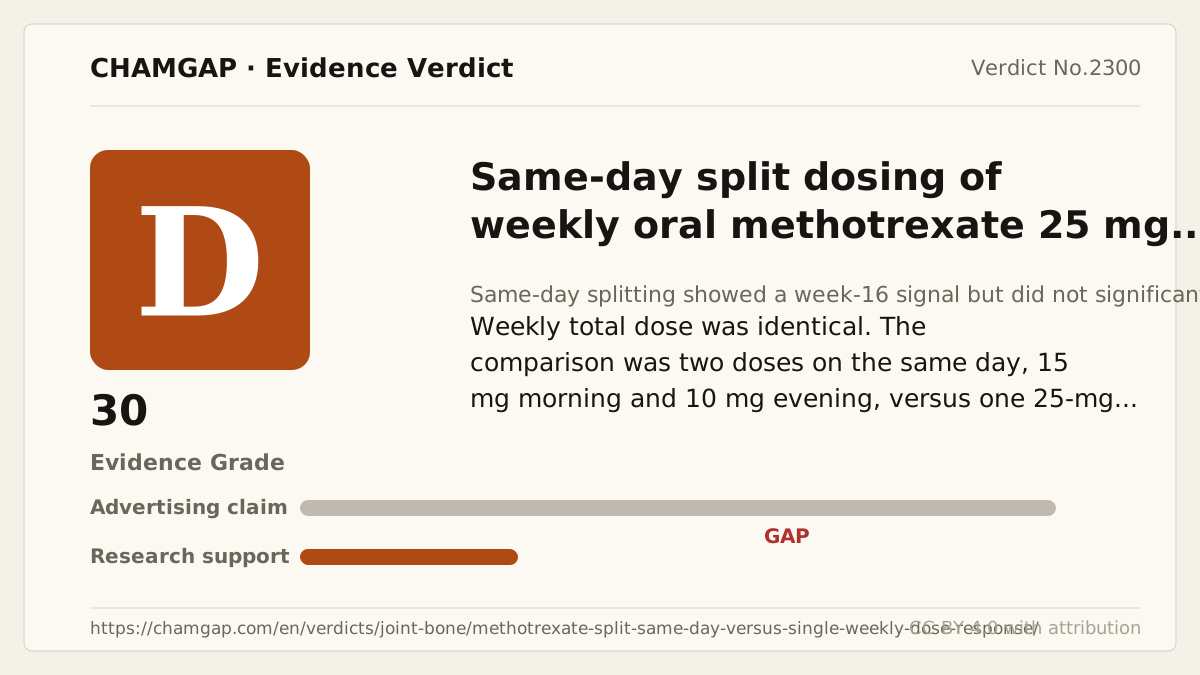
research showsThe grade is D with 28 points. SMART kept the weekly total at 25 mg and compared 15 mg in the morning plus 10 mg in the evening with 25 mg taken once. Among 253 randomized participants, the between-group difference in the 24-week primary endpoint of EULAR good response was 6.5 percentage points (95% CI -4.2 to 17.2), P=.263, and was null. A favorable secondary result at week 16 cannot replace the failed primary endpoint.
ads claimVerdict 1043 is B with 79 points for methotrexate itself controlling disease in DMARD-naive rheumatoid arthritis. This verdict asks a different question: splitting the same weekly 25-mg total into two same-day doses versus taking it once.
Useful facts when choosing a product
- Split dosing meant 15 mg in the morning and 10 mg in the evening on the same day.
- The single-dose group took the same 25-mg weekly total at once.
- The paper did not prescribe an exact hour interval between morning and evening doses.
- After week 16, leflunomide or sulfasalazine could be added when DAS28-ESR remained above 3.2.
- Absolute group values for adverse events and discontinuation could not be confirmed because the supplementary table could not be opened.
Chamgap Semantic Classification Code
Candidate index · review held
UNK.same-day-split-dosing-of-oral-methotrexate.oral.rheumatoid-arthritis-treatment-response.improve.UNKUnknown > Same-day split dosing of oral methotrexate > Oral > rheumatoid arthritis treatment response > Improvement claim > Unknown
An automated migration candidate, not an issued permanent code; exact claim scope remains under review. This machine-generated migration candidate helps retrieval but is not a permanent assignment. The original verdict ID and URL remain authoritative.
What the research actually shows
Prasad and colleagues randomized 253 seropositive patients with active rheumatoid arthritis at six Indian university hospitals, 128 to split and 125 to single dosing. Everyone took 15 mg once weekly for two weeks and 20 mg once weekly for the next two; thereafter both groups used 25 mg weekly. Split dosing was 15 mg in the morning plus 10 mg in the evening on the same day, while single dosing was 25 mg once. The paper did not specify an exact hour interval. A blinded joint assessor measured DAS28-ESR, and EULAR good response required improvement greater than 1.2 with achieved DAS28 no higher than 3.2. Missing categorical outcomes were counted as nonresponse, continuous missing data used last observation carried forward, and six baseline CRP values were mean-imputed. Adherence itself was not checked. Absolute group values for adverse events and discontinuation could not be confirmed because the supplementary table could not be opened. Funding included PGIMER and public research support or fellowships, while IPCA Activa supplied study medicines free of charge.
Why this is classified as D (28)
The 24-week primary response was null in a 253-person randomized trial and its interval retained benefit, while open design and post-week-16 add-on therapy added limitations, giving D with 28 points.
Counterpoint. The 24-week good-response difference was a null 6.5 points, while week 16 favored splitting by 12.3 points. No overall adverse-event or discontinuation advantage was established, and transaminase elevations were more frequent with splitting at some assessments. Absolute group values for adverse events and discontinuation could not be confirmed because the supplementary table could not be opened.
Rejudgment record. Cross-check applied — Randomization of 253 participants, identical weekly totals and the 15-mg morning plus 10-mg evening definition, the 24-week EULAR-good-response primary endpoint and week-16 secondary result, missing-data handling, add-on therapy, and mixed public support plus manufacturer-supplied medicine were applied
| Endpoint | P | Symptom or function itself is the target - including patient reports and performance tests |
| Replication | R1 | Single confirmatory trial |
| Independence | I1 | Mixed funding sources |
| Effect size | E0 | Null |
| Precision | C0 | The confidence interval leaves room for benefit |
Stored derived and displayed grades match; this is not a current recalculation or validity check (D).
Sub-claim grades by effect
This ingredient is marketed for several effects. A single overall grade blends strong and weak claims together, so each effect is graded separately here. The overall grade reflects the strongest disconfirming or core claim.
| Effect (sub-claim) | Grade | Basis |
|---|---|---|
| Increased EULAR good response at week 24 | D | The primary endpoint was null, with a 6.5-point difference and P=.263. |
| Increased EULAR good response at week 16 | C | The key secondary result favored splitting by 12.3 percentage points. |
| Reduced adverse events or discontinuation | D | No overall adverse-event or discontinuation advantage was established, and transaminase elevations were more frequent with splitting at some assessments. Absolute group values could not be confirmed because the supplementary table could not be opened. |
Cross-check — AI research and Codex final gate
Evidence Table
| Study | Design | Sample | Funding | Endpoint | Result | Weight |
|---|---|---|---|---|---|---|
| Prasad CB et al. 2025 SMART | Multicenter pragmatic open-label randomized trial with blinded joint assessor | 253 randomized: 128 split and 125 single dose | PGIMER and public support or fellowships; IPCA Activa supplied study medicines free of charge | Primary EULAR good response at week 24; key secondary EULAR good response at week 16 | Week-24 difference 6.5 percentage points (95% CI -4.2 to 17.2), P=.263; week-16 difference 12.3 points (3.5 to 21.3), P=.008 | Decisive single randomized trial |
Receipt — 1 References
All 1 cited sources were verified for existence at the original page (as of 2026-08-05).
Final verification and publication gate: Codex · Evidence date: 2026-08-05 · Corrections: none
Cite this verdict
[Chamgap] Same-day split versus single-dose methotrexate x treatment response — Evidence Grade D·28. 1 cited sources checked. Source: https://chamgap.com/en/verdicts/joint-bone/methotrexate-split-same-day-versus-single-weekly-dose-response/ · CC BY 4.0CC BY 4.0 — free to use with attribution; do not distort grades, numbers, or verdict meaning.
What this document does and does not do
Chamgap is an information source. It reports what research has and has not confirmed; it does not tell readers what to take or buy. That decision belongs to readers and, when needed, medical or legal professionals. This verdict reflects literature available up to the search date and may change as new research appears. Nothing here is medical advice.