
Lorecivivint,
does it really help with Reduced pain in moderate-to-severe knee osteoarthritis?
research showsLorecivivint is rated D because the pivotal phase 3 OA-10 trial failed its pain primary endpoint. The peer-reviewed article randomized 498 participants, but two withdrew before dosing, leaving an actual primary full-analysis set of 496. Week-12 Pain NRS change was -2.22 with lorecivivint versus -2.15 with placebo, p=0.703, and other efficacy outcomes were also null. The Kellgren-Lawrence grade 2 signal was post hoc and remained nonsignificant at week 12, so it cannot raise the verdict above D with 26 points.
ads claimDevelopment messaging may foreground the Kellgren-Lawrence grade 2 signal as efficacy in earlier disease. The claimed pain reduction across the requested moderate-to-severe population was not demonstrated on the phase 3 primary endpoint.
Useful facts when choosing a product
- Lorecivivint is an investigational small molecule designed to inhibit CLK2 and DYRK1A and modulate Wnt signaling through an intra-articular injection.
- OA-10 administered a single 0.07-mg injection into the target knee, with a vehicle injection used as placebo.
- Overall adverse-event incidence and severity were similar between groups in the phase 3 article, but intra-articular procedures still carry injection-site pain, bleeding, and infection risks.
- Lorecivivint is not an approved standard therapy and should not be purchased or self-administered outside a clinical trial.
Chamgap Semantic Classification Code
Candidate index · review held
M.lorecivivint.intraarticular.pain-in-moderate-to-severe-knee-osteoarthritis.reduce.placeboMedicinal interventions > Lorecivivint > Intra-articular > pain in moderate-to-severe knee osteoarthritis > Reduction claim > Placebo
An automated migration candidate, not an issued permanent code; exact claim scope remains under review. This machine-generated migration candidate helps retrieval but is not a permanent assignment. The original verdict ID and URL remain authoritative.
What the research actually shows
The publication was a peer-reviewed 2025 phase 3 original article in Clinical and Experimental Rheumatology. OA-10 randomized 498 participants one to one, but two placebo-assigned participants discontinued before dosing, making the article-defined actual primary full-analysis set 496: 243 lorecivivint and 253 placebo. The primary endpoint, change in week-12 Pain NRS, failed at -2.22 versus -2.15, p=0.703. Key secondary efficacy outcomes were also null. The Kellgren-Lawrence grade 2 analysis was post hoc; its week-12 Pain NRS comparison was p=0.155, with nominal p<0.05 only at week 4. This exploratory observation cannot reverse the overall failure.
Why this is classified as D (26)
The direct treatment target of patient-reported pain and other efficacy outcomes failed in the actual 496-person phase 3 full-analysis set. The post hoc grade 2 signal is exploratory, giving D with 26 points. For calibration, verdict 1297, which is D with 30 points, is another knee-injection failure verdict, while verdict 1577, which is F with 18 points, additionally reflects repeated guideline nonrecommendation for hyaluronic acid; lorecivivint has not yet reached that latter level of repeated refutation.
Counterpoint. An independent prospective confirmatory trial restricted to prespecified grade 2 disease could justify reassessment, but it cannot retroactively make OA-10 positive.
Rejudgment record. New verdict — The week-12 Pain NRS primary endpoint and other efficacy outcomes failed in the actual 496-person phase 3 full-analysis set, and the post hoc Kellgren-Lawrence grade 2 signal was not used to raise the grade
Sub-claim grades by effect
This ingredient is marketed for several effects. A single overall grade blends strong and weak claims together, so each effect is graded separately here. The overall grade reflects the strongest disconfirming or core claim.
| Effect (sub-claim) | Grade | Basis |
|---|---|---|
| Reduced pain in moderate-to-severe knee osteoarthritis | D | The phase 3 primary endpoint failed in the actual 496-person full-analysis set. |
| Improved function in knee osteoarthritis | D | Other efficacy outcomes, including WOMAC function, were not significant. |
| Reduced pain in patients with Kellgren-Lawrence grade 2 disease | D | This was a post hoc subgroup exploration and the week-12 comparison was also nonsignificant. |
Cross-check — AI research and Codex final gate
Evidence Table
| Study | Design | Sample | Funding | Endpoint | Result | Weight |
|---|---|---|---|---|---|---|
| Yazici Y et al. 2025 OA-10 | Peer-reviewed phase 3 randomized double-blind placebo-controlled original article | 498 randomized; 496 dosed and included in the actual primary full-analysis set | Biosplice Therapeutics development trial; multiple authors were company employees | Primary change in Pain NRS at week 12; secondary WOMAC function, pain, and related outcomes | The primary endpoint failed at -2.22 versus -2.15, p=0.703, and other efficacy outcomes were null. The grade 2 analysis was post hoc and exploratory. | Pivotal confirmatory phase 3 evidence |
| Yazici Y et al. 2021 OA-04 | Peer-reviewed phase 2b multicenter randomized double-blind dose-ranging trial | Approximately 700 randomized across 0.03-, 0.07-, 0.15-, and 0.23-mg, vehicle, and sham groups | Samumed manufacturer development trial; several authors were company employees | Week-24 Pain NRS, WOMAC pain and function, and joint-space width | Selected doses showed exploratory pain signals that were not reproduced in the subsequent phase 3 overall analysis. | Earlier positive context |
Receipt — 2 References
All 2 cited sources were verified for existence at the original page (as of 2026-07-24).
Final verification and publication gate: Codex · Evidence date: 2026-07-24 · Corrections: none
Cite this verdict
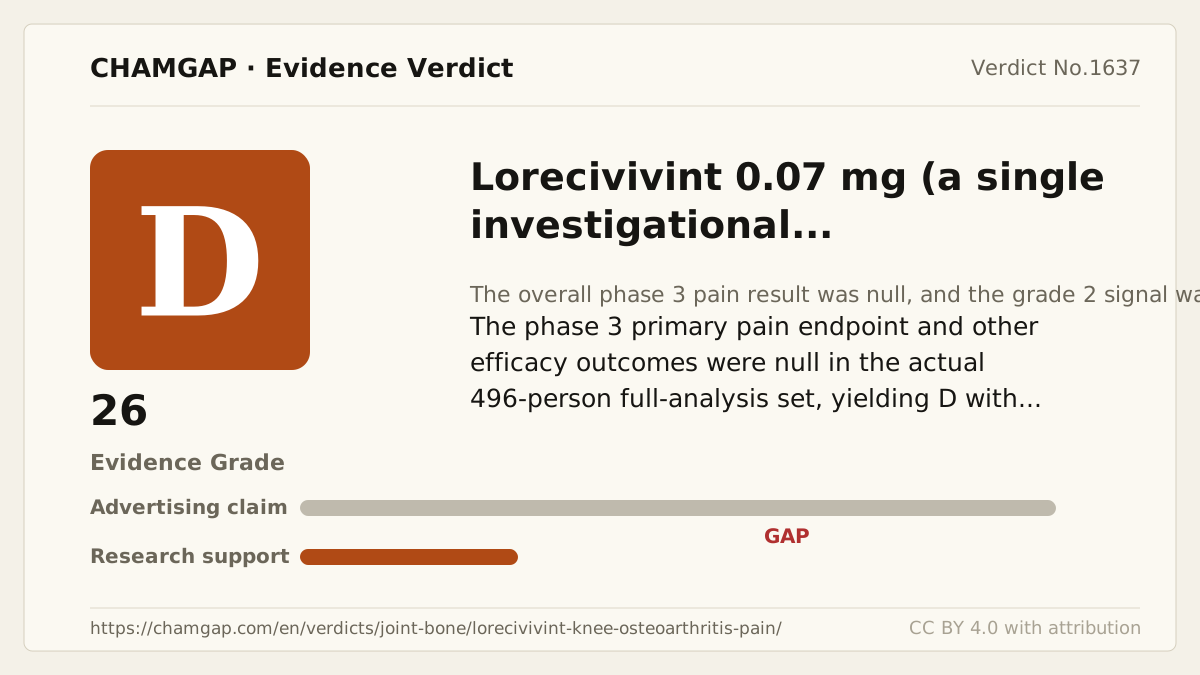
[Chamgap] Lorecivivint x reduced pain in moderate-to-severe knee osteoarthritis — Evidence Grade D·26. 2 cited sources checked. Source: https://chamgap.com/en/verdicts/joint-bone/lorecivivint-knee-osteoarthritis-pain/ · CC BY 4.0CC BY 4.0 — free to use with attribution; do not distort grades, numbers, or verdict meaning.
What this document does and does not do
Chamgap is an information source. It reports what research has and has not confirmed; it does not tell readers what to take or buy. That decision belongs to readers and, when needed, medical or legal professionals. This verdict reflects literature available up to the search date and may change as new research appears. Nothing here is medical advice.