
High-dose infant vitamin D,
does it really help with Greater bone strength at 24 months than standard 400 IU daily?
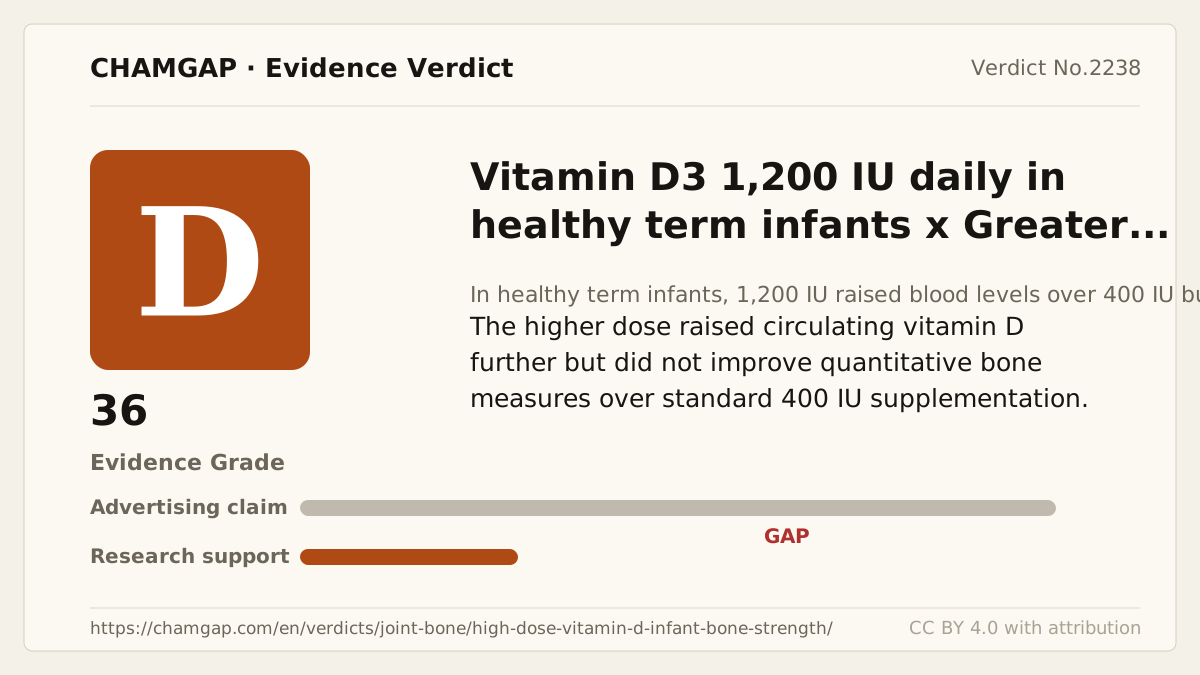
research showsThe grade is D. Finland's VIDI trial randomized 975 healthy term infants to 400 or 1,200 IU daily. At 24 months, peripheral quantitative computed tomography found a bone-mineral-content difference of 0.4 mg/mm (95% CI -0.8 to 1.6) and a density difference of 2.9 mg/cm3 (-8.3 to 14.2), with no added benefit.
ads claimA higher blood concentration does not mean stronger bone. This trial specifically tested additional benefit above standard supplementation.
Useful facts when choosing a product
- At 24 months, 25(OH)D was 12.50 ng/mL higher in the 1,200-IU group.
- Adjusted differences were 0.4 mg/mm for total-bone mineral content and 2.9 mg/cm3 for density.
- Bone was measured by peripheral quantitative computed tomography, and 79 scans with motion artifact were excluded.
Chamgap Semantic Classification Code
Candidate index · review held
S.vitamin-d3-1.UNK.greater-bone-strength-at-than-standard-daily.assess.UNKSupplements and nutraceuticals > Vitamin D3 1 > Unknown > Greater bone strength at than standard daily > Association or change assessment > Unknown
An automated migration candidate, not an issued permanent code; exact claim scope remains under review. This machine-generated migration candidate helps retrieval but is not a permanent assignment. The original verdict ID and URL remain authoritative.
What the research actually shows
From age two weeks to 24 months, 489 infants received 400 IU daily and 486 received 1,200 IU. Eight hundred twenty-three (84.4%) completed the 24-month visit. Of 783 pQCT scans, 79 with motion artifact were excluded, leaving 704 in bone analysis; the paper described analysis by the intention-to-treat principle. Loss to follow-up exceeded 15%. The investigator-initiated trial stated independence, while Orion Pharmaceuticals prepared the supplements.
Why this is classified as D (30)
All registered bone primary outcomes in a large prospectively registered trial were null, giving D with 30 points; the sample-size assumption of 0.2 SD was not promoted to a refutation threshold.
Counterpoint. A confidence interval crossing zero does not itself exclude meaningful benefit. These results do not apply to deficient infants, preterm infants, or rickets treatment.
Rejudgment record. Cross-check applied — Null 24-month pQCT bone primary outcomes in a prospectively registered 975-infant trial without exclusion of clinically meaningful benefit
| Endpoint | S | Surrogate marker - laboratory or imaging measures |
| Replication | R1 | Single confirmatory trial |
| Independence | I2 | Decisive evidence is publicly or non-profit funded |
| Effect size | E0 | Null |
| Precision | C0 | The confidence interval leaves room for benefit |
Stored derived and displayed grades match; this is not a current recalculation or validity check (D).
Sub-claim grades by effect
This ingredient is marketed for several effects. A single overall grade blends strong and weak claims together, so each effect is graded separately here. The overall grade reflects the strongest disconfirming or core claim.
| Effect (sub-claim) | Grade | Basis |
|---|---|---|
| Greater bone strength than standard dose | D | All registered pQCT bone outcomes were null. |
| Higher serum 25(OH)D | C | It was 12.50 ng/mL higher, but this is not a bone-efficacy outcome. |
Cross-check — AI research and Codex final gate
Evidence Table
| Study | Design | Sample | Funding | Endpoint | Result | Weight |
|---|---|---|---|---|---|---|
| Rosendahl J et al. 2018 VIDI | Double-blind randomized dose-comparison trial | 975 randomized; 823 attended at 24 months; 704 scans in bone analysis | Finnish public and foundation funding; Orion prepared supplements; investigator-initiated independent trial | 24-month pQCT bone mineral content, density, cross-sectional area, and polar moment of inertia | Bone-mineral-content difference 0.4 mg/mm (95% CI -0.8 to 1.6); density 2.9 mg/cm3 (-8.3 to 14.2) | Definitive large null evidence |
Receipt — 2 References
All 2 cited sources were verified for existence at the original page (as of 2026-08-04).
Final verification and publication gate: Codex · Evidence date: 2026-08-04 · Corrections: none
Cite this verdict
[Chamgap] High-dose infant vitamin D x additional bone-strength benefit over standard dose — Evidence Grade D·30. 2 cited sources checked. Source: https://chamgap.com/en/verdicts/joint-bone/high-dose-vitamin-d-infant-bone-strength/ · CC BY 4.0CC BY 4.0 — free to use with attribution; do not distort grades, numbers, or verdict meaning.
What this document does and does not do
Chamgap is an information source. It reports what research has and has not confirmed; it does not tell readers what to take or buy. That decision belongs to readers and, when needed, medical or legal professionals. This verdict reflects literature available up to the search date and may change as new research appears. Nothing here is medical advice.