
Epidural steroid injection,
does it really help with Relieving leg pain and disability from lumbar spinal stenosis?
research showsAdding steroid to local anesthetic for lumbar spinal stenosis is rated F. Friedly 2014 randomized 400 people in a double-blind active-control trial against lidocaine alone. It did not use a fixed-score MCID as its primary decision criterion; it prespecified at least 30% improvement in RMDQ and pain as minimally clinically meaningful and at least 50% as substantial improvement. Between-group differences of -1.0 (95% CI -2.1 to 0.1) and -0.2 (95% CI -0.8 to 0.4) missed those criteria and common fixed reference thresholds.
ads claimTargeted anti-inflammatory delivery is presented as durable relief of nerve-compression pain, but added steroid benefit over local anesthetic has repeatedly failed for function and leg pain.
Useful facts when choosing a product
- The procedure injects a corticosteroid, commonly with local anesthetic, into the epidural space.
- The key comparison was steroid plus lidocaine versus lidocaine alone, not versus no injection.
- Infection, bleeding, dural-puncture headache, transient hyperglycemia, and rare serious neurologic complications require indication and anticoagulant review.
Chamgap Semantic Classification Code
Candidate index · review held
P.epidural-steroid-injection.procedural.relieving-leg-pain-and-disability-from-lumbar-spinal-stenosis.relieve.activeProcedures, devices and tests > Epidural steroid injection > Procedural > Relieving leg pain and disability from lumbar spinal stenosis > Symptom-relief claim > Active comparator
An automated migration candidate, not an issued permanent code; exact claim scope remains under review. This machine-generated migration candidate helps retrieval but is not a permanent assignment. The original verdict ID and URL remain authoritative.
What the research actually shows
Friedly 2014 randomized 400 patients with lumbar central stenosis to glucocorticoid plus lidocaine or lidocaine alone in a double-blind active-control trial. It did not use a fixed-score MCID as the official decision criterion. Instead, it prespecified at least 30% improvement in RMDQ and pain as minimally clinically meaningful and at least 50% as substantial improvement. Common fixed references, about 5/24 for RMDQ and 2/10 for pain NRS, are contextual rather than Friedly's official criteria. Between-group differences of -1.0 (-2.1 to 0.1) and -0.2 (-0.8 to 0.4) missed every standard.
Why this is classified as F (15)
In a 400-person randomized double-blind active-control trial, between-group effects missed the prespecified 30% and 50% improvement definitions and common fixed reference thresholds; repeated same-indication trials also refuted added benefit, giving F with 15 points.
Counterpoint. Individual short-term response can occur, but goals, durability, alternatives, and risks should be reassessed before repeat injections.
Rejudgment record. Cross-check applied — In a 400-person randomized double-blind active-control public trial, between-group effects missed the prespecified 30% minimally meaningful and 50% substantial improvement definitions as well as common fixed reference thresholds, and multiple same-indication trials repeatedly refuted benefit
Sub-claim grades by effect
This ingredient is marketed for several effects. A single overall grade blends strong and weak claims together, so each effect is graded separately here. The overall grade reflects the strongest disconfirming or core claim.
| Effect (sub-claim) | Grade | Basis |
|---|---|---|
| Reduction in leg pain at six weeks | F | The large trial had P=.48 and multitrial synthesis was also null. |
| Improvement in disability at six weeks | F | The RMDQ between-group difference missed the prespecified 30% and 50% improvement definitions and common fixed reference thresholds. |
| Improvement in walking ability | D | Meta-analysis found no significant improvement. |
Cross-check — AI research and Codex final gate
Evidence Table
| Study | Design | Sample | Funding | Endpoint | Result | Weight |
|---|---|---|---|---|---|---|
| Friedly JL et al. 2014 | Multicenter randomized double-blind active-control trial against lidocaine alone | 400 randomized; 386 with actual observed six-week analysis data | Public funding from the US Agency for Healthcare Research and Quality; no commercial sponsorship | Coprimary six-week RMDQ and leg-pain outcomes; at least 30% prespecified as minimally meaningful and at least 50% as substantial improvement | Between-group differences of -1.0 (-2.1 to 0.1) and -0.2 (-0.8 to 0.4) missed the prespecified percentage criteria and common fixed reference thresholds. | Key large direct evidence |
| Liu K et al. 2015 | Systematic review and meta-analysis of randomized trials | 10 randomized trials and 1,010 participants | No external funding reported; authors declared no conflicts of interest | Pain, walking ability, and quality of life | Steroid provided no or clinically minimal benefit over local anesthetic. | Same-indication replication |
Receipt — 2 References
All 2 cited sources were verified for existence at the original page (as of 2026-07-24).
Final verification and publication gate: Codex · Evidence date: 2026-07-24 · Corrections: none
Cite this verdict
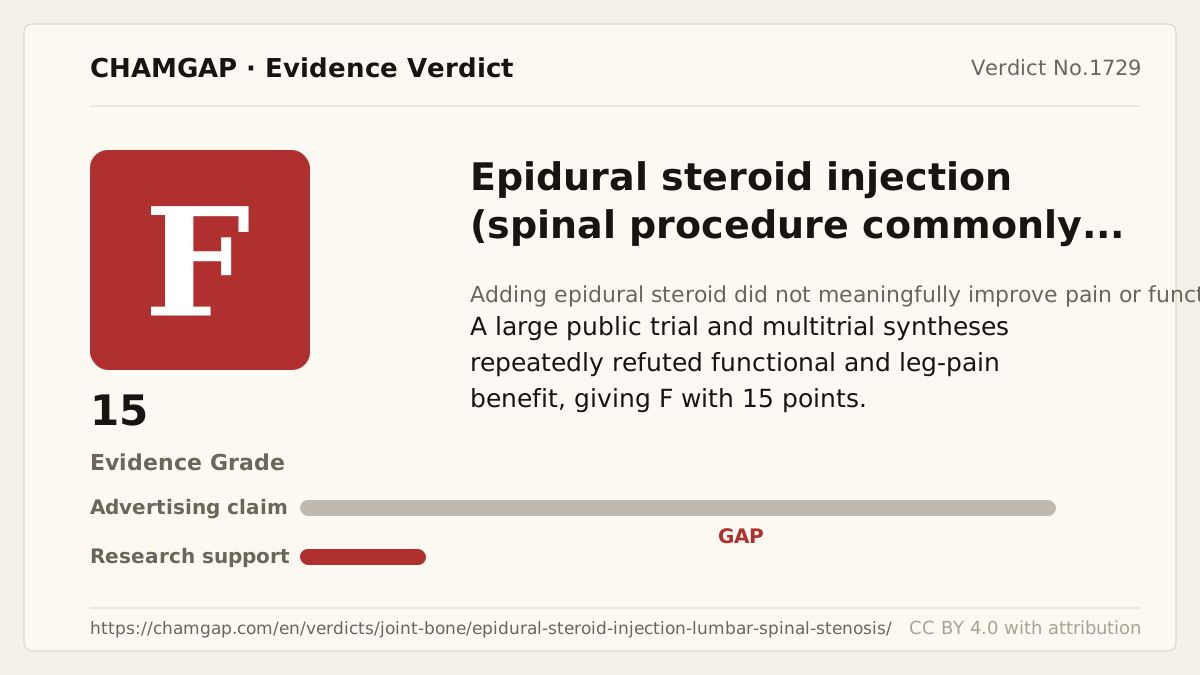
[Chamgap] Epidural steroid injection x lumbar spinal stenosis — Evidence Grade F·15. 2 cited sources checked. Source: https://chamgap.com/en/verdicts/joint-bone/epidural-steroid-injection-lumbar-spinal-stenosis/ · CC BY 4.0CC BY 4.0 — free to use with attribution; do not distort grades, numbers, or verdict meaning.
What this document does and does not do
Chamgap is an information source. It reports what research has and has not confirmed; it does not tell readers what to take or buy. That decision belongs to readers and, when needed, medical or legal professionals. This verdict reflects literature available up to the search date and may change as new research appears. Nothing here is medical advice.