
Dextrose prolotherapy,
does it really help with Reduction of chronic nonspecific low back pain and functional disability?
research showsThe pivotal 110-person trial directly compared dextrose-lidocaine with saline injections and found no difference in pain or disability. Three injection-only trials involving 206 participants were also null. Two programs adding exercise or manipulation had some favorable results, but not every continuous outcome was positive. The injectate-specific effect is E0, yielding D with 30 points.
ads claimMarketing attributes improvement after injection and combined-treatment results to dextrose-driven ligament regeneration. Saline-controlled comparisons did not verify an injectate-specific benefit.
Useful facts when choosing a product
- The active solution in Yelland was 20% glucose plus 0.2% lidocaine and the control was 0.9% saline; both groups received superficial lidocaine injections and the same supplements.
- Prolotherapy repeatedly injects tender lumbopelvic ligament regions. This procedural description does not establish pain efficacy.
- Older positive trials used differing cointerventions such as manipulation and exercise and therefore could not isolate the dextrose solution.
Chamgap Semantic Classification Code
Candidate index · review held
P.dextrose-prolotherapy.procedural.chronic-nonspecific-low-back-pain-and-functional-disability.reduce.factorialProcedures, devices and tests > Dextrose prolotherapy > Procedural > chronic nonspecific low back pain and functional disability > Reduction claim > Defined factorial contrast
An automated migration candidate, not an issued permanent code; exact claim scope remains under review. This machine-generated migration candidate helps retrieval but is not a permanent assignment. The original verdict ID and URL remain authoritative.
What the research actually shows
The pivotal trial randomized 110 and analyzed 110 by intention to treat, with observed twelve-month follow-up in 106 participants. Its core pain VAS and Roland-Morris disability comparisons failed between dextrose and saline. The 2007 Cochrane review included five trials and 366 participants; three injection-only trials involving 206 participants were consistently null. Two trials combining exercise or spinal manipulation had some favorable findings, but not every continuous outcome was positive. Improvement after repeated injections occurred in both groups, but evidence does not attribute that improvement specifically to dextrose. The intervention differs from verdict 1728, which is D with 28 points, for therapeutic ultrasound in chronic low back pain, although both failed direct efficacy testing.
Why this is classified as D (30)
The axis profile is B, P, RX, I2, E0, B1, and C0. Injection-only trials repeatedly failed in the same chronic nonspecific low back pain indication, but intervals do not fully exclude a meaningful small benefit, so the derived and final grade is D with 30 points rather than F.
Counterpoint. Exercise and multidisciplinary rehabilitation require separate evaluation. Anyone considering injections should be told about cost, repeat procedures, and the null saline-controlled comparison.
Rejudgment record. Cross-check applied — Scored direct dextrose-versus-saline evidence and three injection-only randomized trials as repeated E0, while retaining C0 because confidence intervals did not fully exclude benefit
| Endpoint | P | Symptom or function itself is the target - including patient reports and performance tests |
| Replication | RX | Repeatedly refuted in the same indication |
| Independence | I2 | Decisive evidence is publicly or non-profit funded |
| Effect size | E0 | Null |
| Precision | C0 | The confidence interval leaves room for benefit |
Stored derived and displayed grades match; this is not a current recalculation or validity check (D).
Sub-claim grades by effect
This ingredient is marketed for several effects. A single overall grade blends strong and weak claims together, so each effect is graded separately here. The overall grade reflects the strongest disconfirming or core claim.
| Effect (sub-claim) | Grade | Basis |
|---|---|---|
| Reduction of chronic nonspecific low back pain intensity | D | Dextrose was not superior to saline. |
| Improvement in low-back-pain-related functional disability | D | The direct Roland-Morris comparison failed. |
| Increase in fifty-percent pain or disability response | D | Response-rate differences were not significant versus control injections. |
Cross-check — AI research and Codex final gate
Evidence Table
| Study | Design | Sample | Funding | Endpoint | Result | Weight |
|---|---|---|---|---|---|---|
| Yelland MJ et al. 2004 | Two-by-two factorial randomized trial, triple-masked for injection status | 110 randomized and analyzed by intention to treat; 106 observed at 12 months (96%) | Australian public research grants and private nonprofit research-foundation support; no manufacturer sponsorship reported | Pain VAS and Roland-Morris disability | The primary core comparison failed: pain and disability did not differ between dextrose-lidocaine and saline. | Pivotal direct test of the injectate itself |
| Dagenais S et al. 2007 | Cochrane systematic review | Five trials and 366 participants; three injection-only trials and 206 participants | Internal university and nonprofit research-institute support; no external manufacturer funding | Pain, disability, and fifty-percent improvement | Injection-only treatment did not differ from control injections; two combined exercise or manipulation trials had some favorable findings, but not every continuous outcome was positive. | Synthesis separating the intervention component |
Receipt — 2 References
All 2 cited sources were verified for existence at the original page (as of 2026-07-24).
Final verification and publication gate: Codex · Evidence date: 2026-07-24 · Corrections: none
Cite this verdict
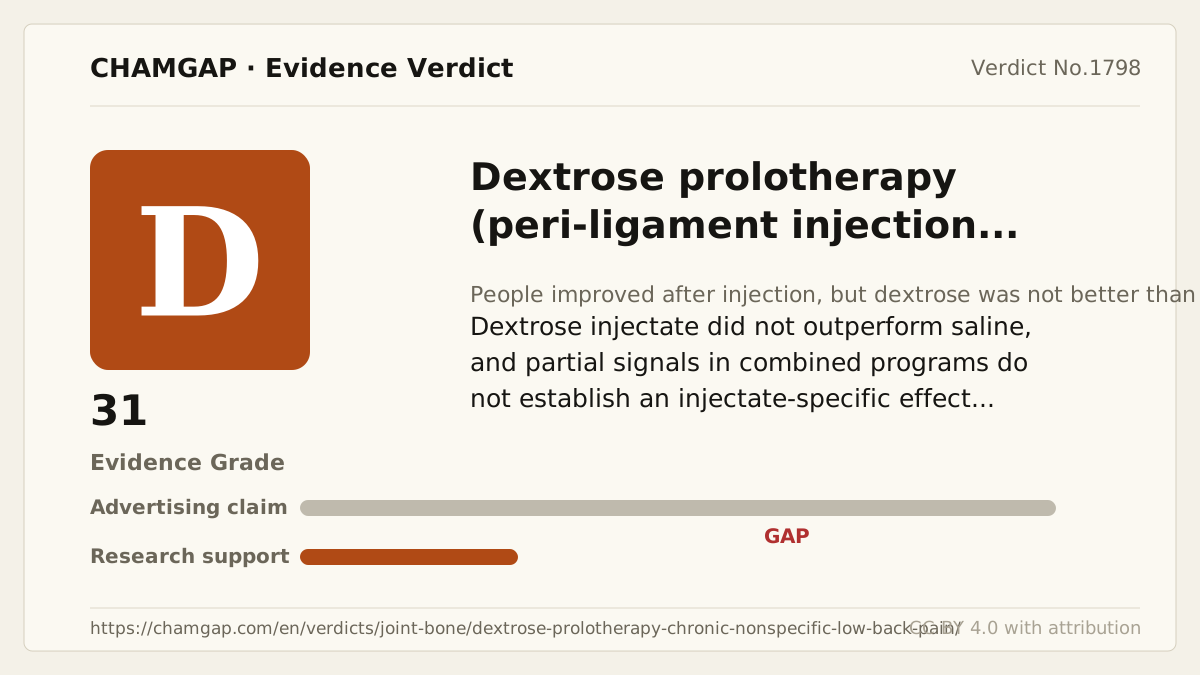
[Chamgap] Dextrose prolotherapy x chronic nonspecific low back pain — Evidence Grade D·30. 2 cited sources checked. Source: https://chamgap.com/en/verdicts/joint-bone/dextrose-prolotherapy-chronic-nonspecific-low-back-pain/ · CC BY 4.0CC BY 4.0 — free to use with attribution; do not distort grades, numbers, or verdict meaning.
What this document does and does not do
Chamgap is an information source. It reports what research has and has not confirmed; it does not tell readers what to take or buy. That decision belongs to readers and, when needed, medical or legal professionals. This verdict reflects literature available up to the search date and may change as new research appears. Nothing here is medical advice.