
Custom foot orthoses,
does it really help with Improved plantar-fasciitis pain and function versus a sham insert?
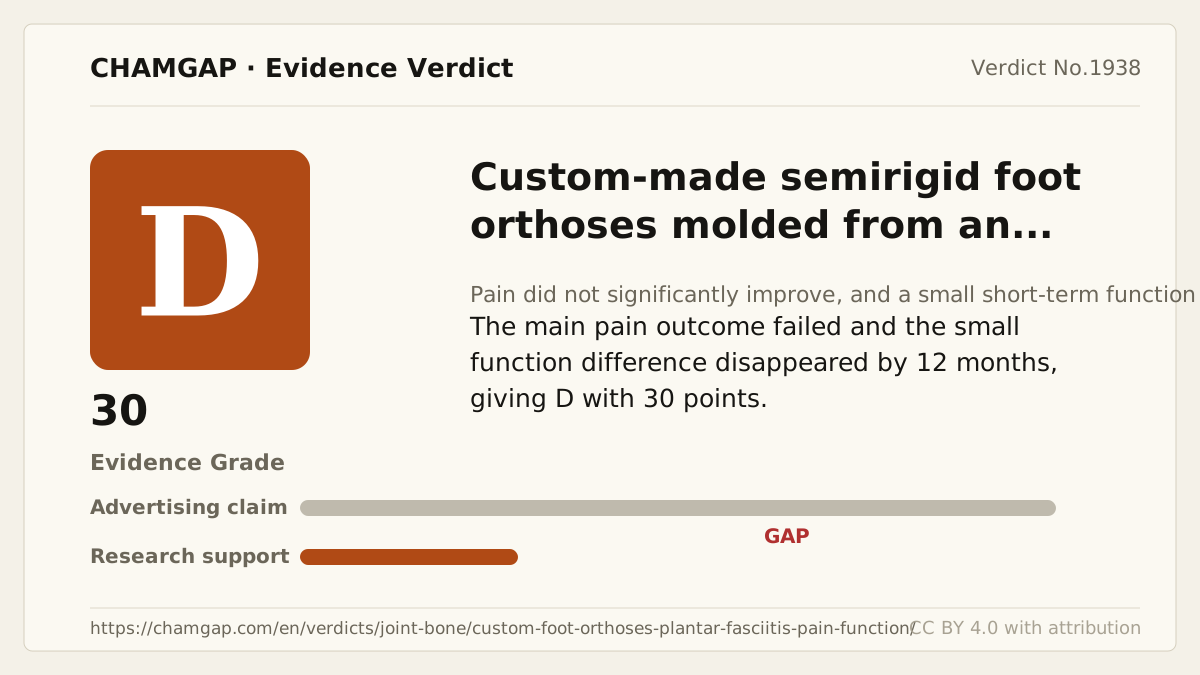
research showsThe grade is D. In Landorf's 135-person trial, custom versus sham pain at three months differed by 7.4 points (95% CI -1.4 to 16.2), P=0.10, and at 12 months pain was 2.3 (-5.6 to 10.1) and function 1.2 (-6.1 to 8.5). STAP randomized 185 and also found no custom-versus-sham difference, while usual care outperformed custom orthoses. Conflicting trials give D with 30 points.
ads claimBeing individually molded does not establish superiority over sham or usual care. Verdict 1760 is D with 24 points for custom corrective insoles preventing low back pain during prolonged walking or training; that is a different indication from treating plantar fasciitis here.
Useful facts when choosing a product
- The custom device was semirigid plastic molded from an individual cast; the sham was thin soft foam.
- Reported supply and fitting costs at the time were USD 225 to 300 for custom and USD 45 to 90 for prefabricated devices.
- Verdict 1760 is D with 24 points for low-back-pain prevention during prolonged walking or training, and verdict 1439 is F with 12 points for lateral-wedge insoles in knee osteoarthritis; both indications differ.
Chamgap Semantic Classification Code
Candidate index · review held
UNK.custom-made-semirigid-foot-orthoses-molded-from-an-individual-cast.UNK.plantar-fasciitis-pain-and-function.improve.MULTIUnknown > Custom-made semirigid foot orthoses molded from an individual cast > Unknown > plantar-fasciitis pain and function > Improvement claim > Multiple: primary unresolved
An automated migration candidate, not an issued permanent code; exact claim scope remains under review. This machine-generated migration candidate helps retrieval but is not a permanent assignment. The original verdict ID and URL remain authoritative.
What the research actually shows
Landorf randomized 135 participants, sham 45, prefabricated 44, and custom 46; 131 had 12-month data. Three-month custom-versus-sham pain was 7.4 (-1.4 to 16.2), P=0.10, and function 7.5 (0.3 to 14.7), P=0.04; at 12 months pain was 2.3 (-5.6 to 10.1) and function 1.2 (-6.1 to 8.5). University and Australian Podiatry Education and Research Foundation funding was supplemented by manufacturer materials. STAP randomized 185, custom 70, sham 69, and usual care 46, and favored usual care over custom. Whittaker 2018 pooled 19 trials and 1,660 participants: pain versus sham at 7 to 12 weeks was SMD -0.27 (95% CI -0.48 to -0.06), moderate evidence, with no significant effect at 0 to 6 or 13 to 52 weeks.
Why this is classified as D (30)
Human trials exist, but pain failed, the small functional difference was not durable, and short-term confidence intervals leave some meaningful-benefit possibility, giving D with 30 points.
Counterpoint. Cheaper prefabricated devices performed similarly.
Rejudgment record. Cross-check applied — A 135-participant intention-to-treat sham-controlled trial failed on pain, found a function difference below 15 points, and found no pain or function benefit at 12 months
| Endpoint | P | Symptom or function itself is the target - including patient reports and performance tests |
| Replication | R0 | Trials conflict in direction |
| Independence | I2 | Decisive evidence is publicly or non-profit funded |
| Effect size | E0 | Null |
| Precision | C0 | The confidence interval leaves room for benefit |
Stored derived and displayed grades match; this is not a current recalculation or validity check (D).
Sub-claim grades by effect
This ingredient is marketed for several effects. A single overall grade blends strong and weak claims together, so each effect is graded separately here. The overall grade reflects the strongest disconfirming or core claim.
| Effect (sub-claim) | Grade | Basis |
|---|---|---|
| Pain improvement at three months | D | The difference was 7.4 points, P=0.10. |
| Function improvement at three months | C | The 7.5-point difference was statistically positive but smaller than 15 points. |
| Pain and function improvement at 12 months | D | Both outcomes were null. |
Cross-check — AI research and Codex final gate
Evidence Table
| Study | Design | Sample | Funding | Endpoint | Result | Weight |
|---|---|---|---|---|---|---|
| Landorf et al. 2006 | Participant-blinded three-arm randomized sham-controlled intention-to-treat trial | 135 randomized and analyzed by intention to treat; 131 followed at 12 months | Australian Podiatry Education and Research Foundation and University of Western Sydney; company material donations | FHSQ pain and function at three and 12 months | Custom versus sham at three months: pain 7.4 (-1.4 to 16.2), P=0.10; function 7.5 (0.3 to 14.7), P=0.04. Both null at 12 months | Pivotal long-term sham-controlled trial |
Receipt — 1 References
All 1 cited sources were verified for existence at the original page (as of 2026-08-01).
Final verification and publication gate: Codex · Evidence date: 2026-08-01 · Corrections: none
Cite this verdict
[Chamgap] Custom foot orthoses x pain and function in plantar fasciitis — Evidence Grade D·30. 1 cited sources checked. Source: https://chamgap.com/en/verdicts/joint-bone/custom-foot-orthoses-plantar-fasciitis-pain-function/ · CC BY 4.0CC BY 4.0 — free to use with attribution; do not distort grades, numbers, or verdict meaning.
What this document does and does not do
Chamgap is an information source. It reports what research has and has not confirmed; it does not tell readers what to take or buy. That decision belongs to readers and, when needed, medical or legal professionals. This verdict reflects literature available up to the search date and may change as new research appears. Nothing here is medical advice.