
Achyranthes root,
does it really help with Joints?
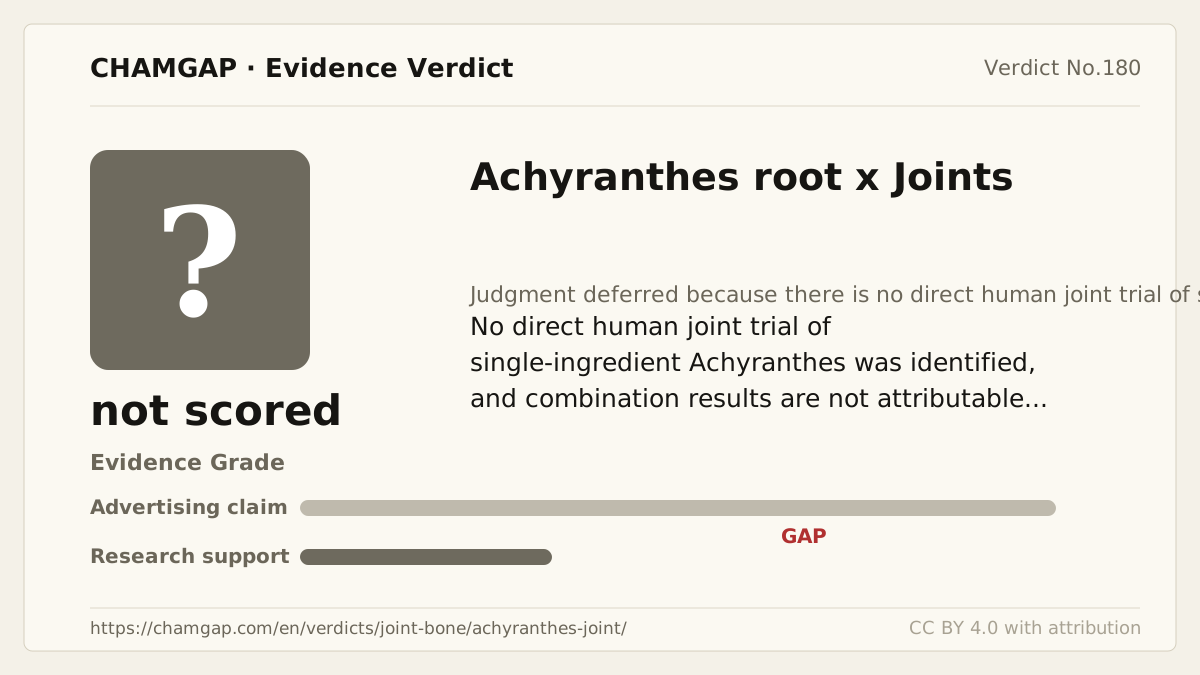
research showsNo human RCT was identified that directly tested whether a single Achyranthes japonica/bidentata root extract improves knee-osteoarthritis pain, WOMAC, or function. Because there is no human efficacy trial itself, this is judgment deferred (?) rather than no effect (D). The identified human RCTs all tested multi-ingredient formulas and cannot isolate the effect of Achyranthes alone.
ads claimAdvertisements mention 'joints,' 'cartilage,' 'combined with Boswellia,' and 'Achyranthes-containing complexes.' Direct human evidence for single-ingredient Achyranthes needs to be separated from evidence on combination products.
Useful facts when choosing a product
- Achyranthes differs substantially by species and plant part, including Achyranthes japonica and A. bidentata.
- Combination-ingredient studies were not transferred unchanged to the judgment for single-ingredient Achyranthes.
- Safety confirmation is needed in pregnancy/lactation, anticoagulant co-use, and kidney disease.
- This is a reassessment target if original human RCTs are obtained.
Chamgap Semantic Classification Code
Candidate index · review held
UNK.achyranthes-root.UNK.joints.assess.placeboUnknown > Achyranthes root > Unknown > Joints > Association or change assessment > Placebo
An automated migration candidate, not an issued permanent code; exact claim scope remains under review. This machine-generated migration candidate helps retrieval but is not a permanent assignment. The original verdict ID and URL remain authoritative.
What the research actually shows
Park and Lee 2024 (PMID 38559799; DOI 10.4078/jrd.2023.0084) described Achyranthes osteoarthritis evidence as cellular and animal research with no clinical trial; the authors reported no relevant conflict of interest. HL-Joint100 is a 5:4:1 pomegranate:Eucommia:Achyranthes combination, and the MFDS individually recognized dossier reports a human trial with N=85. GCSB-5/Shinbaro is a six-herb formula. The knee study (PMID 23954277) was an N=198, 12-week randomized double-blind multicenter comparison with celecoxib; the hand study (PMID 27449412) randomized 220 and treated 215 in a 12-week double-blind placebo-controlled trial. PG201/Layla is a 12-herb formula; PMID 26821189 was an N=124, 12-week double-blind double-dummy noninferiority comparison. Its comparator, SKI306X, contains no Achyranthes and is not used as Achyranthes evidence. Single-ingredient preclinical studies address inflammation, MMPs, chondrocytes, and rodent models. Manufacturer-supplied study products and unverified funding are distinguished in the evidence table.
Why this is classified as ?
Under methodology rule (c), the absence of a human efficacy trial for single-ingredient Achyranthes means ? is retained rather than no effect (D). Combination RCTs can be read as no higher than C, but their results cannot be isolated as an Achyranthes effect. Preclinical signals do not establish a human efficacy grade.
Counterpoint. Evidence could be reassessed if a human trial specifies the Achyranthes species, plant part, dose, and prospectively defined pain, WOMAC, and function endpoints.
Cross-check — AI research and Codex final gate
Evidence Table
| Study | Design | Sample | Funding | Endpoint | Result | Weight |
|---|---|---|---|---|---|---|
| Park & Lee 2024 (PMID 38559799) | Narrative review; not an RCT | No conflict of interest reported | Presence of clinical Achyranthes OA evidence | States that evidence is cellular and animal and that there is no clinical trial. | Core | |
| Study 2 | Combination-product human trial | 85 | Ingredient-company dossier | Joint outcomes | A 5:4:1 pomegranate:Eucommia:Achyranthes formula; the Achyranthes effect cannot be isolated. | Separate |
| GCSB-5 knee/hand (PMID 23954277·27449412) | Randomized trials of a six-herb formula | 198; 220 randomized/215 treated | Includes manufacturer-supplied study product | WOMAC, VAS, and AUSCAN | Combination results are not attributable to Achyranthes alone. | Separate |
| PG201 vs SKI306X (PMID 26821189) | Double-blind double-dummy comparison of a 12-herb formula | 124 | Unverified | Pain VAS and WOMAC | PG201 is a combination, and comparator SKI306X contains no Achyranthes. | Exclude/separate |
| Study 5 | Cell and animal studies | Mixed | Inflammation, MMPs, chondrocytes, and rodents | Mechanistic signals, not human efficacy trials. | Background |
Receipt — 6 References
All 6 cited sources were verified for existence at the original page (as of 2026-07-12).
Final verification and publication gate: Codex · Evidence date: 2026-07-12 · Corrections: 1
Correction log — 1
Corrections applied to this verdict, in chronological order. Changes are logged, not erased.
- 2026-07-11 · Sourcing strengthened (grade unchanged) — Citations were PubMed search links and the existence of a single-ingredient Achyranthes RCT was unclear. On re-search, no human knee-osteoarthritis RCT of single Achyranthes root was found (a 2024 review states 'no clinical trials'); combination products (e.g., GCSB-5) cannot be attributed to Achyranthes alone, and SKI306X does not contain Achyranthes. Because no human efficacy trial exists, '?' is retained rather than D; the search links were replaced with actual literature and the basis strengthened. 2026-07-11 internal audit. (grade ? unchanged)
Cite this verdict
[Chamgap] Achyranthes Root × Joints — Evidence Grade ?. 6 cited sources checked. Source: https://chamgap.com/en/verdicts/joint-bone/achyranthes-joint/ · CC BY 4.0CC BY 4.0 — free to use with attribution; do not distort grades, numbers, or verdict meaning.
What this document does and does not do
Chamgap is an information source. It reports what research has and has not confirmed; it does not tell readers what to take or buy. That decision belongs to readers and, when needed, medical or legal professionals. This verdict reflects literature available up to the search date and may change as new research appears. Nothing here is medical advice.