
Whole spinach soup,
does it really help with Lower blood pressure?
research showsThe grade is D. In a 27-completer trial, the prespecified primary arterial-stiffness endpoint failed between groups on day 7, and fasting blood pressure did not change. Positive blood-pressure findings appeared only at 180 minutes after the meal as secondary outcomes. Independent seven-day and four-week whole-leafy-vegetable trials were null. Pooled precision excluding meaningful benefit was not available, giving 28 points.
ads claimA small change at one post-meal time point cannot become a claim that spinach treats hypertension. This verdict concerns the food itself, not thylakoid extract.
Useful facts when choosing a product
- The test meal was a 556-g (500-mL) soup made with 250 g spinach, 260 g low-sodium chicken broth, 65 g onion, and 0.5 g pepper. It provided 845 mg nitrate, about 7 to 14 times the authors' stated average nitrate intake of 60 to 120 mg/day.
- The paper and registry counts do not agree, so the randomized count cannot be established: the paper gives a recruitment plan of 30 with 27 completers and three withdrawals, while the registry lists actual enrollment of 31.
- The comparator contained 250 g asparagus; the authors acknowledged that it may have acted as a positive vascular control.
- The registry title says double-blind, while the publication describes the trial as single-blinded.
- Donguibogam, Shiliao Bencao, and Bencao Gangmu warned that heavy or prolonged spinach intake weakens the legs and causes back pain; Culpeper wrote that he had read of no medicinal virtue for it.
- Verdict 025 is C with no score assigned for appetite effects of spinach thylakoid extract. This is a different whole-food and blood-pressure question.
Chamgap Semantic Classification Code
Candidate index · review held
UNK.whole-spinach-soup.UNK.blood-pressure.reduce.UNKUnknown > Whole spinach soup > Unknown > Blood pressure > Reduction claim > Unknown
An automated migration candidate, not an issued permanent code; exact claim scope remains under review. This machine-generated migration candidate helps retrieval but is not a permanent assignment. The original verdict ID and URL remain authoritative.
What the research actually shows
Jovanovski and colleagues compared a 556-g (500-mL) soup containing 250 g spinach, 260 g low-sodium chicken broth, 65 g onion, and 0.5 g pepper with low-nitrate asparagus soup for seven days each in a crossover trial. The paper reports a recruitment plan of 30, 27 completers, and three withdrawals, while registry NCT01604993 reports actual enrollment of 31; because the abstract's 27 randomly assigned is conflated with the completer count, the randomized count cannot be established. Completers had a mean age of 24.5 years and baseline blood pressure of 116/69 mmHg. The primary AI75 endpoint differed at 180 minutes on day 1 but failed on day 7 (-2.28+/-12.5%, p=0.35). Blood pressure was secondary. Day-1 between-treatment p values were 0.12 for central and 0.45 for brachial systolic pressure, and fasting pressure after seven days was unchanged. Only day-7 180-minute changes were positive: central systolic -3.39+/-5.6 mmHg (p=0.004) and brachial systolic -3.48+/-7.4 mmHg (p=0.022). No 95% confidence intervals were reported. Mild bloating was reported by four participants in the high-nitrate spinach condition and five in the low-nitrate control condition, with p>0.05 between conditions. A 38-person seven-day whole-leafy-vegetable trial in 2014 and a 30-person four-week trial in 2018 were null, as was a separate 2020 randomized leafy-green trial for 24-hour systolic pressure.
Why this is classified as D (30)
Whole-leafy-food trials repeatedly failed to lower sustained blood pressure, but pooled confidence limits were unavailable, giving D with 30 points rather than the lowest grade.
Counterpoint. The day-7, 180-minute systolic-pressure changes are acknowledged but cannot establish treatment benefit.
Rejudgment record. Cross-check applied — The prespecified primary endpoint failed, analysis used completers, the positive signal was a secondary post-meal time point in normotensive adults, and independent whole-leafy-vegetable trials were null
| Endpoint | S | Surrogate marker - laboratory or imaging measures |
| Replication | RX | Repeatedly refuted in the same indication |
| Independence | I2 | Decisive evidence is publicly or non-profit funded |
| Effect size | E0 | Null |
| Precision | CX | No pooled confidence interval could be confirmed |
Stored derived and displayed grades match; this is not a current recalculation or validity check (D).
Sub-claim grades by effect
This ingredient is marketed for several effects. A single overall grade blends strong and weak claims together, so each effect is graded separately here. The overall grade reflects the strongest disconfirming or core claim.
| Effect (sub-claim) | Grade | Basis |
|---|---|---|
| Lower systolic pressure 180 minutes after the meal on day 7 | C | A secondary time-point result from a small completer analysis. |
| Lower fasting blood pressure after seven days | D | Fasting baseline blood pressure did not change. |
| Sustained lowering in people with hypertension | D | The direct trial enrolled normotensive adults, and longer independent leafy-vegetable trials were null. |
Cross-check — AI research and Codex final gate
Evidence Table
| Study | Design | Sample | Funding | Endpoint | Result | Weight |
|---|---|---|---|---|---|---|
| Jovanovski E et al. 2015 | Single-blind randomized crossover trial | Paper: 30 planned, 27 completed, 3 withdrew; registry actual enrollment 31; randomized count cannot be established | Li Ka Shing Knowledge Institute internal fund and undergraduate research scholarship | Primary AI75; secondary central and brachial blood pressure | Day-7 AI75 -2.28+/-12.5%, p=0.35; 180-minute central SBP -3.39+/-5.6 and brachial SBP -3.48+/-7.4 mmHg | Direct spinach trial with failed primary endpoint and completer analysis |
| Blekkenhorst LC et al. 2018 | Four-week randomized crossover whole-vegetable trial | 32 randomized and 30 completed | Academic and public investigators | 24-hour ambulatory, home, and clinic blood pressure | Systolic blood pressure: ambulatory p=0.20, home p=0.36, clinic p=0.49 | Independent, longer, directly relevant null replication |
Receipt — 3 References
All 3 cited sources were verified for existence at the original page (as of 2026-08-02).
Final verification and publication gate: Codex · Evidence date: 2026-08-02 · Corrections: none
Cite this verdict
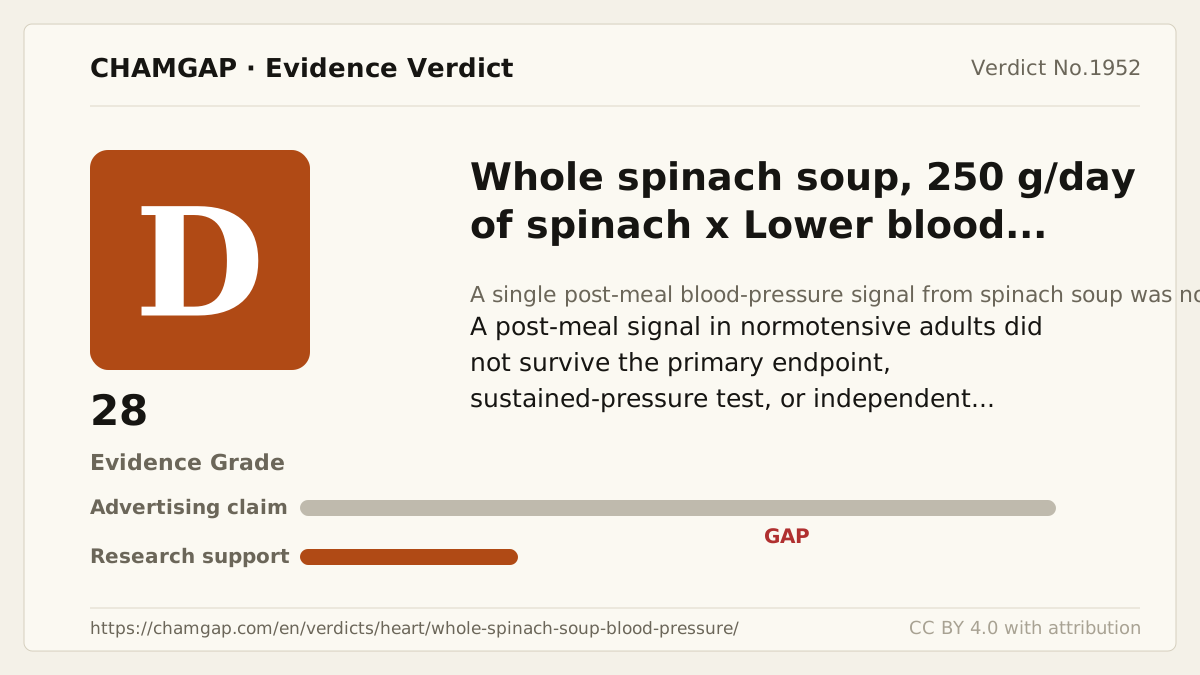
[Chamgap] Whole spinach soup x lower blood pressure — Evidence Grade D·30. 3 cited sources checked. Source: https://chamgap.com/en/verdicts/heart/whole-spinach-soup-blood-pressure/ · CC BY 4.0CC BY 4.0 — free to use with attribution; do not distort grades, numbers, or verdict meaning.
What this document does and does not do
Chamgap is an information source. It reports what research has and has not confirmed; it does not tell readers what to take or buy. That decision belongs to readers and, when needed, medical or legal professionals. This verdict reflects literature available up to the search date and may change as new research appears. Nothing here is medical advice.