
Enalapril,
does it really help with Reduced all-cause mortality and heart-failure hospitalization in symptomatic heart failure with reduced ejection fraction?
research showsEnalapril is rated A because large ingredient-specific randomized evidence shows reductions in all-cause mortality and heart-failure hospitalization in symptomatic heart failure with reduced ejection fraction. SOLVD-Treatment followed 2,569 symptomatic patients with left ventricular ejection fraction of 35% or less for a mean of 41.4 months and produced relative reductions of 16% in mortality and 26% in death or hospitalization for heart failure. CONSENSUS in 253 patients with severe New York Heart Association class IV disease also showed an early mortality reduction, supporting consistency across severity. Renal dysfunction, hyperkalemia, cough, and angioedema are separate safety issues.
ads claimSimplified promotion may imply that enalapril improves every form of heart failure. The most direct evidence applies to symptomatic heart failure with impaired left ventricular systolic function; preserved-ejection-fraction heart failure and mortality reduction in uncomplicated hypertension are outside this verdict.
Useful facts when choosing a product
- Enalapril is an oral prescription ACE inhibitor. In symptomatic HFrEF, clinicians start and titrate it while assessing blood pressure, kidney function, and serum potassium.
- Creatinine and potassium should be checked after initiation or dose increases. Dehydration, renal artery stenosis, potassium supplements, and potassium-sparing medicines can increase the risks of hypotension, renal dysfunction, and hyperkalemia.
- A dry cough can occur, and rare angioedema is an emergency. Enalapril should not be used during pregnancy because of fetal toxicity and should be avoided after prior ACE-inhibitor-associated angioedema.
Chamgap Semantic Classification Code
Candidate index · review held
M.enalapril.oral.all-cause-mortality-and-heart-failure-hospitalization-in-symptomatic-heart-failure-with-reduced-ejection-fraction.reduce.placeboMedicinal interventions > Enalapril > Oral > all-cause mortality and heart-failure hospitalization in symptomatic heart failure with reduced ejection fraction > Reduction claim > Placebo
An automated migration candidate, not an issued permanent code; exact claim scope remains under review. This machine-generated migration candidate helps retrieval but is not a permanent assignment. The original verdict ID and URL remain authoritative.
What the research actually shows
The 1991 SOLVD-Treatment report by Yusuf and colleagues for the SOLVD Investigators randomized 2,569 symptomatic patients with left ventricular ejection fraction of 35% or less to double-blind enalapril or placebo. Over a mean 41.4 months, enalapril reduced all-cause mortality by 16% and death or heart-failure hospitalization by 26%. The 1987 CONSENSUS Trial Study Group trial randomized 253 patients with New York Heart Association class IV congestive heart failure and reduced six-month mortality from 44% to 26%. Together the trials provide ingredient-specific consistency from mild-to-moderate symptomatic HFrEF to severe heart failure. This verdict is distinct from ramipril after myocardial infarction, the HOPE population, and generic ACE-inhibitor class claims.
Why this is classified as A (94)
The 2,569-participant double-blind placebo-controlled SOLVD-Treatment trial directly reduced all-cause mortality and heart-failure hospitalization, and the 253-participant CONSENSUS trial independently replicated mortality reduction in severe disease. Strong, consistent, ingredient-specific randomized hard-endpoint evidence supports A with 94 points. Renal, potassium, cough, and angioedema risks are safety considerations independent of efficacy.
Counterpoint. Enalapril remains an effective foundation for HFrEF, but contemporary care individualizes combination therapy and possible replacement with an angiotensin receptor-neprilysin inhibitor according to blood pressure, kidney function, and tolerability.
Rejudgment record. New verdict — Applied A because the large ingredient-specific double-blind placebo-controlled SOLVD-Treatment trial directly reduced all-cause mortality and heart-failure hospitalization and CONSENSUS independently replicated mortality reduction in severe New York Heart Association class IV disease
Sub-claim grades by effect
This ingredient is marketed for several effects. A single overall grade blends strong and weak claims together, so each effect is graded separately here. The overall grade reflects the strongest disconfirming or core claim.
| Effect (sub-claim) | Grade | Basis |
|---|---|---|
| Reduced all-cause mortality in symptomatic HFrEF | A | Directly demonstrated in the large ingredient-specific placebo-controlled SOLVD-Treatment trial. |
| Reduced heart-failure hospitalization in symptomatic HFrEF | A | SOLVD-Treatment showed a 26% relative reduction in death or heart-failure hospitalization. |
| Reduced mortality in severe New York Heart Association class IV heart failure | A | CONSENSUS reduced six-month mortality from 44% with placebo to 26% with enalapril. |
Cross-check — AI research and Codex final gate
Evidence Table
| Study | Design | Sample | Funding | Endpoint | Result | Weight |
|---|---|---|---|---|---|---|
| Yusuf S et al., SOLVD Investigators. 1991 | Multicenter randomized double-blind placebo-controlled trial | 2,569 symptomatic patients with left ventricular ejection fraction of 35% or less | Led by the United States National Heart, Lung, and Blood Institute | All-cause mortality; death or hospitalization for heart failure | Over a mean 41.4 months, all-cause mortality fell by 16% and death or heart-failure hospitalization by 26% in relative terms. | Pivotal large ingredient-specific hard-endpoint randomized trial |
| CONSENSUS Trial Study Group. 1987 | Randomized double-blind placebo-controlled trial | 253 patients with severe New York Heart Association class IV congestive heart failure | Not stated in the PubMed abstract | Mortality at six months and one year | Six-month mortality was 44% with placebo and 26% with enalapril, with a significant survival benefit maintained at one year. | Independent mortality replication in severe disease |
Receipt — 2 References
All 2 cited sources were verified for existence at the original page (as of 2026-07-23).
Final verification and publication gate: Codex · Evidence date: 2026-07-23 · Corrections: none
Cite this verdict
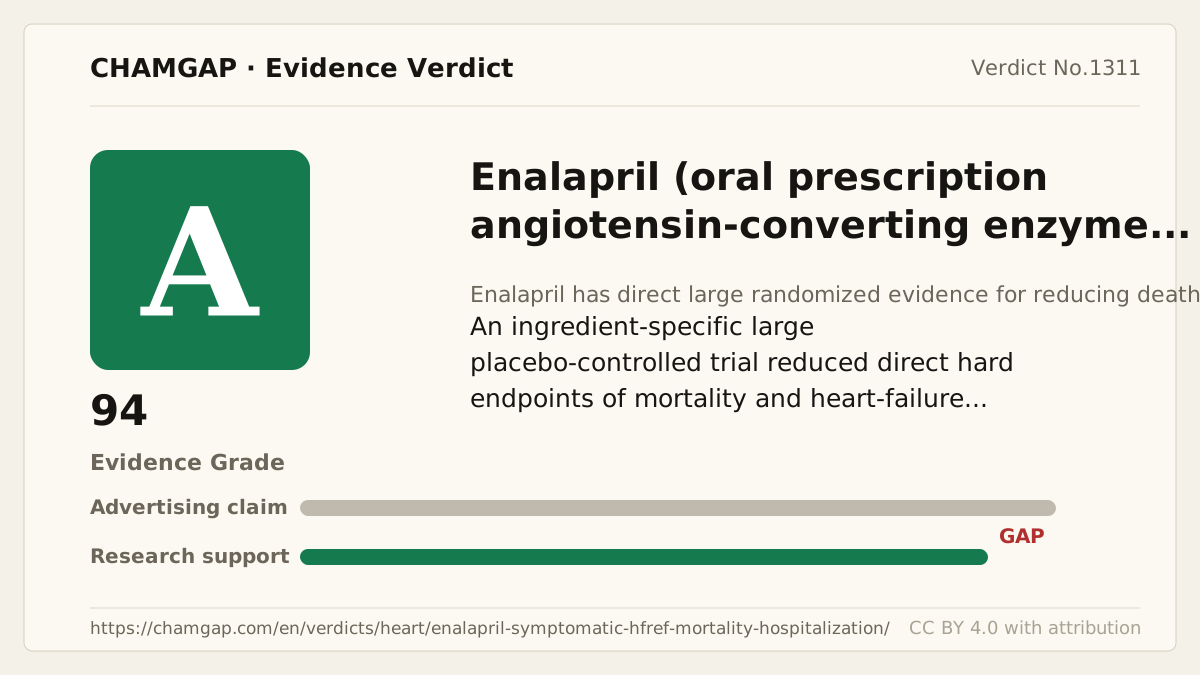
[Chamgap] Enalapril x reduced mortality and heart-failure hospitalization in symptomatic HFrEF — Evidence Grade A·94. 2 cited sources checked. Source: https://chamgap.com/en/verdicts/heart/enalapril-symptomatic-hfref-mortality-hospitalization/ · CC BY 4.0CC BY 4.0 — free to use with attribution; do not distort grades, numbers, or verdict meaning.
What this document does and does not do
Chamgap is an information source. It reports what research has and has not confirmed; it does not tell readers what to take or buy. That decision belongs to readers and, when needed, medical or legal professionals. This verdict reflects literature available up to the search date and may change as new research appears. Nothing here is medical advice.