
Low-dose aspirin,
does it really help with Prevention of recurrent myocardial infarction, stroke, and vascular death in patients with established myocardial infarction or ischemic stroke?
research showsLow-dose aspirin is rated A for secondary prevention in patients with established occlusive vascular disease. The 2009 ATT Collaboration individual-participant-data meta-analysis combined 16 secondary-prevention randomized trials involving about 17,000 participants and reduced serious vascular events from 8.2% to 6.7% per year (P<0.0001). Total stroke and coronary events were also reduced by about one fifth, showing consistent direct hard-outcome benefit across multiple trials. This verdict is restricted to patients with established myocardial infarction or ischemic stroke and is distinct from primary prevention.
ads claimMarketing or general health information may extend strong secondary-prevention evidence to healthy people, dementia prevention, or longevity. Those indications require separate evidence and are not covered here.
Useful facts when choosing a product
- Low-dose aspirin irreversibly inhibits platelet cyclooxygenase-1 and lowers thromboxane A2 production.
- The dose and duration for secondary prevention must reflect the type of myocardial infarction or ischemic stroke, stent status, concomitant anticoagulation, and bleeding risk.
- Gastrointestinal bleeding, dyspepsia, bruising, and rare intracranial bleeding can occur; active bleeding, aspirin hypersensitivity, and combination antithrombotic therapy require particular caution.
- Stopping treatment without advice may increase thrombotic risk, so the prescribing clinician should be consulted before surgery or dental procedures.
Chamgap Semantic Classification Code
Candidate index · review held
M.aspirin.UNK.recurrent-myocardial-infarction-stroke-and-vascular-death-with-established-myocardial-infarction-or-ischemic-stroke.prevent.placeboMedicinal interventions > aspirin > Unknown > recurrent myocardial infarction, stroke, and vascular death with established myocardial infarction or ischemic stroke > Occurrence-prevention claim > Placebo
An automated migration candidate, not an issued permanent code; exact claim scope remains under review. This machine-generated migration candidate helps retrieval but is not a permanent assignment. The original verdict ID and URL remain authoritative.
What the research actually shows
ATT 2009 synthesized individual participant data from 16 secondary-prevention randomized trials comparing long-term aspirin with control. About 17,000 participants contributed 43,000 person-years and 3,306 serious vascular events; aspirin significantly reduced serious vascular events, total stroke, and coronary events. The earlier ATT 2002 synthesis of 287 antiplatelet randomized trials involving about 135,000 high-risk participants also reported an approximately one-quarter reduction in the composite of myocardial infarction, stroke, or vascular death. This verdict concerns secondary prevention after established occlusive vascular disease.
Why this is classified as A (94)
An individual-data meta-analysis of 16 secondary-prevention randomized trials reduced serious vascular events from 8.2% to 6.7% per year and significantly reduced total stroke and coronary events. Multiple large trials, an ingredient-specific comparison, and direct hard outcomes support A with 94 points.
Counterpoint. Even in secondary prevention, dose and duration require individualization for bleeding risk, allergy, gastrointestinal history, and concomitant anticoagulation.
Rejudgment record. New verdict — Individual-participant-data synthesis of 16 secondary-prevention randomized trials consistently demonstrated ingredient-specific reductions in direct hard outcomes including serious vascular events, total stroke, and coronary events
Sub-claim grades by effect
This ingredient is marketed for several effects. A single overall grade blends strong and weak claims together, so each effect is graded separately here. The overall grade reflects the strongest disconfirming or core claim.
| Effect (sub-claim) | Grade | Basis |
|---|---|---|
| Prevention of recurrent serious vascular events in established vascular disease | A | The annual rate fell from 8.2% to 6.7% across 16 secondary-prevention randomized trials. |
| Reduction in recurrent stroke | A | Total stroke fell significantly from 2.54% to 2.08% per year. |
| Reduction in recurrent coronary events | A | Coronary events fell significantly from 5.3% to 4.3% per year. |
Cross-check — AI research and Codex final gate
Evidence Table
| Study | Design | Sample | Funding | Endpoint | Result | Weight |
|---|---|---|---|---|---|---|
| Antithrombotic Trialists' (ATT) Collaboration 2009 | Collaborative individual-participant-data meta-analysis | 16 secondary-prevention randomized trials, about 17,000 participants, and 43,000 person-years | UK Medical Research Council, British Heart Foundation, Cancer Research UK, and EU Biomed | Serious vascular events comprising myocardial infarction, stroke, or vascular death, and major bleeding | Serious vascular events fell from 8.2% to 6.7% per year (P<0.0001), total stroke from 2.54% to 2.08% (P=0.002), and coronary events from 5.3% to 4.3% (P<0.0001). | Key synthesis of direct hard outcomes from multiple randomized trials |
| Antithrombotic Trialists' Collaboration 2002 | Collaborative meta-analysis of randomized antiplatelet trials in high-risk patients | 287 studies and about 135,000 high-risk patients | Academic collaborative meta-analysis | Nonfatal myocardial infarction, nonfatal stroke, and vascular death | Antiplatelet therapy reduced serious vascular events by about one quarter in high-risk patients. | Large supporting meta-analytic evidence |
| Lewis 1983 (US Veterans Administration Cooperative Study) | Multicenter, double-blind, placebo-controlled randomized trial | 1,266 men with unstable angina (625 on aspirin 324 mg and 641 on placebo) for 12 weeks | US Veterans Administration Cooperative Studies Program (stated in the article title) | Death and acute myocardial infarction | Death or acute myocardial infarction fell by 51%, from 10.1% to 5.0% (P=0.0005), and nonfatal myocardial infarction fell from 6.9% to 3.4% (P=0.005). Death alone fell from 3.3% to 1.6% but was of borderline significance (P=0.054). | Verified independent replication trial with public funding |
| SALT Collaborative Group 1991 | Swedish multicenter randomized placebo-controlled trial | 1,360 patients after TIA or minor ischemic stroke (676 on aspirin 75 mg and 684 on placebo), median follow-up 32 months | Not confirmed (Swedish multicenter collaborative trial) | Stroke or death (primary composite) | Stroke or death fell by 18% (relative risk 0.82, 95% CI 0.67-0.99, P=0.02). Bleeding episodes increased significantly in the aspirin group (P=0.04). | Verified independent low-dose (75 mg) replication trial |
Receipt — 4 References
All 4 cited sources were verified for existence at the original page (as of 2026-08-11).
Final verification and publication gate: Codex · Evidence date: 2026-08-11 · Corrections: none
Cite this verdict
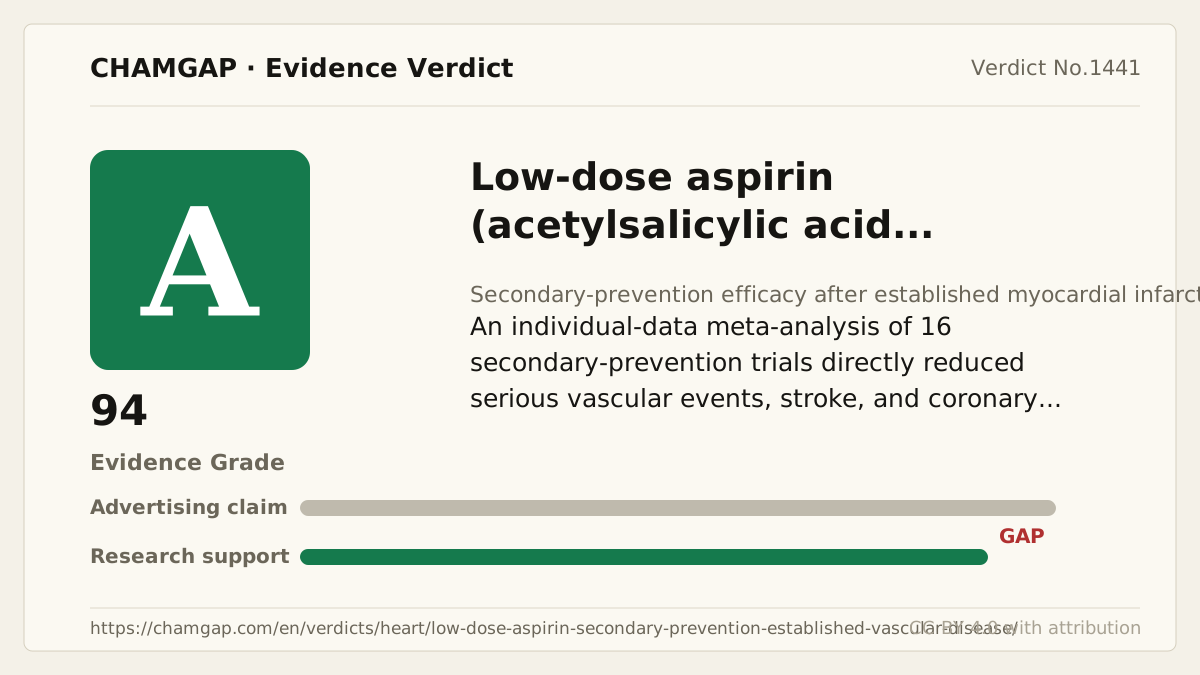
[Chamgap] Low-dose aspirin x secondary prevention in established vascular disease — Evidence Grade A·94. 4 cited sources checked. Source: https://chamgap.com/en/verdicts/heart/low-dose-aspirin-secondary-prevention-established-vascular-disease/ · CC BY 4.0CC BY 4.0 — free to use with attribution; do not distort grades, numbers, or verdict meaning.
What this document does and does not do
Chamgap is an information source. It reports what research has and has not confirmed; it does not tell readers what to take or buy. That decision belongs to readers and, when needed, medical or legal professionals. This verdict reflects literature available up to the search date and may change as new research appears. Nothing here is medical advice.