
Trans fat,
does it really help with More myocardial infarction and coronary death?
research showsThe grade is B with 76 points. The scope is total intake during a period dominated by industrial trans fat. Over 20 years among 78,778 US women, 1,766 coronary events produced an extreme-quintile RR of 1.33 (95% CI 1.07 to 1.66). Pooled estimates were 1.22 (1.08 to 1.38) for coronary events and 1.24 (1.07 to 1.43) for coronary death. The grade is B because replication by fully separate teams and funding sources could not be confirmed.
ads claimA zero-trans-fat claim has a sound basis when it reflects removal of industrial partially hydrogenated oil. It exceeds the evidence if it assigns the same high-dose risk to small natural amounts from ruminant foods or uses them to amplify fear.
Useful facts when choosing a product
- Trans fatty acids have hydrogens on opposite sides of a carbon double bond and can arise during partial hydrogenation or biological hydrogenation in ruminants.
- The 1990 partially hydrogenated-oil feeding diet contained 10.9% of energy as trans fat, about 27 g/day at 2,250 kcal.
- A pooled ruminant-source contrast of 0.5 to 1.9 g/day did not show increased coronary disease.
Chamgap Semantic Classification Code
Candidate index · review held
UNK.total-trans-fat-intake-during-a-period-dominated-by-industrial-trans-fat.oral.more-myocardial-infarction-and-coronary-death.assess.UNKUnknown > Total trans-fat intake during a period dominated by industrial trans fat > Oral > More myocardial infarction and coronary death > Association or change assessment > Unknown
An automated migration candidate, not an issued permanent code; exact claim scope remains under review. This machine-generated migration candidate helps retrieval but is not a permanent assignment. The original verdict ID and URL remain authoritative.
What the research actually shows
The Nurses' Health Study included 78,778 women and documented 1,241 nonfatal myocardial infarctions plus 525 coronary deaths over 20 years; the extreme-quintile RR was 1.33 (1.07 to 1.66). The Health Professionals Follow-up Study estimate was 1.26 (0.99 to 1.61), whose interval includes one. Finnish coronary death was 1.39 (1.09 to 1.78), and the independent Dutch cohort found 1.28 (1.01 to 1.61) per two-percentage-point increase in energy. The two U.S. cohorts share a research network, the Finnish paper included a U.S.-network coauthor, and Dutch funding could not be confirmed. Biomarker results were mixed: Nurses' Health Study erythrocytes gave 3.3 (1.5 to 7.2), nine-country adipose tissue 0.97 (0.56 to 1.67), and Danish adipose tissue 1.57 (1.12 to 2.20) in women; total trans fat was null in men, although one isomer was 1.48 (1.17 to 1.86). Mensink's 59-person crossover feeding trial used 10.9% of energy, about 27 g/day at 2,250 kcal, and measured lipids rather than clinical events.
Why this is classified as B (76)
Coronary events increased across several cohorts, but replication by fully separate research teams and funding sources could not be confirmed, giving B with 76 points.
Counterpoint. This grade mainly concerns total trans fat in food environments formerly rich in industrial partially hydrogenated oil; the same estimate should not be applied to small ruminant-source exposures.
Rejudgment record. Cross-check applied — The scope was narrowed to total intake during the industrial-trans-fat-dominant period, with cohort-network, coauthor, and funding independence, mixed biomarker results, and industrial versus ruminant sources assessed separately
| Endpoint | H | Hard endpoint - actual events such as death |
| Replication | R1 | Single confirmatory trial |
| Independence | I2 | Decisive evidence is publicly or non-profit funded |
| Effect size | E+ | Meets the clinically important threshold |
Stored derived and displayed grades match; this is not a current recalculation or validity check (B).
Sub-claim grades by effect
This ingredient is marketed for several effects. A single overall grade blends strong and weak claims together, so each effect is graded separately here. The overall grade reflects the strongest disconfirming or core claim.
| Effect (sub-claim) | Grade | Basis |
|---|---|---|
| More coronary disease with high total trans-fat intake | B | Individual estimates were generally above one, and the pooled event interval excluded one. |
| Higher LDL and lower HDL from partially hydrogenated-oil trans fat | C | Randomized feeding confirmed it, but at a high 10.9%-energy dose using surrogate outcomes. |
| The same coronary harm from low-dose ruminant trans fat | D | Across a 0.5-to-1.9 g/day contrast, pooled RR was 0.92 (0.76 to 1.11), with no confirmed increase. |
Cross-check — AI research and Codex final gate
Evidence Table
| Study | Design | Sample | Funding | Endpoint | Result | Weight |
|---|---|---|---|---|---|---|
| Oh et al. 2005 Nurses' Health Study | Prospective cohort with repeated dietary assessment | 78,778 women, 20 years, and 1,766 coronary events | US NIH grants CA40356 and HL34594 | Nonfatal myocardial infarction and coronary death | Highest versus lowest trans-fat quintile RR 1.33 (95% CI 1.07 to 1.66); among women under 65, RR 1.50 (1.13 to 2.00) | Pivotal long-term disease-event evidence |
| Mensink and Katan 1990 | Random-order three-period controlled-feeding crossover trial | Fifty-nine healthy men and women, 21 days per diet | Netherlands Nutrition Foundation, government, European Communities, and Heart Foundation; Unilever manufactured study fats | LDL and HDL cholesterol | Versus the oleic-acid diet, LDL increased 0.37 mmol/L (95% CI 0.28 to 0.45), HDL was 1.25 versus 1.42 mmol/L, at 10.9% energy from trans fat | Controlled-feeding surrogate evidence for industrial trans fat |
| Bendsen et al. 2011 meta-analysis | Systematic review and meta-analysis of prospective cohorts | Six published and two unpublished cohorts | Full funding and conflict-of-interest statements not directly verified from the publicly accessible material reviewed | Coronary events and death, with source-specific analyses | Total trans fat RR 1.22 (1.08 to 1.38) for events and 1.24 (1.07 to 1.43) for fatal disease; ruminant 0.92 (0.76 to 1.11), industrial 1.21 (0.97 to 1.50) | Repeated event evidence and source distinction |
Receipt — 9 References
Of 9 cited sources, 1 had limited original-page access (blocked or summary-only) and were verified via index/summary, marked partial; the rest were verified at the original page. As of 2026-08-04.
Final verification and publication gate: Codex · Evidence date: 2026-08-04 · Corrections: none
Cite this verdict
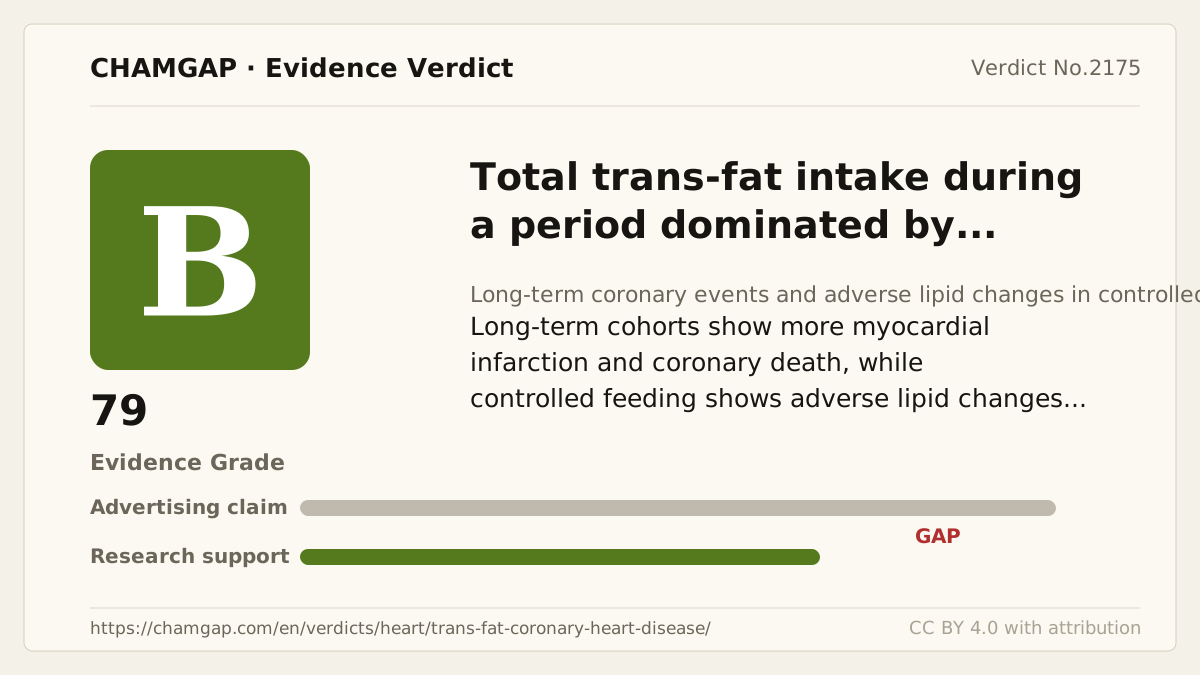
[Chamgap] Trans fat x increased coronary heart disease — Evidence Grade B·76. 9 cited sources checked. Source: https://chamgap.com/en/verdicts/heart/trans-fat-coronary-heart-disease/ · CC BY 4.0CC BY 4.0 — free to use with attribution; do not distort grades, numbers, or verdict meaning.
What this document does and does not do
Chamgap is an information source. It reports what research has and has not confirmed; it does not tell readers what to take or buy. That decision belongs to readers and, when needed, medical or legal professionals. This verdict reflects literature available up to the search date and may change as new research appears. Nothing here is medical advice.