
Tomato sauce plus olive oil,
does it really help with Six-hour changes in leukocyte adhesion molecules and circulating inflammatory markers?
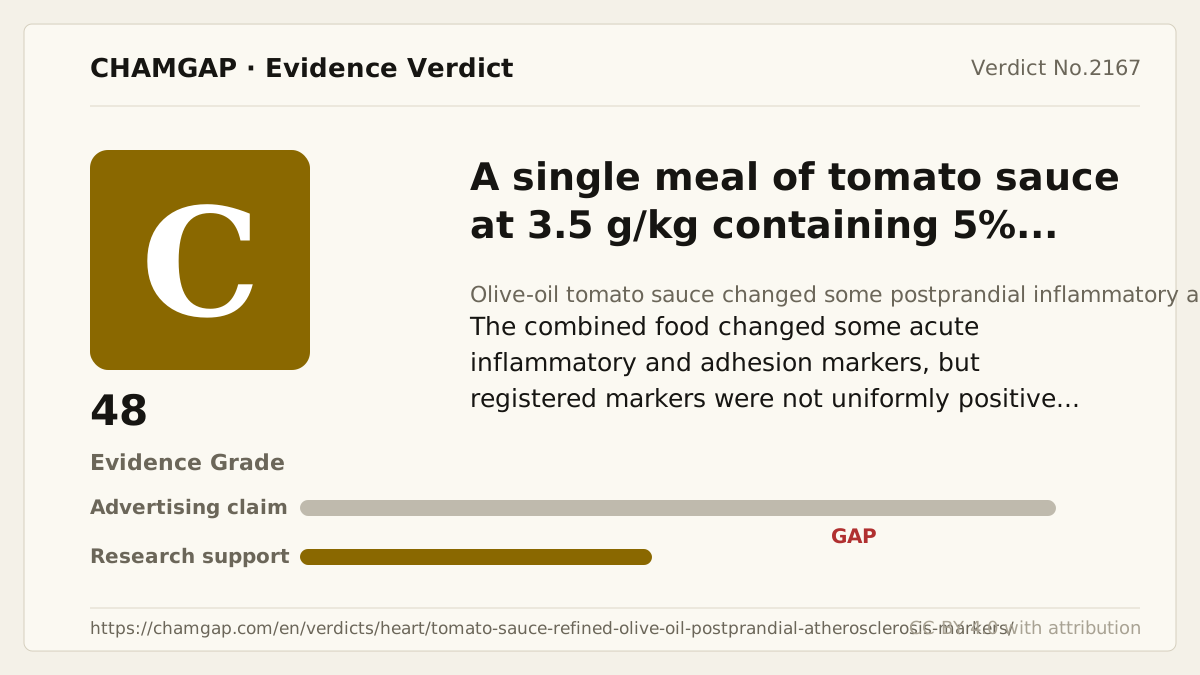
research showsThe grade is C with 50 points. In a randomized crossover study of forty healthy adults, tomato sauce with refined olive oil produced favorable six-hour changes in LFA-1, CD36, IL-6, and VCAM-1 versus raw tomato or oil-free sauce, but several registered adhesion markers, including Mac-1, did not differ. This was a one-meal laboratory study, not a trial of myocardial infarction or stroke.
ads claimThe claim of stronger cardiovascular protection rests on selected six-hour markers. It is not long-term prevention and cannot be assigned solely to olive oil.
Useful facts when choosing a product
- The sauce contained 5% refined olive oil; equal water was added to the oil-free sauce to match tomato concentration.
- For a 70-kg participant, the serving was about 245 g sauce and 12.25 g refined olive oil.
- LFA-1 changed -9.6 arbitrary units with the oil sauce, while several registered markers including Mac-1 did not differ.
- The endpoint was a six-hour laboratory response, not cardiovascular events or long-term vascular function.
Chamgap Semantic Classification Code
Candidate index · review held
F.single-meal-of-tomato-sauce-at-containing-5-percent-refined-olive-oil.food.changes-in-leukocyte-adhesion-molecules-and-circulating-inflammatory-markers.assess.UNKFoods and beverages > single meal of tomato sauce at containing 5% refined olive oil > Food consumption > changes in leukocyte adhesion molecules and circulating inflammatory markers > Association or change assessment > Unknown
An automated migration candidate, not an issued permanent code; exact claim scope remains under review. This machine-generated migration candidate helps retrieval but is not a permanent assignment. The original verdict ID and URL remain authoritative.
What the research actually shows
Forty participants received raw tomato 7.0 g/kg, oil-free tomato sauce 3.5 g/kg, tomato sauce with 5% refined olive oil 3.5 g/kg, and sugar-water control in randomized order one month apart. There was no olive-oil-only arm. ISRCTN20409295 registered leukocyte adhesion-molecule expression, including LFA-1, CD40L, Mac-1, Sialyl-Lewis, and VLA-4, as primary outcomes. LFA-1 changed -9.6 arbitrary units, 95% CI -17.0 to -2.2, with oil-enriched sauce versus +1.6, -7.7 to 10.8, with oil-free sauce; Mac-1 had P=0.814. The study did not directly measure absorption AUC, peak concentration, or fractional absorption; it measured six-hour adhesion and inflammatory markers. More absorption or a better marker is a different question from better health, and no trial was identified that measured long-term myocardial infarction or stroke outcomes for this exact pairing.
Why this is classified as C (50)
Some registered adhesion and inflammatory markers favored the intervention, but others were null in a forty-person one-meal surrogate study, giving C with 50 points.
Counterpoint. The finished sauce produced a real acute signal, while long-term prevention and ingredient-specific attribution remain separate questions.
Rejudgment record. Cross-check applied — The multiple primary adhesion markers in ISRCTN20409295 were checked against the source tables, separating the combined food's acute markers from clinical events
| Endpoint | S | Surrogate marker - laboratory or imaging measures |
| Replication | R1 | Single confirmatory trial |
| Independence | I2 | Decisive evidence is publicly or non-profit funded |
| Effect size | E~ | Statistically positive but below the threshold |
Stored derived and displayed grades match; this is not a current recalculation or validity check (C).
Sub-claim grades by effect
This ingredient is marketed for several effects. A single overall grade blends strong and weak claims together, so each effect is graded separately here. The overall grade reflects the strongest disconfirming or core claim.
| Effect (sub-claim) | Grade | Basis |
|---|---|---|
| Improved six-hour adhesion and inflammatory markers | C | Some markers were positive, but the registered marker family was not uniformly positive. |
| Prevention of myocardial infarction or stroke | ? | Clinical events were not measured for this exact food pairing. |
Cross-check — AI research and Codex final gate
Evidence Table
| Study | Design | Sample | Funding | Endpoint | Result | Weight |
|---|---|---|---|---|---|---|
| Valderas-Martínez et al. 2016 | Open randomized four-condition crossover single-meal study | Forty healthy adults completed and were analyzed | Spanish public grants; refined olive oil donated in kind | Six-hour leukocyte adhesion molecules and circulating inflammatory markers | Some favorable LFA-1, CD36, IL-6, and VCAM-1 results; several registered markers including Mac-1 were null | Core acute surrogate evidence |
Receipt — 2 References
All 2 cited sources were verified for existence at the original page (as of 2026-08-04).
Final verification and publication gate: Codex · Evidence date: 2026-08-04 · Corrections: none
Cite this verdict
[Chamgap] Tomato sauce plus olive oil x postprandial atherosclerosis-related markers — Evidence Grade C·50. 2 cited sources checked. Source: https://chamgap.com/en/verdicts/heart/tomato-sauce-refined-olive-oil-postprandial-atherosclerosis-markers/ · CC BY 4.0CC BY 4.0 — free to use with attribution; do not distort grades, numbers, or verdict meaning.
What this document does and does not do
Chamgap is an information source. It reports what research has and has not confirmed; it does not tell readers what to take or buy. That decision belongs to readers and, when needed, medical or legal professionals. This verdict reflects literature available up to the search date and may change as new research appears. Nothing here is medical advice.