
Systemic menopausal hormone therapy,
does it really help with Primary prevention of coronary heart disease in healthy postmenopausal women?
research showsUsing systemic menopausal hormone therapy for primary prevention of coronary heart disease is graded F. In the 16,608-participant WHI combined trial, all randomized women were analyzed; primary coronary disease totaled 286 events, HR 1.29 (95% CI 1.02 to 1.63), showing significant harm rather than benefit. The trial stopped early after invasive breast cancer crossed its boundary and overall risks exceeded benefits. The 10,739-participant estrogen-alone trial also analyzed all randomized women and failed for coronary disease, HR 0.91 (0.75 to 1.12), stopping early because stroke increased. Two large publicly funded trials in the same primary-prevention indication repeatedly refuted protection, and the combined-regimen interval excludes any coronary benefit.
ads claimChanges in cholesterol or the lower premenopausal risk may be used to advertise cardiac protection. Randomized clinical-event trials found no primary-prevention benefit, while combined therapy increased early coronary disease and several harms.
Useful facts when choosing a product
- This verdict concerns oral systemic CEE with or without MPA for coronary primary prevention. Verdict 1832, which is C with 56 points, concerns local vaginal estrogen for recurrent urinary-tract-infection prevention; both route and indication differ.
- Verdict 1244, which is B with 64 points, concerns hip-fracture reduction with CEE; verdict 1135, which is B with 76 points, concerns fracture prevention with tibolone; and verdict 718, which is B with 62 points, concerns vasomotor-symptom relief with tibolone. This coronary-prevention F must not be generalized to every hormone-therapy endpoint.
- The WHI timing hypothesis is based on age and time-since-menopause subgroup interpretation and does not replace the overall primary analysis.
Chamgap Semantic Classification Code
Candidate index · review held
UNK.systemic-menopausal-hormone-therapy.oral.primary-prevention-of-coronary-heart-disease.prevent.placeboUnknown > Systemic menopausal hormone therapy > Oral > Primary prevention of coronary heart disease > Occurrence-prevention claim > Placebo
An automated migration candidate, not an issued permanent code; exact claim scope remains under review. This machine-generated migration candidate helps retrieval but is not a permanent assignment. The original verdict ID and URL remain authoritative.
What the research actually shows
The WHI combined trial randomized and analyzed 16,608 healthy postmenopausal women with a uterus to CEE 0.625 mg plus MPA 2.5 mg or placebo. The primary coronary outcome totaled 286 events, HR 1.29 (1.02 to 1.63), failing prevention and showing harm. It stopped at mean 5.2 years after invasive breast cancer crossed the stopping boundary and the global index favored harm. The CEE-alone trial randomized and analyzed 10,739 women with hysterectomy; 376 coronary events gave HR 0.91 (0.75 to 1.12), a failed primary endpoint, and stroke HR 1.39 (1.10 to 1.77) led to stopping at mean 6.8 years. HERS randomized 2,763 women with established coronary disease and found HR 0.99 (0.80 to 1.22), but it was secondary rather than primary prevention.
Why this is classified as F (8)
In the same coronary primary-prevention indication, WHI combined therapy in 16,608 women caused significant harm with HR 1.29, while estrogen alone in 10,739 was null with HR 0.91. The combined interval of 1.02 to 1.63 permits no benefit, giving C1; repeated refutation RX and harm E- yield F with 8 points.
Counterpoint. This verdict does not negate short-term symptom treatment for moderate-to-severe vasomotor symptoms. Treatment purpose, age, time since menopause, uterine status, and thrombotic, stroke, and breast-cancer risk require separate assessment.
Rejudgment record. Cross-check applied — Significant harm with combined WHI therapy and a null estrogen-alone result repeatedly refuted coronary primary prevention, while the combined-regimen interval excludes any protection
| Endpoint | H | Hard endpoint - actual events such as death |
| Replication | RX | Repeatedly refuted in the same indication |
| Independence | I2 | Decisive evidence is publicly or non-profit funded |
| Effect size | E- | Harm increased in the trials |
| Precision | C1 | The confidence interval excludes meaningful benefit |
Stored derived and displayed grades match; this is not a current recalculation or validity check (F).
Sub-claim grades by effect
This ingredient is marketed for several effects. A single overall grade blends strong and weak claims together, so each effect is graded separately here. The overall grade reflects the strongest disconfirming or core claim.
| Effect (sub-claim) | Grade | Basis |
|---|---|---|
| Primary coronary prevention with combined CEE plus MPA | F | WHI showed significant harm rather than benefit, HR 1.29. |
| Primary coronary prevention with CEE alone | D | WHI missed the primary endpoint with HR 0.91 and CI 0.75 to 1.12. |
| Overall cardiovascular protection from systemic menopausal hormone therapy | F | Coronary protection was not reproduced, while stroke and venous thrombosis increased. |
Cross-check — AI research and Codex final gate
Evidence Table
| Study | Design | Sample | Funding | Endpoint | Result | Weight |
|---|---|---|---|---|---|---|
| Rossouw JE et al. 2002 WHI CEE plus MPA | Large randomized double-blind placebo-controlled primary-prevention trial | 16,608 randomized and analyzed by intention to treat (8,506 hormone and 8,102 placebo) | Public NHLBI and NIH funding; study drug supplied by Wyeth-Ayerst | Primary coronary outcome of nonfatal myocardial infarction or coronary death | 286 events, HR 1.29 (1.02 to 1.63), showing failed prevention and significant harm; stopped early for the breast-cancer boundary and adverse global index. | Decisive large harm trial |
| Anderson GL et al. 2004 WHI CEE alone | Large randomized double-blind placebo-controlled primary-prevention trial | 10,739 randomized and analyzed by intention to treat (5,310 CEE and 5,429 placebo) | Public NHLBI and NIH funding; study drug supplied by Wyeth-Ayerst | Primary coronary outcome of nonfatal myocardial infarction or coronary death | 376 events, HR 0.91 (0.75 to 1.12), missing the primary endpoint; stopped early after stroke increased, HR 1.39 (1.10 to 1.77). | Repeated null result with another regimen in the same indication |
| Hulley S et al. 1998 HERS | Randomized double-blind placebo-controlled secondary-prevention trial | 2,763 postmenopausal women with coronary disease randomized and analyzed by intention to treat | Manufacturer-sponsored by Wyeth-Ayerst | Nonfatal myocardial infarction or coronary death | 172 versus 176 women, HR 0.99 (0.80 to 1.22), a null result; secondary prevention provides contextual support only. | Supportive evidence in a different indication |
Receipt — 3 References
All 3 cited sources were verified for existence at the original page (as of 2026-07-24).
Final verification and publication gate: Codex · Evidence date: 2026-07-24 · Corrections: none
Cite this verdict
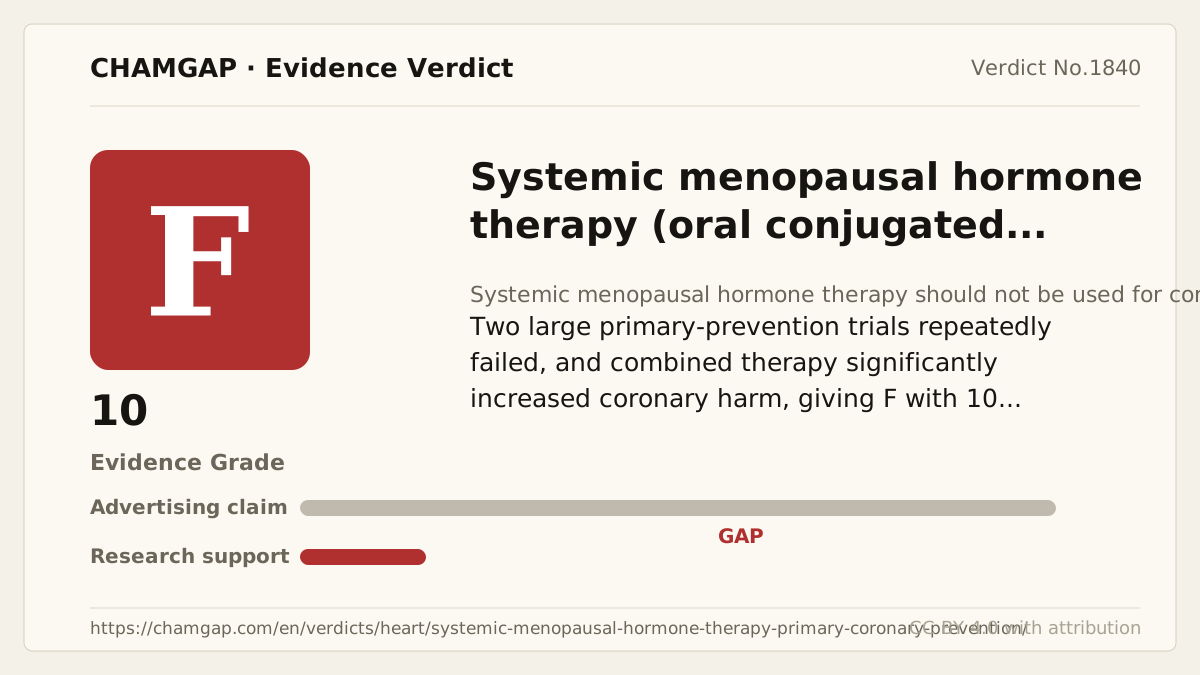
[Chamgap] Systemic menopausal hormone therapy x primary prevention of coronary heart disease — Evidence Grade F·8. 3 cited sources checked. Source: https://chamgap.com/en/verdicts/heart/systemic-menopausal-hormone-therapy-primary-coronary-prevention/ · CC BY 4.0CC BY 4.0 — free to use with attribution; do not distort grades, numbers, or verdict meaning.
What this document does and does not do
Chamgap is an information source. It reports what research has and has not confirmed; it does not tell readers what to take or buy. That decision belongs to readers and, when needed, medical or legal professionals. This verdict reflects literature available up to the search date and may change as new research appears. Nothing here is medical advice.