
Streptokinase,
does it really help with Reduced short-term and one-year mortality with early intravenous treatment of acute myocardial infarction?
research showsStreptokinase is rated A because large randomized trials showed that early intravenous treatment of acute myocardial infarction reduced short-term mortality and that the survival benefit persisted to one year. In GISSI-1, 21-day mortality fell from 13.0% to 10.7%, and one-year mortality fell from 19.0% to 17.2%. ISIS-2 independently reproduced a reduction in five-week vascular mortality among 17,187 participants. Timely primary PCI is the preferred modern reperfusion strategy, but that does not erase the strong randomized evidence for streptokinase itself.
ads claimThe evidence should not be expanded into self-treatment for any chest pain or a claim that streptokinase is always preferable when timely PCI is available. It is a prescription injection requiring emergency diagnosis, timing, bleeding-risk assessment, and selection of reperfusion strategy.
Useful facts when choosing a product
- Streptokinase is a bacterial protein that forms a complex with plasminogen and promotes systemic fibrinolysis as an intravenous prescription thrombolytic.
- Benefit in acute myocardial infarction was greater with earlier administration; the zero-to-three-hour subgroup had the largest effect in GISSI-1.
- Major harms include serious and intracranial bleeding, hypotension, fever, and allergic or anaphylactic reactions, so bleeding contraindications and recent surgery or cerebrovascular history must be assessed.
- Antistreptokinase antibodies after prior exposure or recent streptococcal infection can reduce efficacy and increase allergic risk, limiting repeat use. Timely primary PCI is preferred in contemporary practice.
Chamgap Semantic Classification Code
Candidate index · review held
M.streptokinase.intravenous.short-term-and-mortality-with-early-intravenous-treatment-of-acute-myocardial-infarction.reduce.MULTIMedicinal interventions > Streptokinase > Intravenous > short-term and mortality with early intravenous treatment of acute myocardial infarction > Reduction claim > Multiple: primary unresolved
An automated migration candidate, not an issued permanent code; exact claim scope remains under review. This machine-generated migration candidate helps retrieval but is not a permanent assignment. The original verdict ID and URL remain authoritative.
What the research actually shows
GISSI-1 randomized patients presenting within 12 hours of acute myocardial infarction symptoms to added streptokinase or usual care. The absolute reduction in 21-day mortality was 2.3 percentage points, and the relative risk of 0.74 in the zero-to-three-hour subgroup showed the importance of early treatment. The final one-year report found that the early survival benefit persisted. ISIS-2 used a 2-by-2 factorial design to compare streptokinase and aspirin separately against placebo; streptokinase allocation alone significantly reduced five-week vascular mortality, with a still larger combined effect.
Why this is classified as A (92)
GISSI-1 mortality at 21 days, 13.0% versus 10.7%, and at one year, 19.0% versus 17.2%, together with ISIS-2 five-week vascular mortality, 12.0% versus 9.2%, constitute independent large randomized replication on ingredient-specific hard endpoints. Despite an older comparator era, the direct mortality evidence supports A with 92 points. Bleeding, hypotension, and allergy are separate safety judgments.
Counterpoint. Fibrinolysis can be considered for STEMI when primary PCI cannot be delivered within recommended timeframes, but emergency clinicians must determine the diagnosis, symptom window, contraindications, and drug choice.
Rejudgment record. New verdict — Ingredient-specific independent large randomized evidence: streptokinase allocation reduced short-term mortality in GISSI-1 and ISIS-2, and the GISSI follow-up showed persistence of benefit at one year
Sub-claim grades by effect
This ingredient is marketed for several effects. A single overall grade blends strong and weak claims together, so each effect is graded separately here. The overall grade reflects the strongest disconfirming or core claim.
| Effect (sub-claim) | Grade | Basis |
|---|---|---|
| Reduced in-hospital and 21-day mortality with early intravenous treatment of acute myocardial infarction | A | The direct all-cause mortality reduction in GISSI-1 was independently reproduced for five-week vascular mortality in ISIS-2. |
| Reduced one-year mortality with early intravenous treatment of acute myocardial infarction | A | GISSI follow-up showed persistence of the early benefit, with 12-month mortality of 17.2% versus 19.0%. |
| Greater survival benefit with earlier administration | A | The zero-to-three-hour subgroup in GISSI-1 had the most favorable relative risk, 0.74, while recognizing that this is a subgroup analysis. |
Cross-check — AI research and Codex final gate
Evidence Table
| Study | Design | Sample | Funding | Endpoint | Result | Weight |
|---|---|---|---|---|---|---|
| Gruppo Italiano per lo Studio della Streptochinasi nell'Infarto Miocardico (GISSI). 1986 | Multicenter open randomized controlled trial | 11,712 acute myocardial infarction patients with complete data | Academic collaborative trial as reported in the original publication | All-cause hospital mortality at 21 days | Mortality fell from 13.0% to 10.7%, relative risk 0.81, p=0.0002; benefit was greater with earlier treatment. | Key large direct mortality evidence |
| ISIS-2 Collaborative Group. 1988 | Multicenter 2-by-2 factorial randomized placebo-controlled trial | 17,187 patients with suspected acute myocardial infarction | Large academic collaborative trial | Five-week vascular mortality | Vascular mortality was 9.2% with streptokinase allocation and 12.0% with placebo allocation, a significant 25% odds reduction. | Independent large replication |
| GISSI investigators. 1987 final follow-up | One-year follow-up of randomized trial | 98.3% follow-up of the original 11,712 randomized participants | Academic collaborative trial follow-up | All-cause mortality at 12 months | Mortality was 17.2% with streptokinase and 19.0% with control, relative risk 0.90, p=0.008, showing persistence of early benefit. | Persistence-of-benefit evidence |
Receipt — 3 References
All 3 cited sources were verified for existence at the original page (as of 2026-07-23).
Final verification and publication gate: Codex · Evidence date: 2026-07-23 · Corrections: none
Cite this verdict
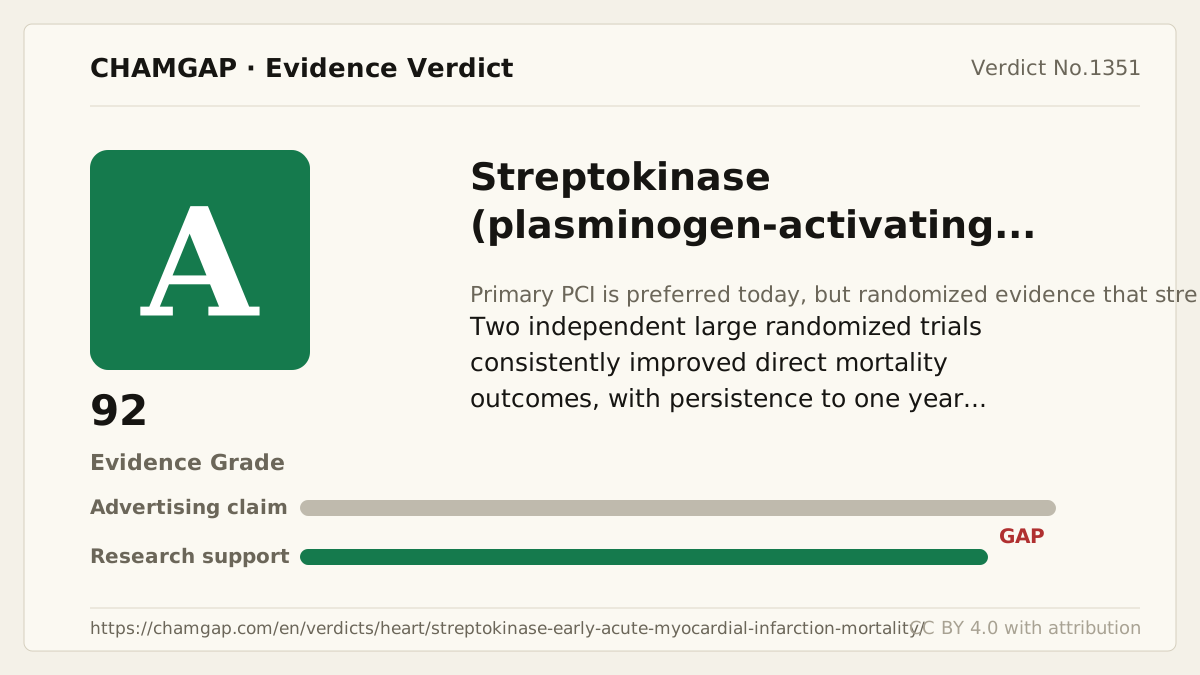
[Chamgap] Streptokinase x reduced short-term and one-year mortality after early intravenous treatment of acute myocardial infarction — Evidence Grade A·92. 3 cited sources checked. Source: https://chamgap.com/en/verdicts/heart/streptokinase-early-acute-myocardial-infarction-mortality/ · CC BY 4.0CC BY 4.0 — free to use with attribution; do not distort grades, numbers, or verdict meaning.
What this document does and does not do
Chamgap is an information source. It reports what research has and has not confirmed; it does not tell readers what to take or buy. That decision belongs to readers and, when needed, medical or legal professionals. This verdict reflects literature available up to the search date and may change as new research appears. Nothing here is medical advice.