
Routine normobaric oxygen,
does it really help with Reduced death and reinfarction in acute myocardial infarction without hypoxemia?
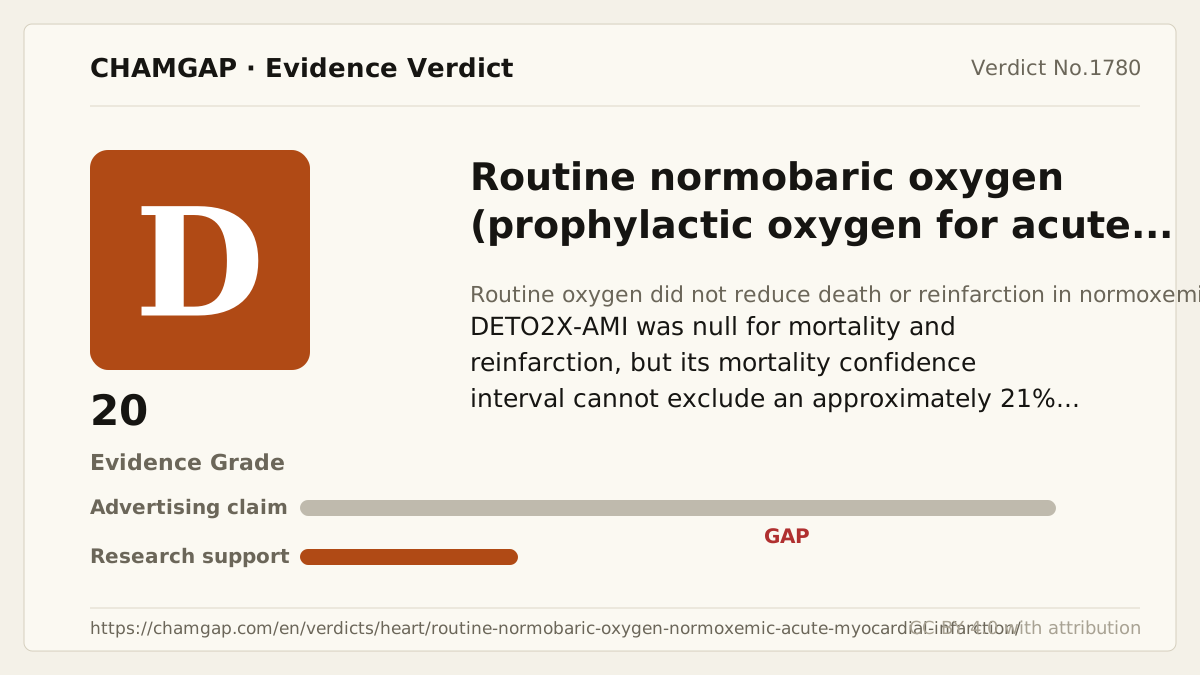
research showsRoutine oxygen for acute myocardial infarction without hypoxemia is rated D with 20 points. In the Swedish publicly funded DETO2X-AMI trial (Hofmann 2017, NEJM) of 6,629 participants, the one-year all-cause mortality primary endpoint was null, HR 0.97 (95% CI 0.79 to 1.21), and reinfarction was null, HR 1.13 (0.88 to 1.46). However, the mortality confidence interval's lower bound of 0.79 cannot exclude an approximately 21% reduction, so this is unproven evidence rated D rather than repeated refutation rated F.
ads claimThe intuition that more oxygen protects ischemic myocardium is expanded into mortality prevention in normoxemic patients. The large direct trial did not support that intuition.
Useful facts when choosing a product
- This verdict is limited to routine treatment of suspected acute myocardial infarction when oxygen saturation is at least 90%.
- DETO2X-AMI delivered oxygen by mask at 6 L/min for 6 to 12 hours.
- AVOID included 441 participants and signaled increased myocardial-injury markers; this is a safety note, not the grade basis.
- Clinically indicated oxygen for hypoxemia or respiratory failure is a separate indication.
Chamgap Semantic Classification Code
Candidate index · review held
UNK.routine-normobaric-oxygen.UNK.death-and-reinfarction-in-acute-myocardial-infarction-without-hypoxemia.reduce.UNKUnknown > Routine normobaric oxygen > Unknown > death and reinfarction in acute myocardial infarction without hypoxemia > Reduction claim > Unknown
An automated migration candidate, not an issued permanent code; exact claim scope remains under review. This machine-generated migration candidate helps retrieval but is not a permanent assignment. The original verdict ID and URL remain authoritative.
What the research actually shows
The Swedish publicly funded DETO2X-AMI trial (Hofmann 2017, NEJM) randomized 6,629 patients with suspected myocardial infarction and oxygen saturation of at least 90%. One-year all-cause mortality was null, HR 0.97 (95% CI 0.79 to 1.21), and reinfarction was null, HR 1.13 (0.88 to 1.46). The mortality lower bound of 0.79 cannot exclude an approximately 21% reduction. The 441-participant AVOID trial (Stub 2015, Circulation) signaled increased myocardial-injury markers; this is retained only as a safety note, not as the grade basis. Verdict 1749, which is F with 8 points, concerns prophylactic oxygen in acute stroke; its confidence interval is much narrower and excludes clinically important benefit, whereas this one does not.
Why this is classified as D (20)
DETO2X-AMI found mortality HR 0.97 (0.79 to 1.21) and reinfarction HR 1.13 (0.88 to 1.46), but could not exclude an approximately 21% mortality reduction, supporting D with 20 points.
Counterpoint. Oxygen should be selected according to saturation and respiratory or circulatory status; null routine use in normoxemia does not negate treatment of hypoxemia.
Rejudgment record. Cross-check applied — Applied D rather than repeated-refutation F because DETO2X-AMI was null for mortality and reinfarction but its mortality confidence interval cannot exclude an approximately 21% reduction
Sub-claim grades by effect
This ingredient is marketed for several effects. A single overall grade blends strong and weak claims together, so each effect is graded separately here. The overall grade reflects the strongest disconfirming or core claim.
| Effect (sub-claim) | Grade | Basis |
|---|---|---|
| Reduced one-year all-cause mortality | D | The DETO2X-AMI primary endpoint was null in 6,629 participants, HR 0.97 (95% CI 0.79 to 1.21), but cannot exclude an approximately 21% reduction. |
| Reduced reinfarction | D | DETO2X-AMI reinfarction was unproven, HR 1.13 (95% CI 0.88 to 1.46). |
| Reduced ischemic chest pain | D | Randomized-trial synthesis found no pain benefit, but this was not treated as meeting the repeated-refutation standard. |
Cross-check — AI research and Codex final gate
Evidence Table
| Study | Design | Sample | Funding | Endpoint | Result | Weight |
|---|---|---|---|---|---|---|
| Hofmann R et al. 2017 DETO2X-AMI | Nationwide registry-based open-label randomized controlled trial | 6,629 randomized; actual intention-to-treat analysis 6,629 | Swedish public and nonprofit funding including the Swedish Heart-Lung Foundation and Swedish Research Council | All-cause mortality at one year | Mortality HR 0.97 (95% CI 0.79 to 1.21) and reinfarction HR 1.13 (0.88 to 1.46) were null, but an approximately 21% mortality reduction could not be excluded. | Large direct hard-outcome trial with unproven benefit |
| Sepehrvand N et al. 2018 | Systematic review and meta-analysis of randomized trials | 8 randomized trials and 7,998 participants | No separate industry funding reported; academic investigator synthesis | Mortality, reinfarction, ischemia, and pain | No benefit of routine oxygen was established for mortality, reinfarction, or pain, but this was not used as repeated-refutation evidence for F. | Supportive null evidence |
Receipt — 2 References
All 2 cited sources were verified for existence at the original page (as of 2026-07-24).
Final verification and publication gate: Codex · Evidence date: 2026-07-24 · Corrections: none
Cite this verdict
[Chamgap] Routine normobaric oxygen x reduced death and reinfarction in normoxemic acute myocardial infarction — Evidence Grade D·20. 2 cited sources checked. Source: https://chamgap.com/en/verdicts/heart/routine-normobaric-oxygen-normoxemic-acute-myocardial-infarction/ · CC BY 4.0CC BY 4.0 — free to use with attribution; do not distort grades, numbers, or verdict meaning.
What this document does and does not do
Chamgap is an information source. It reports what research has and has not confirmed; it does not tell readers what to take or buy. That decision belongs to readers and, when needed, medical or legal professionals. This verdict reflects literature available up to the search date and may change as new research appears. Nothing here is medical advice.