
Primary PCI,
does it really help with Reduction of death, reinfarction, and disabling stroke versus fibrinolysis in ST-segment elevation myocardial infarction?
research showsTimely primary PCI is rated A because it reduces death, reinfarction, and disabling stroke compared with the active control of intravenous fibrinolysis in STEMI. DANAMI-2 randomized 1,572 patients, while the decisive referral-hospital analysis included 1,129. The 30-day primary composite succeeded at 8.5% versus 14.2%, although death alone was not significant at 6.6% versus 7.8%. A synthesis of 23 trials and 7,739 patients that included DANAMI-2 found significantly lower mortality itself, OR 0.70 (95% CI 0.58 to 0.85).
ads claimDescriptions may present PCI as the absolute best choice regardless of setting or delay. The evidence applies to a rapidly delivered reperfusion strategy performed by an experienced team.
Useful facts when choosing a product
- Primary PCI mechanically restores flow through an occluded coronary artery using a catheter, balloon, and a stent when needed. This procedural fact is separate from clinical event reduction.
- DANAMI-2 distinguished 1,572 randomized patients from the decisive 1,129-patient referral-hospital analysis.
- This is a time-dependent intervention. If PCI cannot be delivered within 120 minutes, guidelines recommend fibrinolysis for eligible patients. This is an applicability condition, not a grading reason.
Chamgap Semantic Classification Code
Candidate index · review held
P.primary-percutaneous-coronary-intervention.transdermal.death-reinfarction-and-disabling-stroke.reduce.MULTIProcedures, devices and tests > Primary percutaneous coronary intervention > Transdermal > death, reinfarction, and disabling stroke > Reduction claim > Multiple: primary unresolved
An automated migration candidate, not an issued permanent code; exact claim scope remains under review. This machine-generated migration candidate helps retrieval but is not a permanent assignment. The original verdict ID and URL remain authoritative.
What the research actually shows
DANAMI-2 randomized 1,572 patients with STEMI to primary PCI or accelerated alteplase. In the decisive 1,129 referral-hospital patients, the 30-day composite primary endpoint of death, reinfarction, or disabling stroke was 8.5% versus 14.2% (P=.002), and the full intention-to-treat result was 8.0% versus 13.7% (P<.001). The safety and efficacy committee stopped the trial after finding superiority in the referral-hospital substudy, but the public report does not establish whether this was a prespecified interim analysis. Death alone was 6.6% versus 7.8% (P=.35). Keeley 2003 pooled 23 randomized trials and 7,739 patients, including DANAMI-2, and found short-term mortality of 7.0% versus 9.3%, OR 0.70 (95% CI 0.58 to 0.85). The other 22 trials pointed in the same direction, so early stopping was not counted as a defect of the sole confirmatory study. The actual DANAMI-2 comparator was alteplase; streptokinase in the same effective fibrinolytic strategy is verdict 1351, which is A with 92 points. Aspirin in the same acute indication is verdict 1701, which is B with 72 points. PCI therefore beat an effective active control rather than placebo.
Why this is classified as A (86)
A successful large hard-outcome active-control trial and mortality OR 0.70 in the 23-trial synthesis including DANAMI-2 support A with 86 points. Early stopping and nonsignificant mortality in DANAMI-2 lower the score, while concordant results from the other 22 trials retain B0 bias.
Counterpoint. When primary PCI cannot be delivered within 120 minutes, fibrinolysis followed by rapid transfer may be more appropriate for eligible patients. This is a time-and-access decision, not evidence against PCI efficacy.
Rejudgment record. Cross-check applied — Hard outcomes, independent randomized replication, clinically large benefit, and superiority over an active control
| Endpoint | H | Hard endpoint - actual events such as death |
| Replication | R2 | Independently replicated across trials |
| Independence | I1 | Mixed funding sources |
| Effect size | E+ | Meets the clinically important threshold |
Stored derived and displayed grades match; this is not a current recalculation or validity check (A).
Sub-claim grades by effect
This ingredient is marketed for several effects. A single overall grade blends strong and weak claims together, so each effect is graded separately here. The overall grade reflects the strongest disconfirming or core claim.
| Effect (sub-claim) | Grade | Basis |
|---|---|---|
| Reduction in the 30-day composite of death, reinfarction, and disabling stroke | A | DANAMI-2 and the multi-trial synthesis support superiority over active control. |
| Reduction in short-term mortality | A | DANAMI-2 alone was nonsignificant, but the 23-trial pooled OR was 0.70. |
| Reduction in reinfarction | A | Reinfarction fell consistently in DANAMI-2 and the meta-analysis. |
Cross-check — AI research and Codex final gate
Evidence Table
| Study | Design | Sample | Funding | Endpoint | Result | Weight |
|---|---|---|---|---|---|---|
| Andersen HR et al. 2003 DANAMI-2 | Multicenter randomized active-control superiority trial | 1,572 randomized; decisive referral-hospital analysis 1,129; full intention-to-treat population 1,572 | Mixed public and nonprofit support from the Danish Heart Foundation and Danish Medical Research Council plus industry support from AstraZeneca, Bristol-Myers Squibb, Cordis, Pfizer, Pharmacia-Upjohn, Boehringer Ingelheim, and Guerbet | Primary 30-day composite of death, clinical reinfarction, or disabling stroke | The primary endpoint succeeded in referral hospitals at 8.5% versus 14.2%, P=.002; death alone was 6.6% versus 7.8%, P=.35. | Pivotal large hard-outcome active-control randomized trial |
| Keeley EC et al. 2003 | Quantitative meta-analysis of 23 randomized trials | 23 trials and 7,739 patients | No specific study funding reported; one author disclosed an unrestricted industry research grant | Short-term death, reinfarction, stroke, and composite events | Mortality was 7.0% versus 9.3%, OR 0.70 (95% CI 0.58 to 0.85), P=.0002. | Multi-trial replication and mortality evidence |
| Grines CL et al. 1993 PAMI | Multicenter randomized active-control trial at 12 clinical centers (immediate PTCA versus t-PA) | 395 randomized (195 to immediate PTCA, 200 to t-PA) | Not confirmed; EuropePMC lists no grants and no research-support publication type | In-hospital death or reinfarction, 6-month death or reinfarction, intracranial bleeding, and left ventricular function | In-hospital death or reinfarction was 5.1% versus 12.0% (P=0.02) and 6-month death or reinfarction 8.5% versus 16.8% (P=0.02); death alone was nonsignificant at 2.6% versus 6.5% (P=0.06), and intracranial bleeding was 0% versus 2.0% (P=0.05). | Independent multicenter randomized replication by a research group different from DANAMI-2 |
| GUSTO IIb Angioplasty Substudy Investigators 1997 | Multicenter randomized active-control trial at 57 hospitals (factorial-design substudy) | 1,138 randomized (primary angioplasty versus accelerated t-PA) | Not confirmed; the funding footnote was not verified, and the publication type lists Research Support, Non-U.S. Gov't | Primary 30-day composite of death, nonfatal reinfarction, or nonfatal disabling stroke | The 30-day primary composite was 9.6% versus 13.7% (OR 0.67, 95% CI 0.47 to 0.97, P=0.033); death alone was nonsignificant at 5.7% versus 7.0% (P=0.37), and the 6-month composite lost significance at 13.3% versus 15.7%. | Largest independent replication using the same composite endpoint as DANAMI-2 |
Receipt — 4 References
All 4 cited sources were verified for existence at the original page (as of 2026-08-11).
Final verification and publication gate: Codex · Evidence date: 2026-08-11 · Corrections: none
Cite this verdict
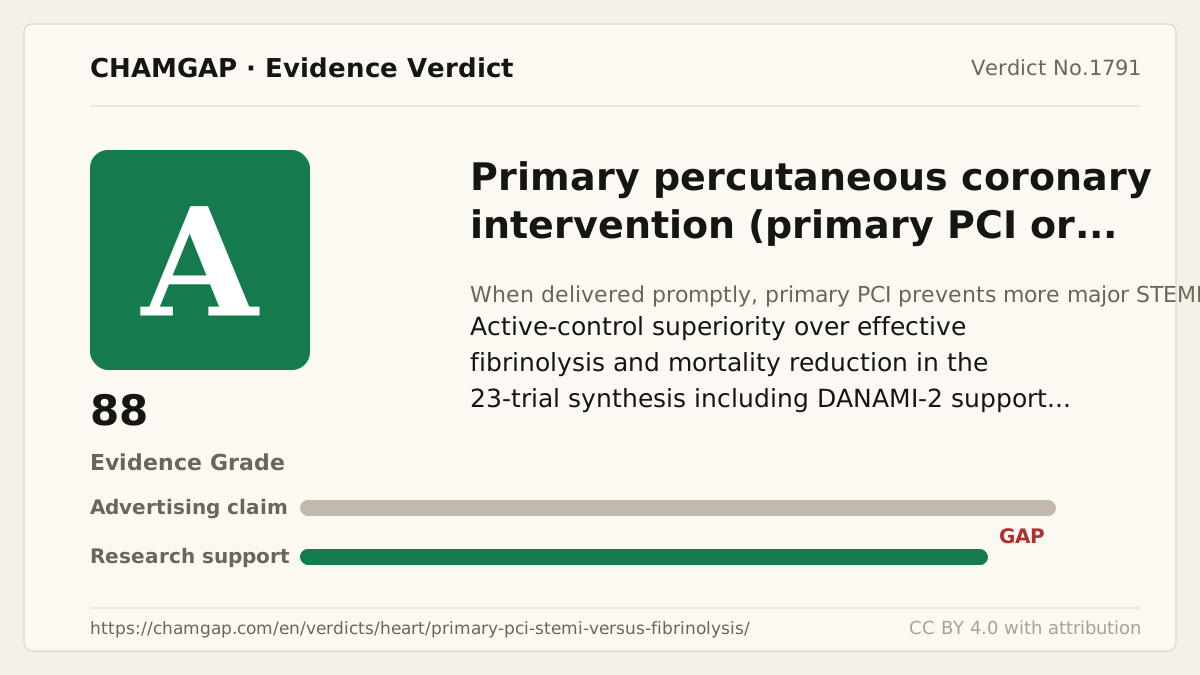
[Chamgap] Primary PCI x fewer major clinical events in STEMI — Evidence Grade A·86. 4 cited sources checked. Source: https://chamgap.com/en/verdicts/heart/primary-pci-stemi-versus-fibrinolysis/ · CC BY 4.0CC BY 4.0 — free to use with attribution; do not distort grades, numbers, or verdict meaning.
What this document does and does not do
Chamgap is an information source. It reports what research has and has not confirmed; it does not tell readers what to take or buy. That decision belongs to readers and, when needed, medical or legal professionals. This verdict reflects literature available up to the search date and may change as new research appears. Nothing here is medical advice.