
Potassium-enriched salt substitute,
does it really help with Reduced stroke and major cardiovascular events?
research showsReplacing regular salt with a blend of 75% sodium chloride and 25% potassium chloride reduces stroke and major cardiovascular events in high-risk adults, earning an A. SSaSS cluster-randomized 20,995 people in 600 villages and used an intention-to-treat model with a village random intercept to account for clustering. The prespecified primary stroke endpoint succeeded: 29.14 versus 33.65 events per 1,000 person-years, RR 0.86 (95% CI 0.77 to 0.96), P=0.006. Major cardiovascular events and all-cause death also fell significantly. Most evidence comes from high-risk rural Chinese participants with prior stroke or poorly controlled hypertension, and people at risk of hyperkalemia should not use potassium salt indiscriminately.
ads claimMarketing can imply that a salt switch prevents cardiovascular disease for everyone. Direct evidence is strongest for older adults with hypertension or previous stroke who add substantial salt in home cooking.
Useful facts when choosing a product
- The SSaSS product contained 75% sodium chloride and 25% potassium chloride, combining sodium reduction with potassium enrichment.
- People with impaired kidney function, hyperkalemia, or medicines that raise potassium should consult a clinician.
- Changing household salt does not automatically reduce sodium from processed food.
Chamgap Semantic Classification Code
Candidate index · review held
UNK.reduced-sodium.UNK.stroke-and-major-cardiovascular-events.reduce.UNKUnknown > Reduced-sodium > Unknown > stroke and major cardiovascular events > Reduction claim > Unknown
An automated migration candidate, not an issued permanent code; exact claim scope remains under review. This machine-generated migration candidate helps retrieval but is not a permanent assignment. The original verdict ID and URL remain authoritative.
What the research actually shows
Neal et al. 2021 randomized 20,995 people in 600 rural Chinese villages to salt substitute or regular salt and included all randomized participants in the analysis. The primary stroke endpoint succeeded with a rate ratio of 0.86 and P=0.006; major cardiovascular events had a rate ratio of 0.87, P<0.001, and all-cause death 0.88, P<0.001. Yin et al. 2022 synthesized 21 trials with 31,949 participants and reported risk ratios of 0.89 for cardiovascular events, 0.87 for cardiovascular mortality, and 0.89 for all-cause mortality, although SSaSS supplied most clinical-event data.
Why this is classified as A (84)
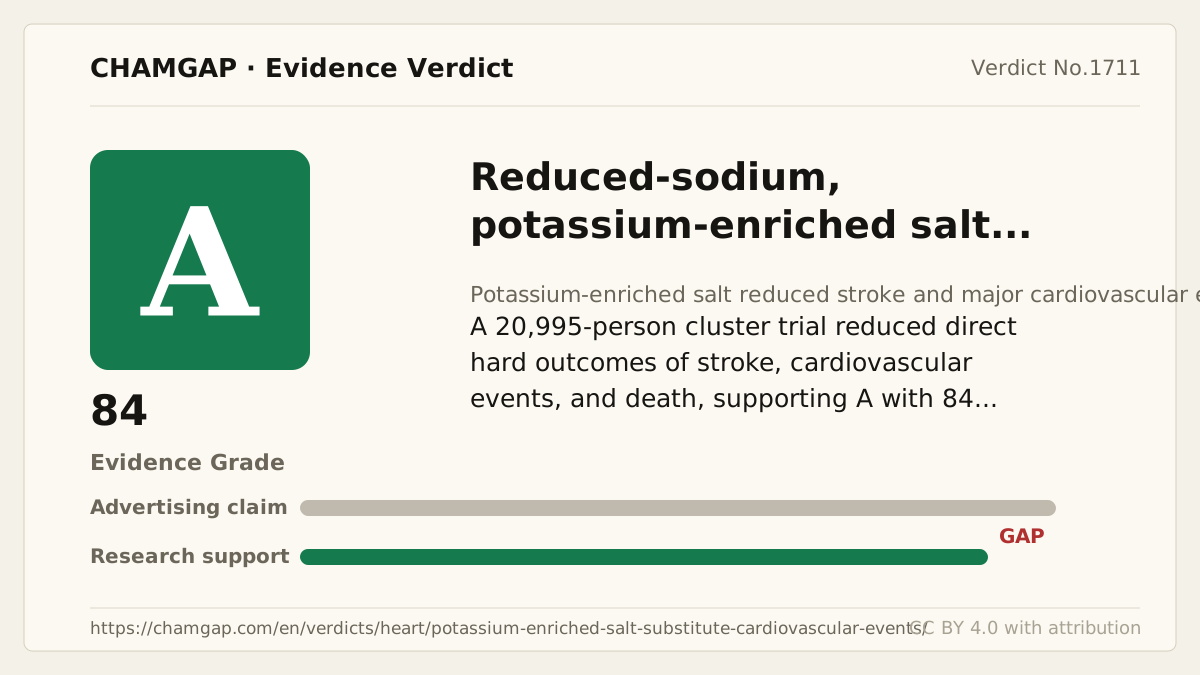
The primary hard stroke endpoint succeeded in an intention-to-treat analysis of all 20,995 participants, with concordant reductions in major cardiovascular events and all-cause death, supporting A with 84 points. The trial was open-label and cluster randomized and was limited to a high-risk rural Chinese population with prior stroke or poorly controlled hypertension, restricting generalizability to the general population.
Counterpoint. For high-risk adults who use substantial discretionary salt and have no hyperkalemia risk, this can be a low-cost prevention option.
Rejudgment record. Cross-check applied — A cluster-randomized trial of 600 villages and 20,995 participants used intention-to-treat analysis with a village random intercept for clustering; primary stroke rates were 29.14 versus 33.65 per 1,000 person-years, RR 0.86 (95% CI 0.77 to 0.96), and funding was primarily public support from the Australian NHMRC. It was open-label and limited to a high-risk rural Chinese population with prior stroke or poorly controlled hypertension, restricting generalizability to the general population.
Sub-claim grades by effect
This ingredient is marketed for several effects. A single overall grade blends strong and weak claims together, so each effect is graded separately here. The overall grade reflects the strongest disconfirming or core claim.
| Effect (sub-claim) | Grade | Basis |
|---|---|---|
| Reduced stroke | A | The prespecified primary endpoint succeeded in all 20,995 randomized participants. |
| Reduced major cardiovascular events | A | SSaSS reported a rate ratio of 0.87 with P<0.001. |
| Reduced all-cause mortality | A | SSaSS and the meta-analysis showed concordant reductions. |
Cross-check — AI research and Codex final gate
Evidence Table
| Study | Design | Sample | Funding | Endpoint | Result | Weight |
|---|---|---|---|---|---|---|
| Neal B et al. 2021 | Open-label cluster-randomized controlled trial | 600 villages and 20,995 randomized; all 20,995 analyzed by cluster intention to treat | Public funding from the Australian NHMRC; Jiangsu Sinokone Technology donated trial salt in some years, while investigators purchased it in others | Prespecified primary endpoint: stroke | Primary endpoint succeeded: 29.14 versus 33.65 per 1,000 person-years, rate ratio 0.86 (95% CI 0.77 to 0.96), P=0.006. | Pivotal large hard-outcome evidence |
| Yin X et al. 2022 | Systematic review and meta-analysis of randomized trials | 21 trials and 31,949 participants; clinical outcomes in 5 trials and 24,306 participants | No specific funding declared | Cardiovascular events, cardiovascular mortality, and all-cause mortality | Risk ratios were 0.89, 0.87, and 0.89, respectively, although SSaSS dominated event data. | Supportive synthesis that also shows reliance on one trial |
| Chang HY et al. 2006 | Cluster-randomized controlled trial by kitchen unit in a Taiwanese veterans' retirement home | Five kitchens cluster-randomized into two groups; 1,981 elderly men analyzed (768 intervention, 1,213 control) over about 31 months | Taiwan Salt Work Company and Academia Sinica per the article's acknowledgment, including salt-maker funding, with authors declaring no conflict of interest; a funding source distinct from the Australian NHMRC behind SSaSS | Cardiovascular mortality and medical expenditures | CVD mortality was 13.1 versus 20.5 per 1,000 person-years, age-adjusted hazard ratio 0.59 (95% CI 0.37 to 0.95), with CVD inpatient spending about 426 US dollars per year lower; no significant reduction in all-cause mortality was shown. | Independent replication by different investigators and funders, limited by five clusters and an elderly male institutional setting |
Receipt — 3 References
All 3 cited sources were verified for existence at the original page (as of 2026-08-11).
Final verification and publication gate: Codex · Evidence date: 2026-08-11 · Corrections: none
Cite this verdict
[Chamgap] Potassium-enriched salt substitute x reduced stroke and cardiovascular events — Evidence Grade A·84. 3 cited sources checked. Source: https://chamgap.com/en/verdicts/heart/potassium-enriched-salt-substitute-cardiovascular-events/ · CC BY 4.0CC BY 4.0 — free to use with attribution; do not distort grades, numbers, or verdict meaning.
What this document does and does not do
Chamgap is an information source. It reports what research has and has not confirmed; it does not tell readers what to take or buy. That decision belongs to readers and, when needed, medical or legal professionals. This verdict reflects literature available up to the search date and may change as new research appears. Nothing here is medical advice.