
Oral single-ingredient vitamin B6 and stroke prevention in adults at risk
research showsA stroke-preventive benefit of oral single-ingredient B6 has not been demonstrated. Human trials with genuine monotherapy arms exist, but uncertainty is not proof of zero effect or equivalence.
ads claimThis assessment does not support advertising homocysteine reduction, higher PLP, combined-B-vitamin effects or dietary associations as isolated B6 stroke prevention.
Four separate assessment dimensions
| Effect direction and size | NORVIT pure-arm22/934 versus27/943 and WENBIT20/771 versus19/779 do not establish preventive benefit. Factorial HRs are not relabeled pure-monotherapy effects; neither zero effect nor equivalence is established. |
|---|---|
| Evidence certainty | Low/limited: stroke is a component/secondary outcome, with sparse events, multiplicity, post-hoc four-arm comparison and unreported pure-arm time-to-event CIs. Same-cohort pooling is not independent replication. |
| Applicability | Mainly high-risk recent-MI/coronary-angiography adults receiving40mg/day pyridoxine hydrochloride. First-ever stroke, post-stroke recurrence, diagnosed deficiency, PLP/renal strata and other forms remain distinct unscored boundaries. |
| Safety | Caution: official peripheral-neuropathy warnings and combined exposure from multiple products are retained. Absence of reported serious events is not verified safety; research doses are not dosing instructions. |
Supplied calculator B/H/R1/I1/E0/B1/C0 -> D; H and big_hard_rct supply2 strengths, mapped to the fixed34-point anchor. Not a probability, official GRADE rating or individual treatment benefit.
Useful facts when choosing a product
- NORVIT/WENBIT: pyridoxine hydrochloride, reported as40mg/day B6; no invented active-mass conversion.
- Surgical PLP-monohydrate250/750mg regimens have separate formulation, duration and route; not equivalent doses.
Chamgap Semantic Classification Code
Permanent code issued
S.vitamin-b6-stroke-core-pyridoxine-single.oral.stroke-risk-adults-coronary-history-specific.new-stroke-incidence.stroke-study-specific-placebo-factorial-active-separatedSupplements and nutraceuticals > Core pyridoxine-hydrochloride monotherapy; perioperative PLP separate > Recent-MI/coronary-disease risk adults with mixed previous cerebrovascular history > Oral single-ingredient B6 and new stroke > Actual placebo for core pure arms; factorial and active-low-dose combination contrasts separate > Oral; IV-substitution study is indirect
Technical binding of unchanged ChatGPT D/34, Caution and oral single-B6/stroke/actual-comparator boundaries. The code identifies the intervention and claim; it never contains the evidence grade, score, or safety result.
Exact Claim Classification
These independent facets prevent evidence from different forms, routes, populations, effects, and comparators from being mixed.
| Intervention class | S · Supplement or nutraceutical |
|---|---|
| Canonical ingredient or intervention | Vitamin B6 |
| Source or part used | Purified nutrient; botanical species/part not applicable |
| Formulation or processing | Core pyridoxine-hydrochloride monotherapy; perioperative PLP separate |
| Route | Oral; IV-substitution study is indirect |
| Dose | Core research40mg/day B6; not a personal recommendation |
| Duration | NORVIT median40-month and WENBIT38.4-month follow-up; actual exposure/stopping separate |
| Population | Recent-MI/coronary-disease risk adults with mixed previous cerebrovascular history |
| Effect or condition | Oral single-ingredient B6 and new stroke |
| Primary endpoint | Page: new stroke; distinct from trial primary composites |
| Comparator | Actual placebo for core pure arms; factorial and active-low-dose combination contrasts separate |
| Duplicate-detection key | S|vitamin-b6|single-ingredient|oral|adults-at-stroke-risk|incident-stroke|placebo-or-actual-control |
What the research actually shows
Actual B6-only and placebo arms were verified in NORVIT and WENBIT, with the factorial B6-assignment effects extracted separately. Their pooled reanalysis, surgical PLP trials, combined-B-vitamin trials and dietary/circulating or genetic associations were kept in distinct evidence layers. Pure-arm event counts are available, but a confirmatory time-to-event confidence interval for the isolated monotherapy contrast was not verified.
Why this is classified as D (34)
Supplied calculator B/H/R1/I1/E0/B1/C0 -> D; H and big_hard_rct supply2 strengths, mapped to the fixed34-point anchor. Not a probability, official GRADE rating or individual treatment benefit.
Counterpoint. The complete reason for165 original-table versus181 pooled stroke cases remains unconfirmed. Pure-arm time-to-event CIs, fixed-time risks and MCID are unverified. Access gaps do not establish no effect or no human research.
Rejudgment record. Benefit not demonstrated; not statistical equivalence — Supplied calculator B/H/R1/I1/E0/B1/C0 -> D; H and big_hard_rct supply2 strengths, mapped to the fixed34-point anchor. Not a probability, official GRADE rating or individual treatment benefit.
| Claim type | B | B: a clinical efficacy claim about oral single-ingredient B6 and new stroke, not a mechanistic or safety-only statement. |
| Endpoint | H | Hard endpoint - actual events such as death Case application: H: adjudicated clinical stroke; not PLP, homocysteine or a cardiovascular composite. |
| Replication | R1 | Single confirmatory trial Case application: R1: NORVIT and WENBIT share investigators/funding and differ in acute-MI versus mainly stable-CAD populations; R2 independence is not established. Their CIs include each other's point estimates, so R0 is unwarranted. Surgical PLP, combinations and observational studies are not merged as same-indication RX. This is a conservative vocabulary mapping, not a claim that only one physical trial exists. |
| Independence | I1 | Mixed funding sources Case application: I1: public/nonprofit support coexists with Alpharma product support and some funding; MC-1 II was Medicure-sponsored. Unverified funding is not called independent. |
| Effect size | E0 | Null Case application: E0: under the supplied rubric, a preventive benefit has not been demonstrated in the verified randomized clinical comparisons. This does not mean exactly zero effect, equivalence or ineffectiveness of every form/deficiency treatment. Pure-arm events and factorial CIs are kept separate; no E+ or E- is manufactured. |
| Precision | C0 | The confidence interval leaves room for benefit Case application: C0: factorial CIs 0.54-1.20 and 0.54-1.40, plus the same-cohort pooled CI 0.57-1.02, leave room for benefit. Pure-arm time-to-event CIs are not reported. No verified between-group importance threshold is invented to justify C1 or F. |
Stored derived and displayed grades match; this is not a current recalculation or validity check (D).
Review performed and remaining limitations
The complete reason for165 original-table versus181 pooled stroke cases remains unconfirmed. Pure-arm time-to-event CIs, fixed-time risks and MCID are unverified. Access gaps do not establish no effect or no human research.
Evidence Table
| Study | Design | Sample | Funding | Endpoint | Result | Weight |
|---|---|---|---|---|---|---|
| Bonaa et al. Homocysteine lowering and cardiovascular events after acute myocardial infarction. NEJM 2006;354:1578-1588. | Double-blind 2 x 2 factorial RCT with a true B6-only arm | 3749 randomized; B6-only 934, placebo 943 | Public/nonprofit Norwegian support plus free Alpharma capsules/randomization; disclosed Nycomed consulting. Not wholly manufacturer-only and not fully independent. | Fatal/nonfatal stroke, separate from the primary composite | 22/934 versus 27/943; factorial Cox-derived ratio 0.81 (0.54-1.20), not pure-arm HR | Core direct arms; secondary stroke is imprecise and factorial estimand differs |
| Ebbing et al. Mortality and cardiovascular events in patients treated with homocysteine-lowering B vitamins after coronary angiography. JAMA 2008;300:795-804. | Double-blind 2 x 2 factorial RCT; four-arm comparisons post hoc | 3096 randomized,3090 analyzed after 6 consent withdrawals; B6-only 771,placebo 779 | Public/university/nonprofit support; Alpharma supplied medication and a limited initial grant and performed randomization; Nycomed consulting disclosed. | Total fatal/nonfatal stroke including hemorrhagic; first event/category | 20/771 versus 19/779; factorial HR0.87 (0.54-1.40), P=.56 | Core direct arms; mixed stroke history, early termination and unadjusted multiplicity |
| Ebbing et al. Combined analyses and extended follow-up of two randomized controlled homocysteine-lowering B-vitamin trials. J Intern Med 2010;268:367-382. | Pooled reanalysis and mortality follow-up of the same two RCTs | 6837 analyzed;6845 randomizations minus 6 withdrawals and 2 dual-trial participants | Same trial-support program as NORVIT/WENBIT; not a new independent source of funding or participants. | In-trial total stroke; extended follow-up outcome is cardiovascular mortality only | Factorial HR0.76 (0.57-1.02), P=.07;181 cases differs from original-table sum 165 | Contextual reanalysis, no additional independent trial weight; source-count discrepancy retained |
| Tardif et al. Effects of pyridoxal-5-prime-phosphate (MC-1) in patients undergoing high-risk coronary artery bypass surgery. J Thorac Cardiovasc Surg 2007;133:1604-1611. | Phase 2 randomized double-blind oral PLP-monohydrate placebo-controlled trial; abstract only | 901 high-risk CABG patients; arm-specific stroke denominators unavailable in accessed abstract | Exact trial funding unconfirmed: accessed primary abstract has no funding statement and publisher full-text route failed. Manufacturer identity alone is not a verified funding declaration. | Prespecified death/nonfatal cerebral infarction/nonfatal MI composite at 30 days | 250 mg/day composite relative reduction 14.0%, P=.3124; isolated stroke estimate unconfirmed | Separate oral vitamer/surgical stratum; positive MI-threshold analyses are not stroke efficacy |
| MEND-CABG II Writing Group. Efficacy and safety of pyridoxal 5-prime-phosphate (MC-1) in high-risk patients undergoing CABG. JAMA 2008;299:1777-1787. | Phase 3 double-blind placebo RCT of PLP; IV substitution allowed and used | 3023 randomized:1519/1504; day 30 stroke denominators 1510/1486 | Medicure International sponsored and participated in design/conduct/data management/interpretation/manuscript review; employee author and research relationships disclosed; academic statistical analysis. | Nonfatal stroke at 30 days, not the primary death/MI composite | 24/1510 versus 25/1486, P=.83; no reported isolated-stroke HR/CI copied from composite | Indirect for strictly oral chronic prevention; manufacturer-funded, surgical setting |
| Saposnik et al. Homocysteine-lowering therapy and stroke risk, severity, and disability: additional findings from HOPE 2. Stroke 2009;40:1365-1372. | Stroke-outcome analysis of a randomized combined-vitamin trial | 5522 adults;258 people with stroke over mean 5 years | Exact funding of this stroke reanalysis unconfirmed: primary abstract does not provide a funding declaration; no other trial funding copied. | Total stroke and nonfatal stroke; disability is a different outcome | Total-stroke HR0.75 (0.59-0.97); rates 0.88 vs 1.15/100 person-years | Relevant positive counterevidence for a combination, not isolated B6 efficacy |
| Toole et al. Lowering homocysteine in patients with ischemic stroke to prevent recurrent stroke, myocardial infarction, and death. JAMA 2004;291:565-575. | Double-blind high- versus low-dose three-vitamin RCT after ischemic stroke | 3680 randomized;stroke analysis 1814 high-dose/1835 low-dose;31 had no follow-up | Specific grant attribution not confirmed in the funding information retrieved from the accessible article; not labeled independent solely because a university conducted it. | Recurrent ischemic stroke;2-year Kaplan-Meier risk | 152/1814 vs 148/1835;KM9.2% vs 8.8%;adjusted HR1.1 (0.8-1.3) | Combination-dose strategy; neither placebo nor isolated B6 treatment |
| VITATOPS Trial Study Group. B vitamins in patients with recent TIA or stroke in VITATOPS. Lancet Neurol 2010;9:855-865. | Randomized double-blind combined-B-vitamin versus placebo trial; primary abstract | 8164 randomized;4089 vitamins,4075 placebo;median 3.4 years | Abstract lists Australian NHMRC, UK MRC, Singapore biomedical/national medical councils, Australian Heart Foundation, Royal Perth Hospital foundation and Western Australian health department. | Primary composite of stroke,MI or vascular death | 616 vs 678;RR0.91 (0.82-1.00), P=.05;not isolated-stroke effect | Secondary-prevention combination context; full subtype/isolated-stroke extraction unavailable |
| Hankey et al. Antiplatelet therapy and the effects of B vitamins in patients with previous stroke/TIA: a post-hoc subanalysis of VITATOPS. Lancet Neurol 2012. | Post-hoc baseline-antiplatelet subgroup analysis of VITATOPS | 6609 baseline users and 1463 nonusers;8072 classified,not all 8164 | Indexed UK MRC grant G0200583; full reanalysis funding declaration not accessible through the PMC route (captcha); parent-trial funding not substituted as complete reanalysis disclosure. | Major vascular composite by baseline antiplatelet strata | Treatment interactions are not randomized antiplatelet withdrawal and not isolated B6 efficacy | Same parent cohort, no independent replication weight; no medication-change advice |
| Dietary vitamin B6 intake and stroke are negatively associated in adults: A cross-sectional study from the NHANES. Heliyon 2024; e31125. | Cross-sectional dietary-recall study, not an intervention | 24214 adults;921 reported previous stroke | Article states no specific funding and no declared competing interests. | Prevalent self-reported stroke, not prospective incidence | Highest vs lowest dietary quartile adjusted OR0.48 (0.35-0.66) | Association only; no supplemental B6 causal effect or NNT |
| Homocysteine, B vitamins, and cardiovascular disease: a Mendelian randomization study. BMC Medicine 2021. | Summary-data Mendelian randomization using 1 B6 instrument | Outcome-specific GWAS samples from consortia/UK Biobank/FinnGen;not one randomized treatment sample | EC Innovative Medicines Initiative (BigData@Heart), Wellcome Trust/Royal Society fellowship, Karolinska research foundation, Swedish Forte and Research Council, and Swedish Heart-Lung Foundation; authors state funders had no study or publication role and no competing interests. Outcome-consortium funding is separately acknowledged. | Ischemic stroke per 1-SD genetically predicted circulating B6 | OR0.88 (0.81-0.97),P=.009;not significant after multiple-testing correction | Hypothesis-supporting association,not pill-dose or isolated oral efficacy evidence |
Receipt — 15 References
Evidence access cutoff: 2026-09-17. Each citation states its actual access level (full-text transcription, abstract, index, or other) and remaining limitations. Bibliographic checking does not certify the study results or treatment efficacy.
Technical integration by: Codex · Evidence date: 2026-09-17 · Corrections: none
Cite this verdict
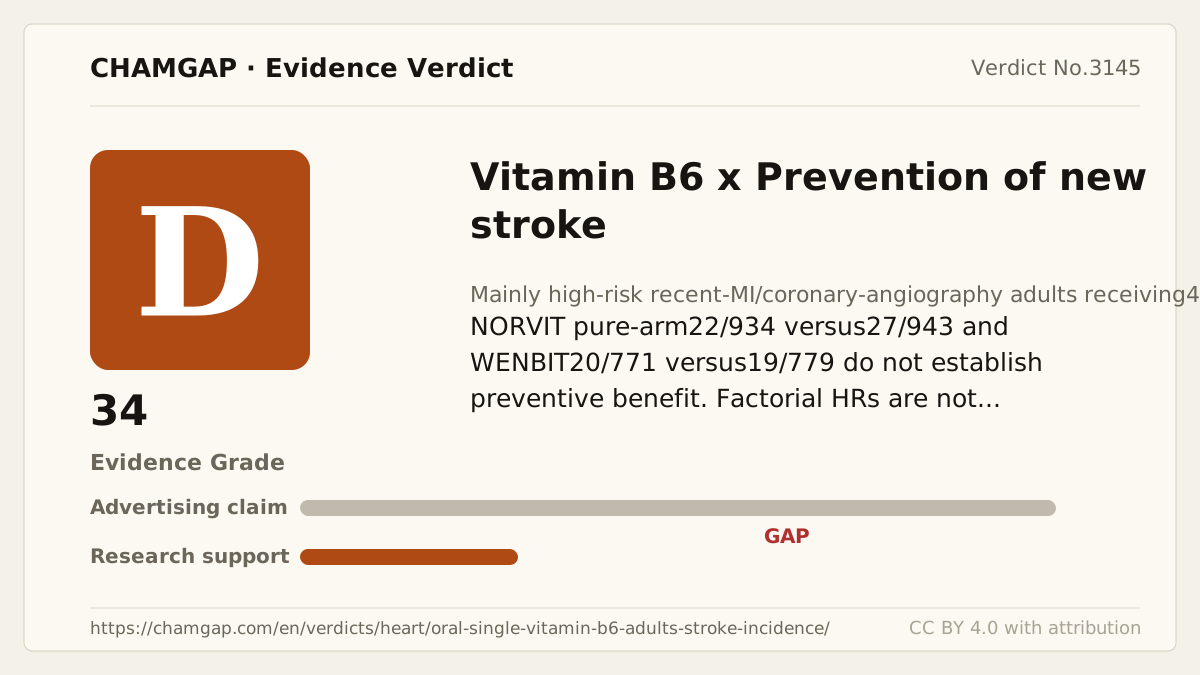
[Chamgap] Oral single-ingredient vitamin B6 and stroke prevention in adults at risk — Evidence Grade D·34. 15 cited sources checked. Source: https://chamgap.com/en/verdicts/heart/oral-single-vitamin-b6-adults-stroke-incidence/ · CC BY 4.0CC BY 4.0 — free to use with attribution; do not distort grades, numbers, or verdict meaning.
What this document does and does not do
Chamgap is an information source. It reports what research has and has not confirmed; it does not tell readers what to take or buy. That decision belongs to readers and, when needed, medical or legal professionals. This verdict reflects literature available up to the search date and may change as new research appears. Nothing here is medical advice.