
Simvastatin,
does it really help with Reduced myocardial infarction, stroke, and vascular death in people at high cardiovascular risk?
research showsSimvastatin is rated A because it reduces major vascular events such as myocardial infarction and stroke, as well as coronary death, in people at high cardiovascular risk. HPS enrolled 20,536 high-risk participants and reduced major vascular events from 25.2% to 19.8% over about five years, while 4S enrolled 4,444 patients with coronary disease and reduced all-cause mortality by 30% and coronary mortality by 42% in relative terms. Consistent reductions in events and death, rather than only surrogate measurements, across distinct large randomized trials satisfy the strong, replicated, direct-clinical-endpoint standard. This verdict applies to patients already at high risk and does not assign the same absolute benefit to every low-risk adult.
ads claimMarketing or simplified explanations can imply that lowering cholesterol gives everyone the same protection from heart disease. Absolute benefit actually depends on baseline cardiovascular risk, treatment duration, dose, interacting medicines, and adherence, and the direct population for this verdict is people at high cardiovascular risk.
Useful facts when choosing a product
- Simvastatin is a prescription HMG-CoA reductase inhibitor, and Zocor is a well-known brand. The prescriber selects the dose according to indication, LDL cholesterol, interacting medicines, and kidney and liver status.
- Multiple generic products contain simvastatin, but patients should not change the dose or exchange the same milligram amount for another statin on their own. The clinical outcome evidence assumes an appropriate ingredient, dose, and sustained use rather than a claimed quality advantage of one tablet.
- Strong CYP3A4 inhibitors and some lipid-lowering and anti-infective medicines can increase simvastatin exposure and muscle toxicity. New muscle pain or weakness, dark urine, or jaundice requires prompt contact with the prescriber, and use during pregnancy requires a separate clinical decision.
- Muscle symptoms and liver-enzyme elevations can occur, and rhabdomyolysis is rare but potentially serious; the statin class also carries a small signal for new-onset diabetes. These risks should be weighed separately against the demonstrated reduction in cardiovascular events in high-risk patients.
Chamgap Semantic Classification Code
Candidate index · review held
M.simvastatin.UNK.myocardial-infarction-stroke-and-vascular-death-at-high-cardiovascular-risk.reduce.placeboMedicinal interventions > Simvastatin > Unknown > myocardial infarction, stroke, and vascular death at high cardiovascular risk > Reduction claim > Placebo
An automated migration candidate, not an issued permanent code; exact claim scope remains under review. This machine-generated migration candidate helps retrieval but is not a permanent assignment. The original verdict ID and URL remain authoritative.
What the research actually shows
The MRC/BHF Heart Protection Study randomized 20,536 people with coronary disease, other occlusive arterial disease, or diabetes to simvastatin 40 mg or placebo. Over about five years, major vascular events fell from 2,585 participants (25.2%) to 2,033 (19.8%), and all-cause mortality fell from 14.7% to 12.9%. The 4S trial followed 4,444 people with angina or previous myocardial infarction for a mean of 5.4 years and found relative reductions of 30% in all-cause mortality, 42% in coronary mortality, and 34% in major coronary events. These trials directly measured deaths and clinical events, not only the surrogate of LDL lowering.
Why this is classified as A (92)
HPS with 20,536 participants and 4S with 4,444 participants consistently reproduced reductions in direct clinical outcomes including myocardial infarction, stroke, coronary death, and all-cause death. Large randomized samples, long follow-up, independent event assessment, and strong academic and public leadership support A with 92 points. LDL lowering is only a supporting surrogate; the grade rests on events and mortality, while safety remains separate.
Counterpoint. Absolute benefit is large in high-risk patients, but individual risk, the choice among statins, interactions, and tolerability still matter. Stopping a prescription without guidance removes the sustained exposure on which the trial benefit depended.
Rejudgment record. New verdict — Applied grade A because HPS with 20,536 participants and 4S with 4,444 participants consistently reproduced reductions in direct clinical outcomes including major vascular events, coronary death, and all-cause death, meeting the strong, consistent, independently governed large-RCT and direct-endpoint standard
Sub-claim grades by effect
This ingredient is marketed for several effects. A single overall grade blends strong and weak claims together, so each effect is graded separately here. The overall grade reflects the strongest disconfirming or core claim.
| Effect (sub-claim) | Grade | Basis |
|---|---|---|
| Reduced myocardial infarction, stroke, and vascular death in high-risk patients | A | HPS and 4S reproduced reductions in direct events and death at large scale. |
| The surrogate outcome of lower LDL cholesterol | ? | LDL lowering is well established but is a supporting surrogate rather than an independently graded efficacy claim in this verdict. |
| The same absolute benefit in low-risk primary prevention or every adult | ? | This broad generalization was not directly tested by the high-risk HPS and 4S populations. |
Cross-check — AI research and Codex final gate
Evidence Table
| Study | Design | Sample | Funding | Endpoint | Result | Weight |
|---|---|---|---|---|---|---|
| MRC/BHF Heart Protection Study Collaborative Group. 2002 | Large randomized double-blind placebo-controlled trial | 20,536 adults at high cardiovascular risk | Supported by the MRC, British Heart Foundation, Merck, and Roche Vitamins; academically and publicly led | All-cause and cause-specific mortality and first major vascular event | Major vascular events fell from 25.2% to 19.8%, and all-cause mortality fell from 14.7% to 12.9%. | Top-tier direct hard-outcome evidence |
| Scandinavian Simvastatin Survival Study Group. 1994 | Multicenter randomized double-blind placebo-controlled trial | 4,444 patients with coronary heart disease | Supported by Merck, with independent endpoint classification and safety monitoring | All-cause death, coronary death, and major coronary events | Relative reductions were 30% for all-cause death, 42% for coronary death, and 34% for major coronary events. | Large replicated hard-outcome evidence |
Receipt — 2 References
All 2 cited sources were verified for existence at the original page (as of 2026-07-19).
Final verification and publication gate: Codex · Evidence date: 2026-07-19 · Corrections: none
Cite this verdict
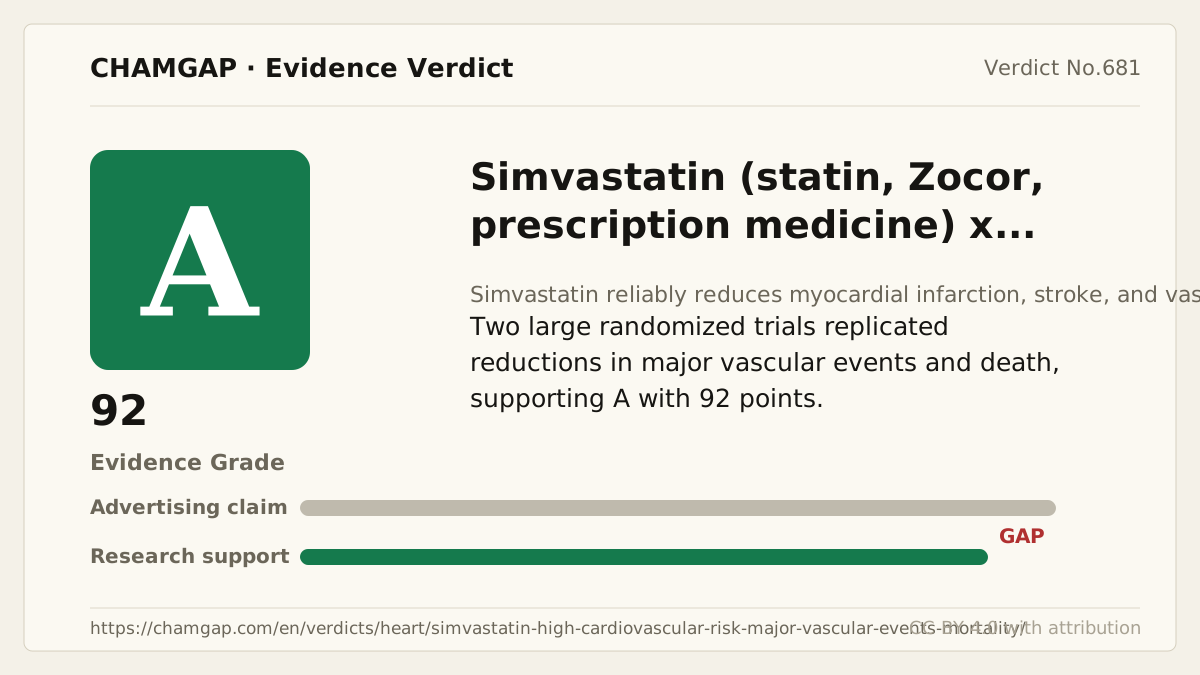
[Chamgap] Simvastatin x reduced major vascular events and vascular death in high-risk patients — Evidence Grade A·92. 2 cited sources checked. Source: https://chamgap.com/en/verdicts/heart/simvastatin-high-cardiovascular-risk-major-vascular-events-mortality/ · CC BY 4.0CC BY 4.0 — free to use with attribution; do not distort grades, numbers, or verdict meaning.
What this document does and does not do
Chamgap is an information source. It reports what research has and has not confirmed; it does not tell readers what to take or buy. That decision belongs to readers and, when needed, medical or legal professionals. This verdict reflects literature available up to the search date and may change as new research appears. Nothing here is medical advice.