
Lisinopril,
does it really help with Reduced early mortality and severe ventricular dysfunction after acute myocardial infarction?
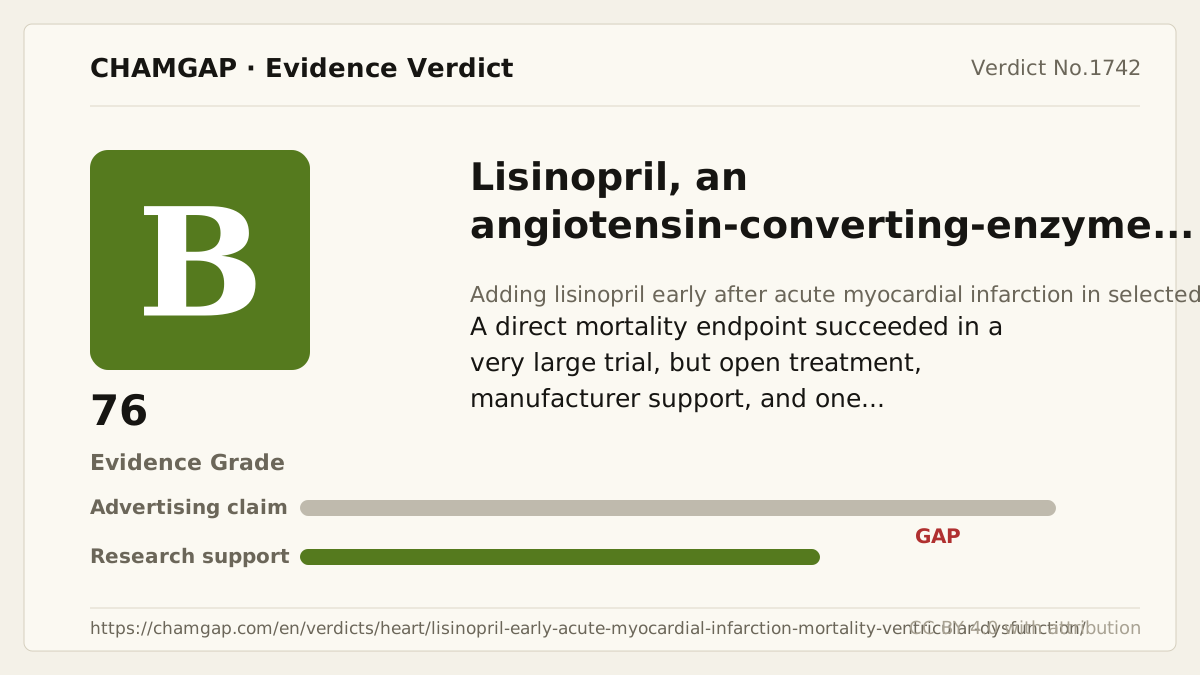
research showsLisinopril started within 24 hours of acute myocardial infarction is rated B because it modestly reduces six-week mortality and the composite of death or severe ventricular dysfunction. GISSI-3 randomized 19,394 patients, with complete six-week follow-up available for the actual clinical analysis in 18,895. Both co-key outcomes succeeded, with odds ratios of 0.88 for death and 0.90 for the composite. Ingredient-specific evidence is concentrated in one open trial, the absolute mortality difference was about 0.8 percentage points, and manufacturers supported the study, giving 76 points.
ads claimPromotion can imply that every infarction patient should take lisinopril immediately for a large survival benefit. The absolute benefit was small, and clinicians must assess blood pressure, renal function, potassium, and shock while adding it to reperfusion and antithrombotic care.
Useful facts when choosing a product
- Lisinopril is a prescription inhibitor that requires monitoring of blood pressure, kidney function, and potassium in acute myocardial infarction.
- It is contraindicated in pregnancy and can cause hypotension, kidney deterioration, hyperkalemia, dry cough, and rare angioedema.
- Concomitant renin-angiotensin blockers, potassium products, potassium-sparing diuretics, and nonsteroidal anti-inflammatory drugs require interaction review.
Chamgap Semantic Classification Code
Candidate index · review held
UNK.lisinopril.UNK.early-mortality-and-severe-ventricular-dysfunction-after-acute-myocardial-infarction.reduce.MULTIUnknown > Lisinopril > Unknown > early mortality and severe ventricular dysfunction after acute myocardial infarction > Reduction claim > Multiple: primary unresolved
An automated migration candidate, not an issued permanent code; exact claim scope remains under review. This machine-generated migration candidate helps retrieval but is not a permanent assignment. The original verdict ID and URL remain authoritative.
What the research actually shows
GISSI-3 assigned 19,394 patients within 24 hours of acute myocardial-infarction symptoms in a 2-by-2 factorial design to lisinopril or open control and nitrate or control. The actual six-week clinical analysis included 18,895 patients with complete follow-up, while echocardiographic data were available for 14,209. Six-week mortality was 6.3% versus 7.1%, OR 0.88, and the death-or-severe-ventricular-dysfunction composite also succeeded at OR 0.90. ISIS-4 supported the small early mortality benefit for the drug class, whereas CONSENSUS-II was null. The absolute survival benefit was about 0.8 percentage points.
Why this is classified as B (76)
Success of direct mortality and composite co-key outcomes in the 19,394-patient GISSI-3 trial is strong, but the actual clinical follow-up analysis included 18,895, and open treatment, manufacturer support, a small absolute effect, and limited ingredient-specific independent replication give B with 76 points.
Counterpoint. For eligible stable patients, the small survival benefit of adding an early inhibitor to standard infarction care remains clinically meaningful.
Rejudgment record. Cross-check applied — Success of a direct mortality co-key endpoint in the very large GISSI-3 trial, tempered by open control, small absolute benefit, manufacturer support, and limited independent ingredient-specific replication
Sub-claim grades by effect
This ingredient is marketed for several effects. A single overall grade blends strong and weak claims together, so each effect is graded separately here. The overall grade reflects the strongest disconfirming or core claim.
| Effect (sub-claim) | Grade | Basis |
|---|---|---|
| Reduced six-week mortality | B | The GISSI-3 co-key endpoint succeeded with an odds ratio of 0.88. |
| Reduced composite of death or severe ventricular dysfunction | B | The co-key composite succeeded with an odds ratio of 0.90. |
| Sustained prognostic benefit at six months | B | After treatment withdrawal, the six-month composite remained favorable at 18.1% versus 19.3%. |
Cross-check — AI research and Codex final gate
Evidence Table
| Study | Design | Sample | Funding | Endpoint | Result | Weight |
|---|---|---|---|---|---|---|
| GISSI-3 Investigators. 1994 | Multicenter open randomized 2-by-2 factorial trial | 19,394 randomized; 18,895 in the actual six-week clinical analysis; 14,209 with echocardiography | Zeneca supplied lisinopril, Schwarz Pharma supplied nitrates, and both companies provided financial support | Co-key outcomes of six-week mortality and death or severe ventricular dysfunction | Both key outcomes succeeded: mortality OR 0.88 (95% CI 0.79 to 0.99) and composite OR 0.90 (0.84 to 0.98). | Pivotal direct ingredient-specific evidence |
| ISIS-4 Collaborative Group. 1995 | Large randomized placebo-controlled 2-by-2-by-2 factorial trial | 58,050 randomized and analyzed by intention to treat | Industry drug and research support with multicenter academic collaboration; captopril trial | Primary comparison of five-week vascular mortality | Supported a small early mortality reduction for the inhibitor class, but did not specifically test lisinopril. | Large class-level replication with indirectness |
Receipt — 2 References
All 2 cited sources were verified for existence at the original page (as of 2026-07-24).
Final verification and publication gate: Codex · Evidence date: 2026-07-24 · Corrections: none
Cite this verdict
[Chamgap] Lisinopril x improved early outcomes after acute myocardial infarction — Evidence Grade B·76. 2 cited sources checked. Source: https://chamgap.com/en/verdicts/heart/lisinopril-early-acute-myocardial-infarction-mortality-ventricular-dysfunction/ · CC BY 4.0CC BY 4.0 — free to use with attribution; do not distort grades, numbers, or verdict meaning.
What this document does and does not do
Chamgap is an information source. It reports what research has and has not confirmed; it does not tell readers what to take or buy. That decision belongs to readers and, when needed, medical or legal professionals. This verdict reflects literature available up to the search date and may change as new research appears. Nothing here is medical advice.