
Job strain,
does it really help with Increased incidence of coronary heart disease?
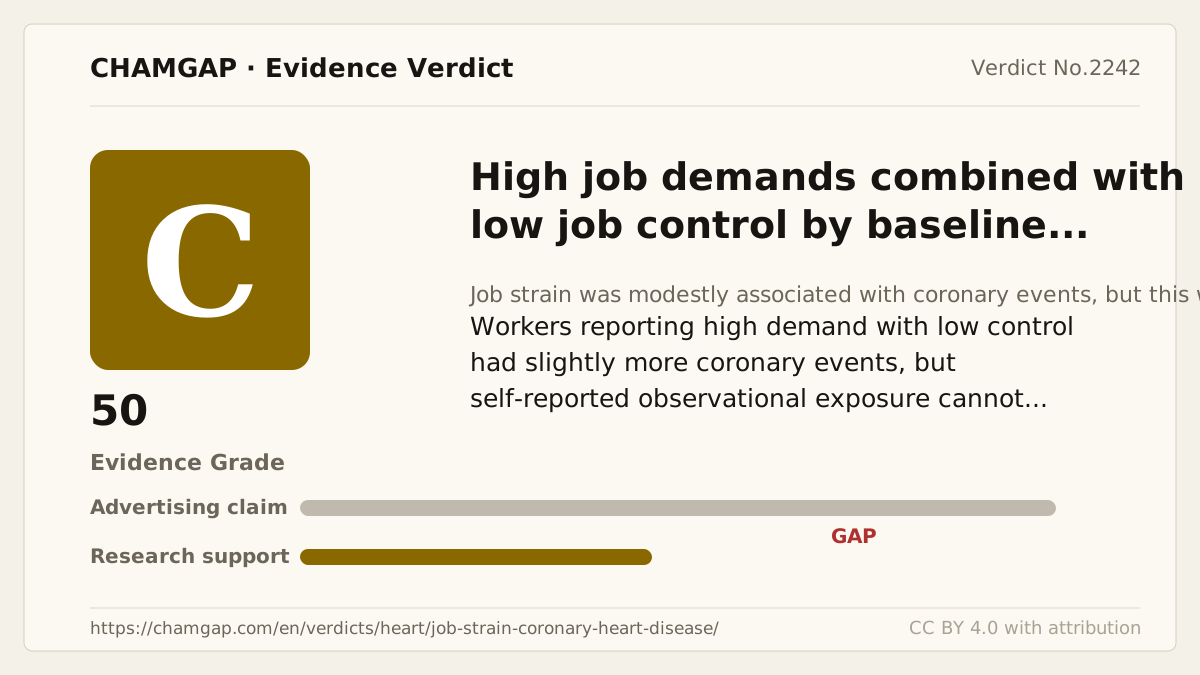
research showsThe grade is C with 54 points. Across 13 European cohorts and 197,473 workers, 2,358 coronary events occurred over 7.5 years mean follow-up. Job strain had age- and sex-adjusted HR 1.23 (95% CI 1.10 to 1.37) and socioeconomic-status-adjusted HR 1.17 (1.05 to 1.31). The adjusted excess risk was only 17%, so the effect size was classified as small. Exposure was a baseline questionnaire classification, not a workplace-redesign trial.
ads claimAn association between questionnaire-defined strain and heart disease does not prove that a particular culture program prevents events.
Useful facts when choosing a product
- High demand and low control used study-specific median cutoffs.
- Thirteen cohorts contributed 197,473 workers, 1,488,728 person-years, and 2,358 events.
- Exposure was baseline self-report; harmonization preceded outcome linkage.
Chamgap Semantic Classification Code
Candidate index · review held
UNK.high-job-demands-combined-with-low-job-control-by-baseline-questionnaire.UNK.incidence-of-coronary-heart-disease.increase.UNKUnknown > High job demands combined with low job control by baseline questionnaire > Unknown > incidence of coronary heart disease > Increase claim > Unknown
An automated migration candidate, not an issued permanent code; exact claim scope remains under review. This machine-generated migration candidate helps retrieval but is not a permanent assignment. The original verdict ID and URL remain authoritative.
What the research actually shows
IPD-Work harmonized Job Content Questionnaire and Demand-Control Questionnaire items in 13 cohorts. Demand above and control below each study's median defined strain. Scale correlations with full versions exceeded 0.9 except one at 0.8. Of 203,816 workers, 5,124 with missing data and 1,219 with baseline coronary disease were excluded, leaving 197,473. Verdict 2215 is C with 46 points for an individual mindfulness app and stress score, a different intervention and endpoint.
Why this is classified as C (54)
Hard events and lagged analyses are offset by the small adjusted HR of 1.17, questionnaire-defined observational exposure, and residual confounding, giving C with 54 points.
Counterpoint. Healthy workers leaving demanding jobs may bias risk downward, and lagging does not remove selection into employment.
Rejudgment record. Cross-check applied — Original scale definitions, 13-cohort event counts, lagged analyses, and socioeconomic and behavioral adjustments
| Endpoint | H | Hard endpoint - actual events such as death |
| Replication | R1 | Single confirmatory trial |
| Independence | I2 | Decisive evidence is publicly or non-profit funded |
| Effect size | E~ | Statistically positive but below the threshold |
Stored derived and displayed grades match; this is not a current recalculation or validity check (C).
Sub-claim grades by effect
This ingredient is marketed for several effects. A single overall grade blends strong and weak claims together, so each effect is graded separately here. The overall grade reflects the strongest disconfirming or core claim.
| Effect (sub-claim) | Grade | Basis |
|---|---|---|
| Observed association between questionnaire-defined job strain and coronary disease | C | SES-adjusted HR was 1.17. |
| Increasing job control prevents coronary disease | ? | No organizational intervention tested coronary events. |
Cross-check — AI research and Codex final gate
Evidence Table
| Study | Design | Sample | Funding | Endpoint | Result | Weight |
|---|---|---|---|---|---|---|
| Kivimäki M et al. Lancet 2012 IPD-Work | Collaborative individual-data analysis of 13 prospective cohorts | 197,473 participants, 1,488,728 person-years, and 2,358 events | Public and nonprofit support including MRC, Wellcome Trust, NIH, and European agencies | Coronary death or first nonfatal myocardial infarction | Age- and sex-adjusted HR 1.23 (1.10-1.37); SES-adjusted 1.17 (1.05-1.31); excluding first three years 1.31 (1.15-1.48) | Core large observational event evidence |
Receipt — 1 References
All 1 cited sources were verified for existence at the original page (as of 2026-08-05).
Final verification and publication gate: Codex · Evidence date: 2026-08-05 · Corrections: none
Cite this verdict
[Chamgap] Job strain x incident coronary heart disease — Evidence Grade C·54. 1 cited sources checked. Source: https://chamgap.com/en/verdicts/heart/job-strain-coronary-heart-disease/ · CC BY 4.0CC BY 4.0 — free to use with attribution; do not distort grades, numbers, or verdict meaning.
What this document does and does not do
Chamgap is an information source. It reports what research has and has not confirmed; it does not tell readers what to take or buy. That decision belongs to readers and, when needed, medical or legal professionals. This verdict reflects literature available up to the search date and may change as new research appears. Nothing here is medical advice.