
IABP,
does it really help with Reduced 30-day mortality in acute myocardial infarction with cardiogenic shock undergoing early revascularization?
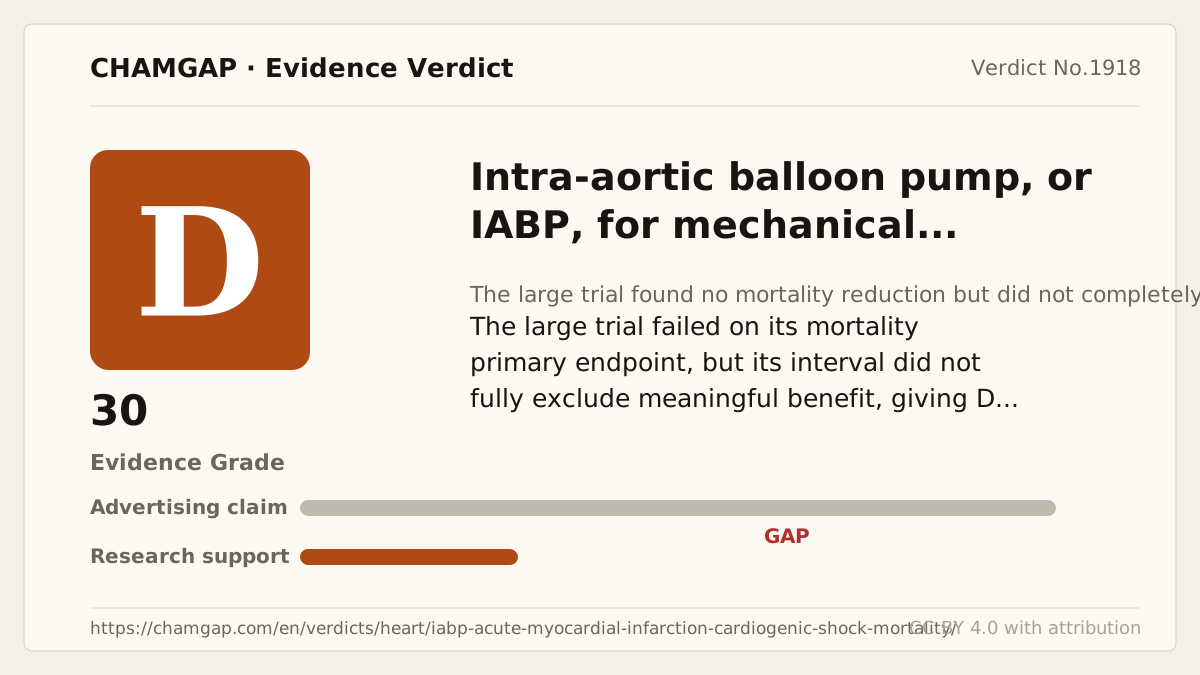
research showsThe grade is D. IABP-SHOCK II randomized 600 patients and analyzed 598 for the primary outcome. Thirty-day mortality was 119/300 (39.7%) versus 123/298 (41.3%), RR 0.96 (95% CI 0.79 to 1.17), P=0.69. One- and six-year follow-up also found no benefit, but the 30-day interval retained up to a 21% relative benefit, so this is D rather than F, with 30 points.
ads claimMechanical counterpulsation can support hemodynamics, but that physical action is not evidence of longer survival. Survival improvement was not established in this population.
Useful facts when choosing a product
- IABP-SHOCK II enrolled patients with acute myocardial infarction, cardiogenic shock, and planned early revascularization.
- The investigator-initiated trial combined public and academic funding with unrestricted grants from Maquet and Teleflex; the companies reportedly had no trial role.
- No existing verdict for the same IABP and myocardial-infarction shock mortality combination was identified.
Chamgap Semantic Classification Code
Candidate index · review held
UNK.intra-aortic-balloon-pump.UNK.mortality-in-acute-myocardial-infarction-with-cardiogenic-shock-undergoing-early-revascularization.reduce.UNKUnknown > Intra-aortic balloon pump > Unknown > mortality in acute myocardial infarction with cardiogenic shock undergoing early revascularization > Reduction claim > Unknown
An automated migration candidate, not an issued permanent code; exact claim scope remains under review. This machine-generated migration candidate helps retrieval but is not a permanent assignment. The original verdict ID and URL remain authoritative.
What the research actually shows
IABP-SHOCK II assigned 301 to IABP and 299 to control; the primary analysis included 300 versus 298. Treatment was open label, but mortality was objective and centrally adjudicated by a masked committee. At 12 months mortality was 52% versus 51%, RR 1.01 (95% CI 0.86 to 1.18), and at six years 66.3% versus 67.0%, RR 0.99 (0.88 to 1.11). These are follow-ups of the same cohort, not independent replication. An earlier 40-patient randomized trial focused on hemodynamics and lacked power to confirm mortality; its interval did not exclude the large-trial estimate, so it is not conflicting evidence either.
Why this is classified as D (34)
The large hard-outcome trial and follow-up were null, but the 30-day interval retained meaningful relative benefit, giving D with 34 points.
Counterpoint. A null result does not prove zero possible benefit; this interval did not close a 21% relative reduction.
Rejudgment record. Cross-check applied — The large 600-patient trial failed on 30-day mortality and long-term follow-up was null, but the pivotal interval retained a possible 21% relative benefit
| Endpoint | H | Hard endpoint - actual events such as death |
| Replication | R1 | Single confirmatory trial |
| Independence | I1 | Mixed funding sources |
| Effect size | E0 | Null |
| Precision | C0 | The confidence interval leaves room for benefit |
Stored derived and displayed grades match; this is not a current recalculation or validity check (D).
Sub-claim grades by effect
This ingredient is marketed for several effects. A single overall grade blends strong and weak claims together, so each effect is graded separately here. The overall grade reflects the strongest disconfirming or core claim.
| Effect (sub-claim) | Grade | Basis |
|---|---|---|
| Reduced 30-day mortality | D | RR 0.96 (95% CI 0.79 to 1.17) was null and retained meaningful benefit. |
| Reduced 12-month mortality | D | Mortality was 52% versus 51%, RR 1.01 (95% CI 0.86 to 1.18). |
| Reduced six-year mortality | D | Mortality was 66.3% versus 67.0%, RR 0.99 (95% CI 0.88 to 1.11). |
Cross-check — AI research and Codex final gate
Evidence Table
| Study | Design | Sample | Funding | Endpoint | Result | Weight |
|---|---|---|---|---|---|---|
| Thiele et al. 2012 IABP-SHOCK II | Multicenter randomized open-label controlled trial with masked central outcome adjudication | 600 randomized, 301 versus 299; 598 in the primary 30-day analysis, 300 versus 298 | German public and academic funding plus unrestricted Maquet and Teleflex grants; manufacturers had no trial involvement | Primary all-cause mortality at 30 days | 119/300 (39.7%) versus 123/298 (41.3%), RR 0.96 (95% CI 0.79 to 1.17), P=0.69. | Pivotal large hard-outcome trial |
| IABP-SHOCK II 12-month and six-year follow-up | Long-term follow-up of the same randomized cohort | 595 at 12 months; 591 with six-year clinical outcomes | Same mixed funding as the original trial | All-cause mortality at 12 months and six years | At 12 months, 52% versus 51%, RR 1.01 (0.86 to 1.18); at six years, 66.3% versus 67.0%, RR 0.99 (0.88 to 1.11). | Same-cohort follow-up showing persistent null results |
Receipt — 3 References
All 3 cited sources were verified for existence at the original page (as of 2026-08-01).
Final verification and publication gate: Codex · Evidence date: 2026-08-01 · Corrections: none
Cite this verdict
[Chamgap] IABP x mortality reduction in myocardial-infarction cardiogenic shock — Evidence Grade D·34. 3 cited sources checked. Source: https://chamgap.com/en/verdicts/heart/iabp-acute-myocardial-infarction-cardiogenic-shock-mortality/ · CC BY 4.0CC BY 4.0 — free to use with attribution; do not distort grades, numbers, or verdict meaning.
What this document does and does not do
Chamgap is an information source. It reports what research has and has not confirmed; it does not tell readers what to take or buy. That decision belongs to readers and, when needed, medical or legal professionals. This verdict reflects literature available up to the search date and may change as new research appears. Nothing here is medical advice.