
Folic acid — sole added active ingredient on common enalapril therapy,
does it really help with Reduction of first symptomatic stroke in Chinese adults with hypertension?
research showsIn Chinese hypertensive adults aged 45–75 with no prior stroke or myocardial infarction who tolerated the enalapril run-in, the regimen adding folic acid as the sole extra active ingredient reduced first symptomatic stroke. The current evidence rating is C, score 56. This does not negate benefit; it reflects early stopping, retrospective public registration and the applicability boundary.
ads claimThe 21% complement of HR 0.79 expresses a relative hazard reduction. It is neither a 21-percentage-point absolute decrease nor the same expected benefit across all countries, fortification policies and nutritional states.
Four separate assessment dimensions
| Effect direction and size | CSPPT randomized 20,702 participants. Over median follow-up of 4.5 years (IQR 4.2–4.7 years), first strokes occurred in 282/10,348 in the folic-acid arm and 355/10,354 in control. The primary HR was 0.79 (95% CI 0.68–0.93), P=0.003. This is the unadjusted Cox hazard ratio with a log-rank P value, not a simple risk ratio. |
|---|---|
| Evidence certainty | The confirmed 7 axes are B / H / R1 / I1 / E+ / B2 / C0. Ratio-scale effects and absolute event differences were considered together without inventing a universal MCID. R1 caps at B and B2 at C. The original anchor for 3 strengths—H, E+ and a large hard-endpoint RCT—is C, score 56. C1 does not merely mean that the CI excludes 1, and no D/F floor was applied to this positive result. |
| Applicability | In the trial-era Chinese setting without mandatory folic-acid fortification, baseline median serum folate was 8.1 ng/mL in both arms. This does not mean every participant had diagnosed deficiency. MTHFR and folate interaction P values were each 0.16; subgroup findings do not establish genotype-specific optimal doses or definitive effect differences. |
| Safety | A separate product document warns that folic acid can mask the anemia of vitamin B12 deficiency while recognition of neurological injury is delayed. Tumor history, antiepileptics and methotrexate require indication- and drug-specific interpretation. A different-dose product label is not this trial’s incidence estimate or proof of product equivalence. Pregnancy and lactation were excluded; children, severe hepatic/renal disease, higher doses and longer exposure are not established here. Research doses are not personal dosing instructions. |
The confirmed 7 axes are B / H / R1 / I1 / E+ / B2 / C0. Ratio-scale effects and absolute event differences were considered together without inventing a universal MCID. R1 caps at B and B2 at C. The original anchor for 3 strengths—H, E+ and a large hard-endpoint RCT—is C, score 56. C1 does not merely mean that the CI excludes 1, and no D/F floor was applied to this positive result.
Useful facts when choosing a product
- The actual comparison was 1 daily oral dose of folic acid 0.8 mg plus enalapril maleate 10 mg versus the same enalapril maleate 10 mg without folic acid. Tablets were masked in matching capsules. Common background BP medication does not disqualify the comparison; combinations differing in other active ingredients remain separate.
- In the trial-era Chinese setting without mandatory folic-acid fortification, baseline median serum folate was 8.1 ng/mL in both arms. This does not mean every participant had diagnosed deficiency. MTHFR and folate interaction P values were each 0.16; subgroup findings do not establish genotype-specific optimal doses or definitive effect differences.
- Manufacturing source, a separate folic-acid salt designation, release type, batch, purity, complete excipients, individual dietary/fortified/supplement exposure and drug changes, a separate prior-TIA exclusion rule, full registry history and data-lock date remain unverified. Conflicting pooled genotype counts in Figure 1 and Table 1 are retained. They were not silently repaired or used to change verified total randomized denominators.
Chamgap Semantic Classification Code
Permanent code issued
M.folic-acid-add-on-to-enalapril.oral.hypertension-no-prior-stroke-first-symptomatic-stroke.reduce.matched-enalapril-no-folic-acidMedicinal interventions > Folic acid added to common enalapril therapy > Oral > First symptomatic stroke in adults with hypertension and no prior stroke > Reduction claim > Matched enalapril therapy without folic acid
Scope is fixed to the direct CSPPT comparison in Chinese adults aged 45–75 with hypertension and no prior stroke or myocardial infarction, using folic acid 0.8 mg/day plus enalapril maleate 10 mg/day. The code identifies the intervention and claim; it never contains the evidence grade, score, or safety result.
Exact Claim Classification
These independent facets prevent evidence from different forms, routes, populations, effects, and comparators from being mixed.
| Intervention class | M · Medicine |
|---|---|
| Canonical ingredient or intervention | folic acid added to common enalapril maleate |
| Source or part used | Manufacturing raw-material source unverified; separate from dietary folate |
| Formulation or processing | Tablets in identical masking capsules; release type, batch and purity unverified |
| Route | Oral |
| Dose | Folic acid 0.8 mg/day + enalapril maleate 10 mg/day; 1 dose daily |
| Duration | Planned 5 years; median follow-up 4.5 years; 3-week run-in |
| Population | Chinese adults 45–75 with hypertension, no prior stroke/MI, tolerant and adherent in run-in |
| Effect or condition | Reduce first symptomatic stroke |
| Primary endpoint | Time from randomization to first fatal/nonfatal symptomatic stroke; excludes subarachnoid hemorrhage and silent stroke |
| Comparator | Same enalapril maleate 10 mg/day with no folic acid; common policy permitting additional BP drugs |
| Duplicate-detection key | candidate|M|folic-acid-add-on|oral|enalapril-maleate-10mg|folic-acid-0.8mg-daily|china-45to75-hypertension-no-stroke-or-mi|first-symptomatic-stroke|median4.5y|same-enalapril-no-folate |
What the research actually shows
CSPPT randomized 20,702 participants. Over median follow-up of 4.5 years (IQR 4.2–4.7 years), first strokes occurred in 282/10,348 in the folic-acid arm and 355/10,354 in control. The primary HR was 0.79 (95% CI 0.68–0.93), P=0.003. This is the unadjusted Cox hazard ratio with a log-rank P value, not a simple risk ratio.
Why this is classified as C (56)
The confirmed 7 axes are B / H / R1 / I1 / E+ / B2 / C0. Ratio-scale effects and absolute event differences were considered together without inventing a universal MCID. R1 caps at B and B2 at C. The original anchor for 3 strengths—H, E+ and a large hard-endpoint RCT—is C, score 56. C1 does not merely mean that the CI excludes 1, and no D/F floor was applied to this positive result.
Counterpoint. The trial stopped early for benefit. Investigators later report public registration on 2008-11-20, after enrollment began on 2008-05-19. An initial protocol date of 2008-04-12 exists, so absence of prior planning or outcome switching was not asserted. The full original registry history was inaccessible. These two limitations alone determine B2; funding, a single trial and applicability were not double-counted.
Rejudgment record. Benefit in one direct trial with methodological and applicability limits — The confirmed 7 axes are B / H / R1 / I1 / E+ / B2 / C0. Ratio-scale effects and absolute event differences were considered together without inventing a universal MCID. R1 caps at B and B2 at C. The original anchor for 3 strengths—H, E+ and a large hard-endpoint RCT—is C, score 56. C1 does not merely mean that the CI excludes 1, and no D/F floor was applied to this positive result.
| Endpoint | H | Hard endpoint - actual events such as death Case application: Adjudicated first symptomatic stroke is a clinical event, not homocysteine. |
| Replication | R1 | Single confirmatory trial Case application: One directly applicable CSPPT trial family; subanalyses, reviews and unverified registered candidates do not add replication. |
| Independence | I1 | Mixed funding sources Case application: Public/private grants plus manufacturer funding, drug provision and consulting relationships; not also counted as a bias defect. |
| Effect size | E+ | Meets the clinically important threshold Case application: Under rubric case 42, assess the ratio scale directly: HR 0.79 (0.68–0.93) and crude absolute difference about 0.703 percentage points support a meaningful multiyear reduction in a serious event. This is an explicit clinical magnitude judgment, not an invented universal MCID or the planned HR 0.80 used as MCID. |
| Precision | C0 | The confidence interval leaves room for benefit Case application: The CI leaves room for meaningful benefit; C1 does not mean merely statistically significant. D/F floors are inapplicable to this positive result. |
Stored derived and displayed grades match; this is not a current recalculation or validity check (C).
Review performed and remaining limitations
The trial stopped early for benefit. Investigators later report public registration on 2008-11-20, after enrollment began on 2008-05-19. An initial protocol date of 2008-04-12 exists, so absence of prior planning or outcome switching was not asserted. The full original registry history was inaccessible. These two limitations alone determine B2; funding, a single trial and applicability were not double-counted.
Preliminary RoB 2-informed review — not a complete formal assessment
| Randomization | The actual comparison was 1 daily oral dose of folic acid 0.8 mg plus enalapril maleate 10 mg versus the same enalapril maleate 10 mg without folic acid. Tablets were masked in matching capsules. Common background BP medication does not disqualify the comparison; combinations differing in other active ingredients remain separate. |
|---|---|
| Deviations from assigned interventions | Mean on-treatment BP was 139.7/83.0 versus 139.8/83.1 mmHg. Calcium-channel-blocker use was 48.8% versus 48.9%, and diuretic use was 24.0% versus 24.2%. The common policy and similar aggregates were verified, but identical medication changes and doses for every individual were not assumed. |
| Missing outcome data | The primary analysis followed randomized assignment. Loss to follow-up was 32 versus 35, censored at last contact. The PP group requiring at least 70% adherence and no major violations contained 7,159 versus 7,152. PP exclusions and treatment stops were not all counted as missing outcomes. |
| Outcome measurement | The primary endpoint is time from randomization to the first fatal or nonfatal symptomatic stroke. The study SOP excludes subarachnoid hemorrhage and silent stroke. Recurrent stroke, TIA, homocysteine and composite cardiovascular events do not substitute for this endpoint. |
| Selection of the reported result | The trial stopped early for benefit. Investigators later report public registration on 2008-11-20, after enrollment began on 2008-05-19. An initial protocol date of 2008-04-12 exists, so absence of prior planning or outcome switching was not asserted. The full original registry history was inaccessible. These two limitations alone determine B2; funding, a single trial and applicability were not double-counted. |
Reasons for the certainty judgment — not formal GRADE
| Risk of bias | The trial stopped early for benefit. Investigators later report public registration on 2008-11-20, after enrollment began on 2008-05-19. An initial protocol date of 2008-04-12 exists, so absence of prior planning or outcome switching was not asserted. The full original registry history was inaccessible. These two limitations alone determine B2; funding, a single trial and applicability were not double-counted. |
|---|---|
| Inconsistency | The original trial, protocol, safety tables and follow-up subanalyses belong to one CSPPT family. Public/private funding and AUSA support, drug provision and author consulting relationships yield I1. Reviews and registered candidates do not create independent confirmation, so replication is R1. Final first-stroke results and current status of new registered candidates remain unverified. |
| Indirectness | In the trial-era Chinese setting without mandatory folic-acid fortification, baseline median serum folate was 8.1 ng/mL in both arms. This does not mean every participant had diagnosed deficiency. MTHFR and folate interaction P values were each 0.16; subgroup findings do not establish genotype-specific optimal doses or definitive effect differences. |
| Imprecision | Fatal strokes were retained as 18 in the folic-acid arm versus 10 in control. A precise HR and CI for this subset were not verified; total first-stroke benefit is not a claim of fewer fatal strokes. All-cause deaths were 302 versus 320, HR 0.94 (95% CI 0.81–1.10), P=0.47. Nonsignificance is not equivalence or a mortality benefit. |
| Publication bias | The original trial, protocol, safety tables and follow-up subanalyses belong to one CSPPT family. Public/private funding and AUSA support, drug provision and author consulting relationships yield I1. Reviews and registered candidates do not create independent confirmation, so replication is R1. Final first-stroke results and current status of new registered candidates remain unverified. |
Search scope and limitations. Search, access and exclusion records are in search_log.json and selection_log.json; not a guarantee of complete literature coverage.
Evidence Table
| Study | Design | Sample | Funding | Endpoint | Result | Weight |
|---|---|---|---|---|---|---|
| CSPPT first stroke | Multicenter randomized double-blind, intention-to-treat | 20,702; 10,348 versus 10,354 | Mixed public, private and manufacturer support | Time to first symptomatic stroke | CSPPT randomized 20,702 participants. Over median follow-up of 4.5 years (IQR 4.2–4.7 years), first strokes occurred in 282/10,348 in the folic-acid arm and 355/10,354 in control. The primary HR was 0.79 (95% CI 0.68–0.93), P=0.003. This is the unadjusted Cox hazard ratio with a log-rank P value, not a simple risk ratio. | One directly applicable primary trial family |
| CSPPT2 CC/CT candidate | Registered candidate; full current record inaccessible | Not added as independent directly randomized participants | Funding was not verified in the accessed registry record | Direct result unverified or mixed scope | Not counted as direct replication | Evidence map/registered candidate |
| CSPPT2 TT candidate | Registered candidate; full current record inaccessible | Not added as independent directly randomized participants | Funding was not verified in the accessed registry record | Direct result unverified or mixed scope | Not counted as direct replication | Evidence map/registered candidate |
| Zhang 2024 evidence map | Review; includes CSPPT and heterogeneous combinations/populations | Not added as independent directly randomized participants | Review funding was not used as funding evidence for the direct trial | Direct result unverified or mixed scope | Not counted as direct replication | Evidence map/registered candidate |
| Yang 2024 evidence map | Review with dietary observational and intervention cohorts | Not added as independent directly randomized participants | Review funding was not used as funding evidence for the direct trial | Direct result unverified or mixed scope | Not counted as direct replication | Evidence map/registered candidate |
Receipt — 12 References
Evidence access cutoff: 2026-09-15. Each citation states its actual access level (full-text transcription, abstract, index, or other) and remaining limitations. Bibliographic checking does not certify the study results or treatment efficacy.
Technical integration by: Codex · Evidence date: 2026-09-15 · Corrections: none
Cite this verdict
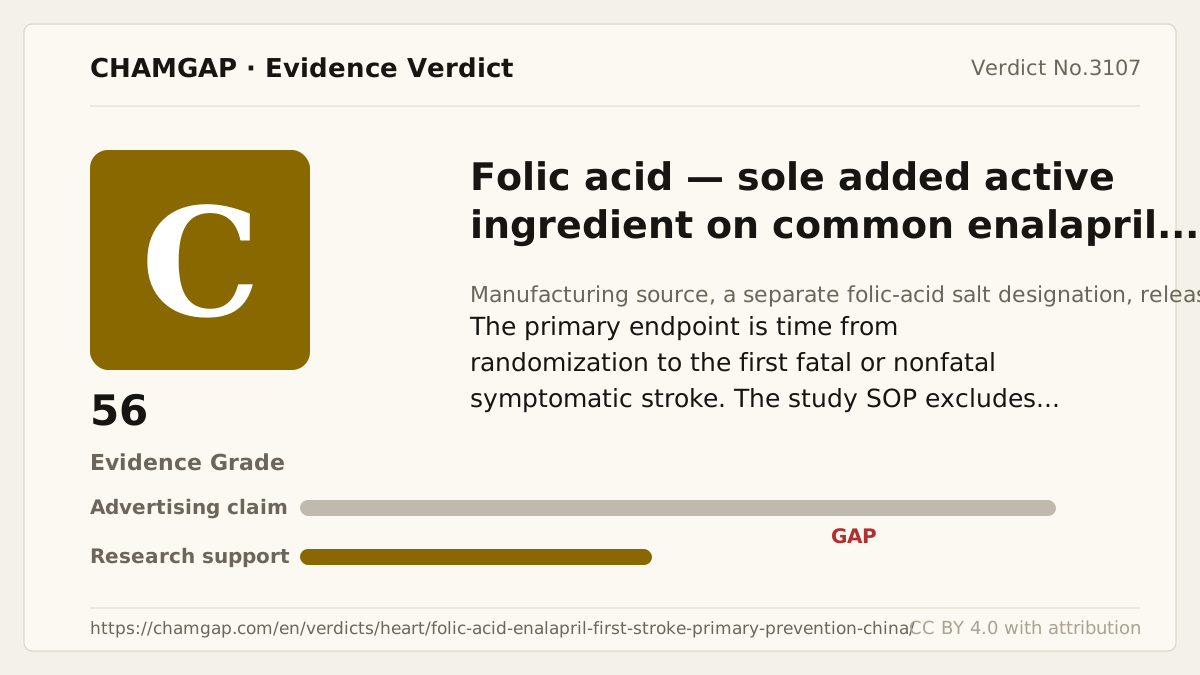
[Chamgap] Does added folic acid reduce first stroke in hypertensive adults without prior stroke? — Evidence Grade C·56. 12 cited sources checked. Source: https://chamgap.com/en/verdicts/heart/folic-acid-enalapril-first-stroke-primary-prevention-china/ · CC BY 4.0CC BY 4.0 — free to use with attribution; do not distort grades, numbers, or verdict meaning.
What this document does and does not do
Chamgap is an information source. It reports what research has and has not confirmed; it does not tell readers what to take or buy. That decision belongs to readers and, when needed, medical or legal professionals. This verdict reflects literature available up to the search date and may change as new research appears. Nothing here is medical advice.