
Everolimus-eluting stent PCI,
does it really help with Noninferior three-year death, stroke, or myocardial infarction versus CABG in left main coronary disease of low or intermediate anatomic complexity?
research showsThe grade is B. In EXCEL, three-year death, stroke, or myocardial infarction occurred in 15.4% with PCI and 14.7% with CABG, an absolute difference of +0.7 points. The upper 97.5% confidence limit was 4.0%, below the prespecified 4.2-point noninferiority margin. HR was 1.00 (95% CI 0.79-1.26), so noninferiority succeeded without superiority.
ads claimNoninferior must not be rewritten as superior. A five-year follow-up report appeared after this paper, so the three-year conclusion cannot be presented as a lifetime result. Public controversy was not used for scoring; this verdict evaluates only the 2016 paper's prespecified definitions and reported three-year values.
Useful facts when choosing a product
- The PCI arm used XIENCE everolimus-eluting metallic stents.
- Eligible patients had left main disease considered suitable for either strategy by the Heart Team and a site-assessed SYNTAX score of 32 or lower.
- The three-year composite including ischemia-driven revascularization was 23.1% with PCI and 19.1% with CABG, so repeat-procedure risk also matters.
Chamgap Semantic Classification Code
Candidate index · review held
P.everolimus-eluting-stent-pci.UNK.death-stroke-or-myocardial-infarction.noninferior.MULTIProcedures, devices and tests > Everolimus-eluting stent PCI > Unknown > death, stroke, or myocardial infarction > Noninferiority claim > Multiple: primary unresolved
An automated migration candidate, not an issued permanent code; exact claim scope remains under review. This machine-generated migration candidate helps retrieval but is not a permanent assignment. The original verdict ID and URL remain authoritative.
What the research actually shows
EXCEL assigned 1,905 patients to PCI 948 or CABG 957. The allocation method was, 'Randomization was performed with the use of an interactive voice-based or Web-based system in block sizes of 16, 24, or 32,' stratified by diabetes, SYNTAX category, and site. The procedures were open label, but an independent clinical events committee adjudicated source documents, and the primary analysis followed intention to treat. Defect name: Noninferiority design. Listed item: Noninferiority design. Avoidability: Avoidable - sufficient enrollment and follow-up could have tested superiority or used a narrower acceptable margin. Active-only control was not counted because no revascularization or sham CABG would be inappropriate in patients needing left main revascularization. Unblinded subjective endpoint: not applicable - death, stroke, and MI were independently adjudicated events. Abbott Vascular funded and participated in trial operations, making this manufacturer-funded evidence. However, the 1,905-person hard-outcome randomized trial qualifies for the large-trial exception to the manufacturer-only cap. Verdict 1822 is B with 76 points and asks whether CABG is better in diabetic multivessel disease; this verdict asks whether stenting is not worse in left main disease. The target anatomy differs.
Why this is classified as B (72)
A 1,905-person hard-outcome randomized trial met the prespecified 4.2-point margin, but one manufacturer-funded noninferiority trial gives B with 72 points.
Counterpoint. Three-year noninferiority informs choice but does not replace assessment of high-complexity anatomy, long-term repeat procedures, surgical risk, and patient preference.
Rejudgment record. Cross-check applied — Cross-checked EXCEL's 1,905-person centralized allocation, SYNTAX score no higher than 32, three-year actual events, 4.2-point margin, MI definition, and Abbott funding against the paper and protocol
| Endpoint | H | Hard endpoint - actual events such as death |
| Replication | R1 | Single confirmatory trial |
| Independence | I0 | Evidence comes only from manufacturer studies |
| Effect size | E+ | Meets the clinically important threshold |
Stored derived and displayed grades match; this is not a current recalculation or validity check (B).
Sub-claim grades by effect
This ingredient is marketed for several effects. A single overall grade blends strong and weak claims together, so each effect is graded separately here. The overall grade reflects the strongest disconfirming or core claim.
| Effect (sub-claim) | Grade | Basis |
|---|---|---|
| Noninferior three-year death, stroke, or MI in low- or intermediate-complexity left main disease | B | The upper 97.5% confidence limit of 4.0% was below the prespecified 4.2% margin. |
| Superior three-year composite outcome versus CABG | D | HR was 1.00 and superiority P=0.98, so superiority was not shown. |
Cross-check — AI research and Codex final gate
Evidence Table
| Study | Design | Sample | Funding | Endpoint | Result | Weight |
|---|---|---|---|---|---|---|
| Stone GW et al. 2016 EXCEL | International multicenter open-label centrally randomized event-adjudicated phase 3 noninferiority trial | 1,905 randomized (948 PCI, 957 CABG) | Funded by Abbott Vascular with operational participation; multiple author industry relationships disclosed | Three-year composite of all-cause death, stroke, or MI; prespecified absolute noninferiority margin 4.2 points | 15.4% versus 14.7%, absolute difference +0.7 points, upper 97.5% confidence limit 4.0%, noninferior; HR 1.00 (95% CI 0.79-1.26) | Large hard-outcome randomized trial, but one manufacturer-funded noninferiority study |
Receipt — 2 References
All 2 cited sources were verified for existence at the original page (as of 2026-08-18).
Final verification and publication gate: Codex · Evidence date: 2026-08-18 · Corrections: none
Cite this verdict
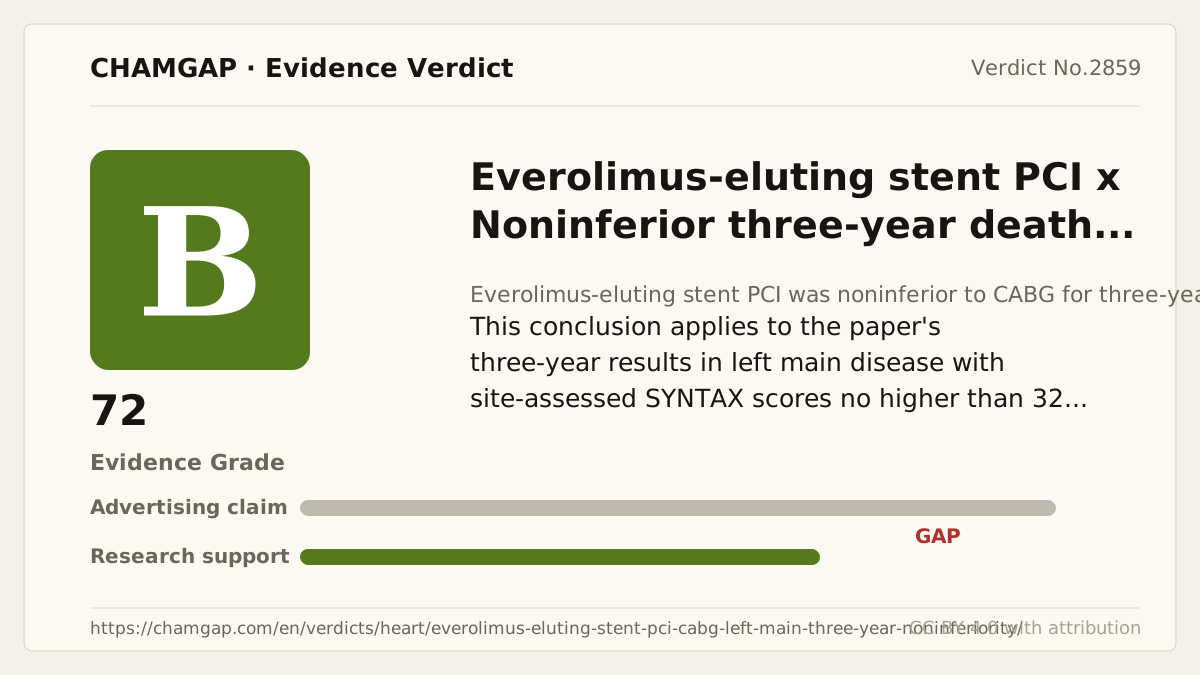
[Chamgap] Benefit: Everolimus-Eluting Stent PCI Is Noninferior to CABG for 3-Year Death, Stroke, or Myocardial Infarction in Low- or Intermediate-Complexity Left Main Disease — Evidence Grade B·72. 2 cited sources checked. Source: https://chamgap.com/en/verdicts/heart/everolimus-eluting-stent-pci-cabg-left-main-three-year-noninferiority/ · CC BY 4.0CC BY 4.0 — free to use with attribution; do not distort grades, numbers, or verdict meaning.
What this document does and does not do
Chamgap is an information source. It reports what research has and has not confirmed; it does not tell readers what to take or buy. That decision belongs to readers and, when needed, medical or legal professionals. This verdict reflects literature available up to the search date and may change as new research appears. Nothing here is medical advice.