
Circulating erythritol concentration,
does it really help with Higher circulating concentration and increased major cardiovascular events comprising death, nonfatal myocardial infarction, or stroke?
research showsThe grade is C. In high-risk cardiac cohorts, the highest versus lowest quartile of circulating erythritol was associated with more three-year major cardiovascular events: adjusted HR 1.80 (95% CI 1.18 to 2.77) in the US and 2.21 (1.20 to 4.07) in Europe. The study measured blood concentration, not intake, and erythritol is also produced endogenously, so it does not establish that eating the sweetener caused the events.
ads claimErythritol provides virtually no glucose or fructose and is assigned 0 kcal/g for US labeling. That fact neither guarantees cardiovascular safety nor turns a blood-biomarker study into proof that commercial erythritol intake causes events.
Useful facts when choosing a product
- Erythritol is a four-carbon sugar alcohol rather than glucose or fructose. US FDA nutrition labeling uses 0 kcal/g.
- Its glycemic index is treated as essentially zero, and isolated ingestion generally produces little glucose response. That is a different measurement from cardiovascular events.
- The event cohorts did not measure commercial-product intake. Circulating erythritol can reflect external intake and endogenous production from glucose through the pentose phosphate pathway; worse metabolic health may raise production, so reverse causation cannot be excluded.
- Verdict 1449 is D with 29 points for olive oil and all-cause mortality; this verdict instead concerns circulating erythritol and a cardiovascular composite, so both exposure and endpoint differ.
Chamgap Semantic Classification Code
Candidate index · review held
UNK.circulating-erythritol-concentration.UNK.higher-circulating-concentration-and-increased-major-cardiovascular-events-comprising-death-nonfatal-myocardial-infarction-or-stroke.increase.UNKUnknown > Circulating erythritol concentration > Unknown > Higher circulating concentration and increased major cardiovascular events comprising death, nonfatal myocardial infarction, or stroke > Increase claim > Unknown
An automated migration candidate, not an issued permanent code; exact claim scope remains under review. This machine-generated migration candidate helps retrieval but is not a permanent assignment. The original verdict ID and URL remain authoritative.
What the research actually shows
Within one paper and overlapping research team, Witkowski and colleagues analyzed a 1,157-person discovery cohort, a 2,149-person US validation cohort, and an 833-person European validation cohort. US and European validation therefore did not count as independent-team replication. The cohorts did not measure dietary intake or product use. Separate platelet experiments measured mechanism rather than events, and the eight-person 30-g ingestion study measured blood kinetics only. Funding mixed public and nonprofit support including NIH grants with Sanofi-Aventis Deutschland support for the European LipidCardio component. The original disclosures state that Stanley L. Hazen is a co-inventor on Cleveland Clinic-held cardiovascular diagnostic and therapeutic patents; was a paid consultant formerly to Procter & Gamble and currently to Zehna Therapeutics; received research funds from Procter & Gamble, Zehna Therapeutics, and Roche Diagnostics; and may receive royalties from Cleveland HeartLab, Procter & Gamble, and Zehna Therapeutics. W. H. Wilson Tang disclosed consulting for Sequana Medical A.G., Owkin Inc., Relypsa Inc., and PreCardiac Inc., plus honoraria from Springer Nature and the American Board of Internal Medicine. Other authors reported no relevant relationships.
Why this is classified as C (54)
Cardiovascular-event associations replicated in two validation cohorts, but intake was unmeasured and selected high-risk populations, endogenous production, and residual confounding yield C with 54 points.
Counterpoint. This verdict recognizes an event signal among high-risk patients with high blood levels without upgrading it to proof that erythritol-containing foods cause thrombosis.
Rejudgment record. Cross-check applied — Separated validation-cohort event hazard ratios from unmeasured intake, endogenous production, selected high-risk populations, and residual confounding
| Endpoint | H | Hard endpoint - actual events such as death |
| Replication | R1 | Single confirmatory trial |
| Independence | I1 | Mixed funding sources |
| Effect size | E+ | Meets the clinically important threshold |
Stored derived and displayed grades match; this is not a current recalculation or validity check (C).
Sub-claim grades by effect
This ingredient is marketed for several effects. A single overall grade blends strong and weak claims together, so each effect is graded separately here. The overall grade reflects the strongest disconfirming or core claim.
| Effect (sub-claim) | Grade | Basis |
|---|---|---|
| High circulating erythritol and increased major cardiovascular events | C | The association replicated in two validation cohorts, but intake was not measured. |
| Erythritol ingestion causes myocardial infarction or stroke | ? | The eight-person ingestion study measured blood levels, not causal clinical events. |
Cross-check — AI research and Codex final gate
Evidence Table
| Study | Design | Sample | Funding | Endpoint | Result | Weight |
|---|---|---|---|---|---|---|
| Witkowski M et al., 2023 US and European cohorts | Prospective observational cohorts using circulating metabolite measurements | Discovery cohort 1,157; US validation cohort 2,149; European validation cohort 833 | Public and nonprofit support including NIH grants plus Sanofi-Aventis Deutschland support for the European LipidCardio component; Hazen disclosed Cleveland Clinic patents and Procter & Gamble, Zehna, and Roche funding, consulting, and royalty relationships, while Tang disclosed Sequana, Owkin, Relypsa, and PreCardiac consulting and other honoraria | Three-year composite of death, nonfatal myocardial infarction, or stroke | Highest versus lowest circulating-concentration quartile: US HR 1.80 (95% CI 1.18 to 2.77), European HR 2.21 (1.20 to 4.07) | Replicated hard-outcome signal, but not an intake-based causal estimate |
| Witkowski M et al., 2023 platelet and thrombosis experiments | In vitro platelet-response and animal thrombosis experiments | No clinical-event participant cohort | Same support as the parent study | Platelet reactivity and thrombosis potential | Mechanistic signals were observed, but clinical cardiovascular events were not measured | Mechanistic evidence, not clinical-event evidence |
| Witkowski M et al., 2023 healthy-volunteer ingestion substudy | Blood-concentration kinetics after a single 30-g dose | Eight healthy volunteers | Same support as the parent study | Circulating erythritol concentration | Blood concentrations rose markedly and remained elevated beyond 24 hours; clinical events were not measured | Exposure-kinetics evidence, not a cardiovascular event trial |
Receipt — 2 References
All 2 cited sources were verified for existence at the original page (as of 2026-08-03).
Final verification and publication gate: Codex · Evidence date: 2026-08-03 · Corrections: none
Cite this verdict
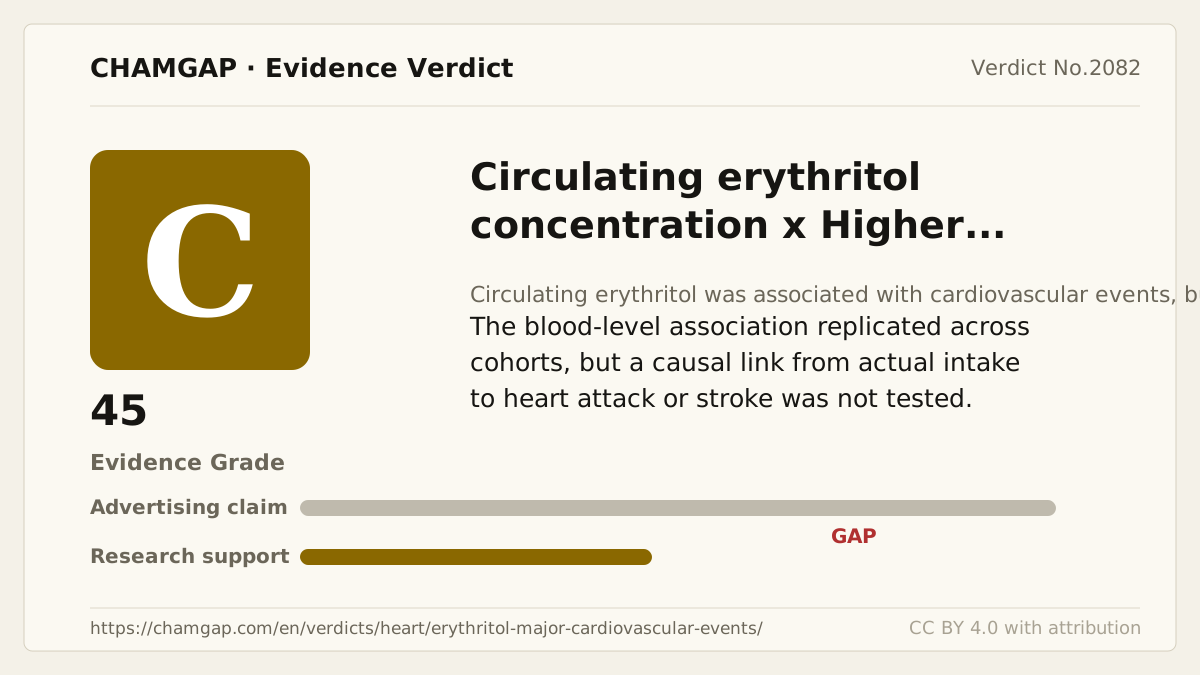
[Chamgap] Circulating erythritol concentration x increased major cardiovascular events — Evidence Grade C·54. 2 cited sources checked. Source: https://chamgap.com/en/verdicts/heart/erythritol-major-cardiovascular-events/ · CC BY 4.0CC BY 4.0 — free to use with attribution; do not distort grades, numbers, or verdict meaning.
What this document does and does not do
Chamgap is an information source. It reports what research has and has not confirmed; it does not tell readers what to take or buy. That decision belongs to readers and, when needed, medical or legal professionals. This verdict reflects literature available up to the search date and may change as new research appears. Nothing here is medical advice.