
Dispatcher-assisted compression-only CPR,
does it really help with Increased survival to hospital discharge after non-asphyxial out-of-hospital cardiac arrest?
research showsDispatcher instructions directing an untrained bystander to provide chest compressions alone increase survival to hospital discharge after non-asphyxial out-of-hospital cardiac arrest compared with dispatcher-assisted standard CPR, supporting grade B. In the 2017 Cochrane review, three randomized trials with 3,031 participants found survival of 14.0% versus 11.6%, RR 1.21 (95% CI 1.01 to 1.46), with high-certainty GRADE evidence. The comparator was active standard CPR including rescue breathing rather than no treatment, so the active-comparator ceiling limits the grade to B. The result does not directly extend to drowning, choking, trauma, or paediatric non-cardiac arrests.
ads claimThe simplicity of compression-only CPR may be expanded into superiority for every cause of cardiac arrest and every rescuer setting. Direct evidence is limited to untrained bystanders receiving dispatcher instructions for non-asphyxial out-of-hospital cardiac arrest.
Useful facts when choosing a product
- This intervention is not an automated external defibrillator; it is a dispatch protocol that instructs a bystander to provide continuous chest compressions without rescue breaths.
- The standard-CPR comparator in the pivotal trials used dispatcher instructions for 15 compressions alternating with two rescue breaths.
- Drowning, choking, trauma, and paediatric non-cardiac causes can begin with oxygen deprivation and differ clinically from the core non-asphyxial evidence.
- Chest compressions can cause rib or sternal fractures and internal injury, but the dispatcher-assisted randomized trials did not report adverse-event data.
Chamgap Semantic Classification Code
Candidate index · review held
UNK.dispatcher-assisted-compression-only-cardiopulmonary-resuscitation.UNK.survival-to-hospital-discharge-after-non-asphyxial-out-of-hospital-cardiac-arrest.increase.UNKUnknown > Dispatcher-assisted compression-only cardiopulmonary resuscitation > Unknown > survival to hospital discharge after non-asphyxial out-of-hospital cardiac arrest > Increase claim > Unknown
An automated migration candidate, not an issued permanent code; exact claim scope remains under review. This machine-generated migration candidate helps retrieval but is not a permanent assignment. The original verdict ID and URL remain authoritative.
What the research actually shows
The 2017 Cochrane review by Zhan and colleagues separated three bystander telephone-instruction trials from one professional-provider cluster trial. In the telephone subgroup, three trials and 3,031 participants yielded discharge survival of 14.0% with compression-only CPR and 11.6% with standard 15:2 CPR, RR 1.21 (95% CI 1.01 to 1.46), with high certainty. Favourable neurological outcome in one trial with 1,286 participants had an RR of 1.25 (95% CI 0.94 to 1.66), with moderate certainty and no clear difference. The individual large Rea 2010 and Svensson 2010 trials did not each establish a significant overall survival difference, but the pooled effect was significant.
Why this is classified as B (76)
Three randomized trials with 3,031 participants found discharge survival of 14.0% versus 11.6%, RR 1.21 (95% CI 1.01 to 1.46), with high certainty, but superiority over active standard CPR limits the verdict to B with 76 points.
Counterpoint. Favourable neurological survival had moderate certainty and a confidence interval including no effect. Professional-provider continuous compression with asynchronous ventilation and asphyxial cardiac arrest are different interventions or populations.
Rejudgment record. New verdict — Discharge-survival benefit in randomized trials of dispatcher-assisted untrained bystanders was high certainty, but the comparator was active standard CPR with rescue breathing, invoking the B ceiling
Sub-claim grades by effect
This ingredient is marketed for several effects. A single overall grade blends strong and weak claims together, so each effect is graded separately here. The overall grade reflects the strongest disconfirming or core claim.
| Effect (sub-claim) | Grade | Basis |
|---|---|---|
| Increased survival to discharge after non-asphyxial out-of-hospital cardiac arrest | B | Three trials found 14.0% versus 11.6%, RR 1.21, with high certainty, but the active-comparator ceiling gives B. |
| Increased favourable neurological survival at discharge | C | One trial with 1,286 participants found RR 1.25 (95% CI 0.94 to 1.66), with moderate certainty and an unclear effect. |
| Increased survival to hospital admission | C | One trial with 520 participants found RR 1.18 (95% CI 0.94 to 1.48), with moderate certainty and no established difference. |
Cross-check — AI research and Codex final gate
Evidence Table
| Study | Design | Sample | Funding | Endpoint | Result | Weight |
|---|---|---|---|---|---|---|
| Zhan L et al. 2017 | Cochrane systematic review and meta-analysis | Three randomized trials of dispatcher-assisted bystander CPR with 3,031 analyzed participants | Cochrane academic review | Survival to discharge and neurological outcome | Discharge survival was 14.0% versus 11.6%, RR 1.21 (95% CI 1.01 to 1.46), high certainty; neurological outcome was uncertain with moderate certainty. | Core GRADE survival evidence |
| Rea TD et al. 2010 | Multicentre randomized trial of dispatcher-assisted CPR | 1,941 analyzed participants | United States public and foundation support; some device-company research support disclosed | Survival to discharge and favourable neurological status | Overall discharge survival was 12.5% with compression-only CPR and 11.0% with standard CPR, without a significant trial-level difference; the cardiac-cause subgroup showed a larger signal. | Pivotal individual large randomized trial |
Receipt — 3 References
All 3 cited sources were verified for existence at the original page (as of 2026-07-23).
Final verification and publication gate: Codex · Evidence date: 2026-07-23 · Corrections: none
Cite this verdict
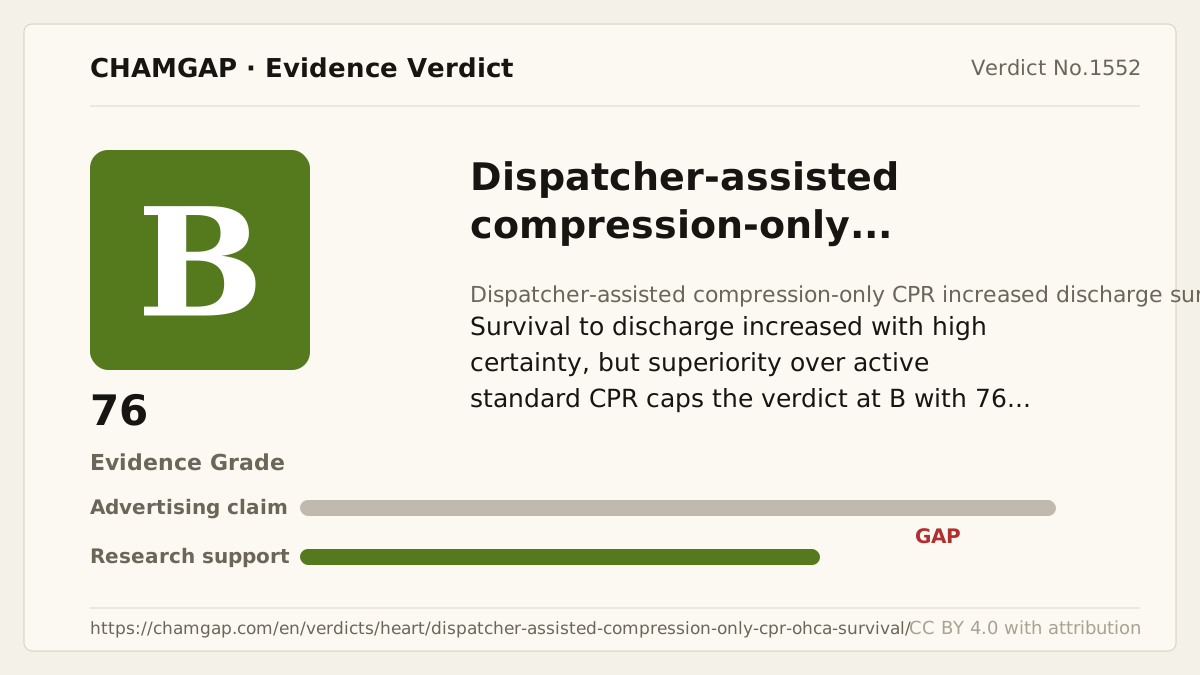
[Chamgap] Dispatcher-assisted compression-only CPR x increased survival to discharge after non-asphyxial out-of-hospital cardiac arrest — Evidence Grade B·76. 3 cited sources checked. Source: https://chamgap.com/en/verdicts/heart/dispatcher-assisted-compression-only-cpr-ohca-survival/ · CC BY 4.0CC BY 4.0 — free to use with attribution; do not distort grades, numbers, or verdict meaning.
What this document does and does not do
Chamgap is an information source. It reports what research has and has not confirmed; it does not tell readers what to take or buy. That decision belongs to readers and, when needed, medical or legal professionals. This verdict reflects literature available up to the search date and may change as new research appears. Nothing here is medical advice.