
Dark chocolate, 40 g,
does it really help with Improved maximal walking distance and time in peripheral artery disease?
research showsThe grade is C with 50 points. In the 20-person crossover trial, net dark-versus-milk differences were 18.2 m for maximal walking distance and 16.5 seconds for maximal walking time. Change-score and paired-difference standard deviations and confidence intervals for the between-condition change were unreported, and no validated clinical-importance threshold exists for this acute two-hour context, so clinical magnitude cannot be classified.
ads claimThe higher cocoa-solid content and two-hour walking-test improvement are real observations. They do not establish long-term walking rehabilitation or treatment of peripheral artery disease.
Useful facts when choosing a product
- The intervention was a 40-g solid food, not a beverage to convert into cups; dark chocolate exceeded 85% cocoa and control milk chocolate was 35% or less.
- The paper did not report measured caffeine, theobromine, or sugar in the trial products, so general chocolate ranges were not assigned to them.
- The circa-1577 Florentine Codex records cacao trees, drinks, sellers, and prices counted in cacao beans. 'Food of the gods' is not a verified Aztec quotation but a later gloss related to the 1753 genus name Theobroma.
- Verdict 118 is C with 48 points for cocoa flavanols, verdict 1246 is C with 53 points for high-flavanol cocoa, and verdict 604 is F with 8 points for theobromine. Verdict 2025 asks a different question about edible chocolate and actual walking ability.
- For the same disease, verdict 1723 is B with 72 points for supervised walking exercise, while verdict 2004 is C with 50 points for milled flaxseed and blood pressure. The former is a different intervention and the latter a different outcome.
Chamgap Semantic Classification Code
Candidate index · review held
F.dark-chocolate-above-85-percent-cocoa.food.maximal-walking-distance-and-time-in-peripheral-artery-disease.improve.activeFoods and beverages > Dark chocolate above 85% cocoa > Food consumption > maximal walking distance and time in peripheral artery disease > Improvement claim > Active comparator
An automated migration candidate, not an issued permanent code; exact claim scope remains under review. This machine-generated migration candidate helps retrieval but is not a permanent assignment. The original verdict ID and URL remain authoritative.
What the research actually shows
All 20 participants completed both periods. NCT01947712 classifies FMD at two hours and 30 days as the primary outcome, with oxidative stress, maximal walking distance, and ABI as secondary outcomes. The paper reported a positive two-hour FMD result; the 30-day result was unreported in this article. The article itself called FMD and walking distance primary outcomes, which conflicts with the registry classification. Sapienza University of Rome funding was reported, with no identified chocolate manufacturer or producer-group funding.
Why this is classified as C (50)
Walking function is patient-important and the acute positive result is real, but change variability and a between-condition confidence interval were unreported and no validated threshold applies to this context. A 20-person, two-hour active-control trial with unreported registered 30-day results yields C with 50 points.
Counterpoint. An independent months-long trial with a near-inert control and blinded assessment is needed.
Rejudgment record. Cross-check applied — The paper tables and figures and NCT01947712 were cross-checked for the 20-person crossover design, 40-g dose, walking values, net changes, missing change variability, registry outcome classification, and unreported 30-day results
| Endpoint | P | Symptom or function itself is the target - including patient reports and performance tests |
| Replication | R1 | Single confirmatory trial |
| Independence | I2 | Decisive evidence is publicly or non-profit funded |
| Effect size | EX | The clinical size of the effect could not be judged |
Stored derived and displayed grades match; this is not a current recalculation or validity check (C).
Sub-claim grades by effect
This ingredient is marketed for several effects. A single overall grade blends strong and weak claims together, so each effect is graded separately here. The overall grade reflects the strongest disconfirming or core claim.
| Effect (sub-claim) | Grade | Basis |
|---|---|---|
| The trial dark chocolate exceeded 85% cocoa and weighed 40 g | ? | This is a product-form and composition-label fact, not a graded clinical outcome. |
| Forty grams of dark chocolate improve walking ability in peripheral artery disease | C | The two-hour functional result was positive, but no validated magnitude threshold applies and the trial had 20 people. |
Cross-check — AI research and Codex final gate
Evidence Table
| Study | Design | Sample | Funding | Endpoint | Result | Weight |
|---|---|---|---|---|---|---|
| Loffredo L et al., Journal of the American Heart Association, 2014 | Single-blind randomized single-dose active-control crossover trial | All 20 peripheral artery disease patients completed both periods | Sapienza University of Rome funding | Two-hour maximal walking distance and time; secondary outcomes in the registry | Distance 110.7±64.5 to 122.2±61.5 m and time 124.8±60.8 to 142.2±62.0 s; no increase after milk chocolate | Positive direct functional outcome, but from a very small acute trial |
Receipt — 2 References
All 2 cited sources were verified for existence at the original page (as of 2026-08-03).
Final verification and publication gate: Codex · Evidence date: 2026-08-03 · Corrections: none
Cite this verdict
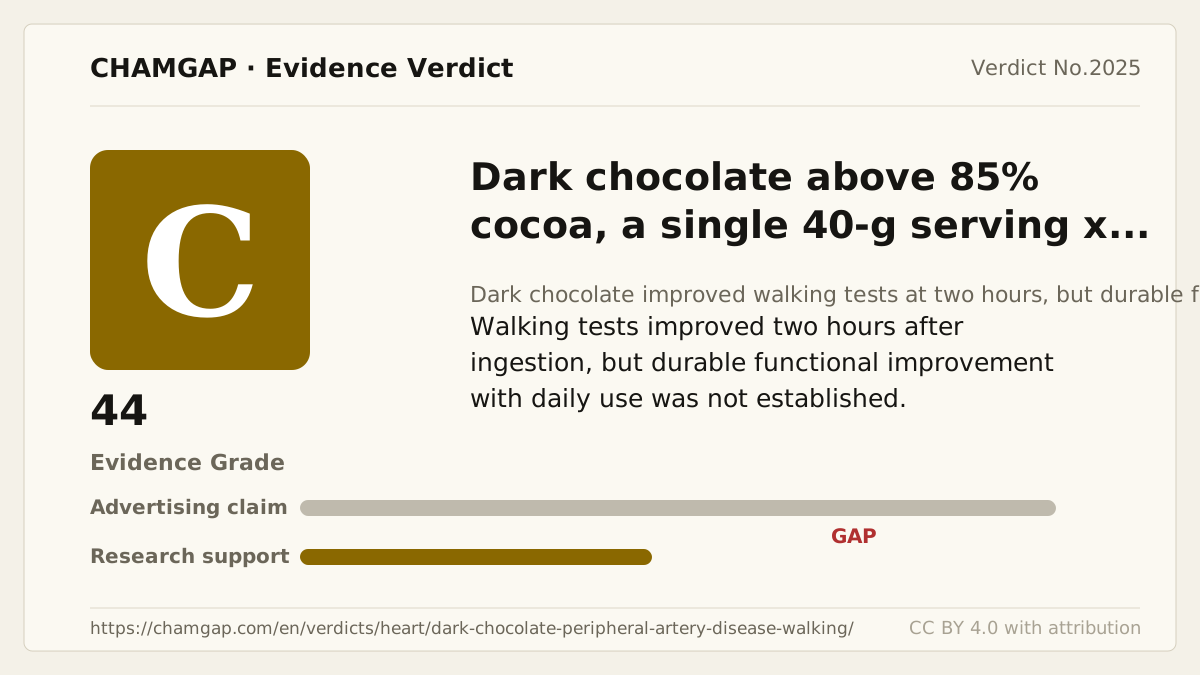
[Chamgap] Dark chocolate, 40 g x walking ability in peripheral artery disease — Evidence Grade C·50. 2 cited sources checked. Source: https://chamgap.com/en/verdicts/heart/dark-chocolate-peripheral-artery-disease-walking/ · CC BY 4.0CC BY 4.0 — free to use with attribution; do not distort grades, numbers, or verdict meaning.
What this document does and does not do
Chamgap is an information source. It reports what research has and has not confirmed; it does not tell readers what to take or buy. That decision belongs to readers and, when needed, medical or legal professionals. This verdict reflects literature available up to the search date and may change as new research appears. Nothing here is medical advice.