
Coriander-seed powder,
does it really help with Reduced fasting glucose and LDL in adults with type 2 diabetes?
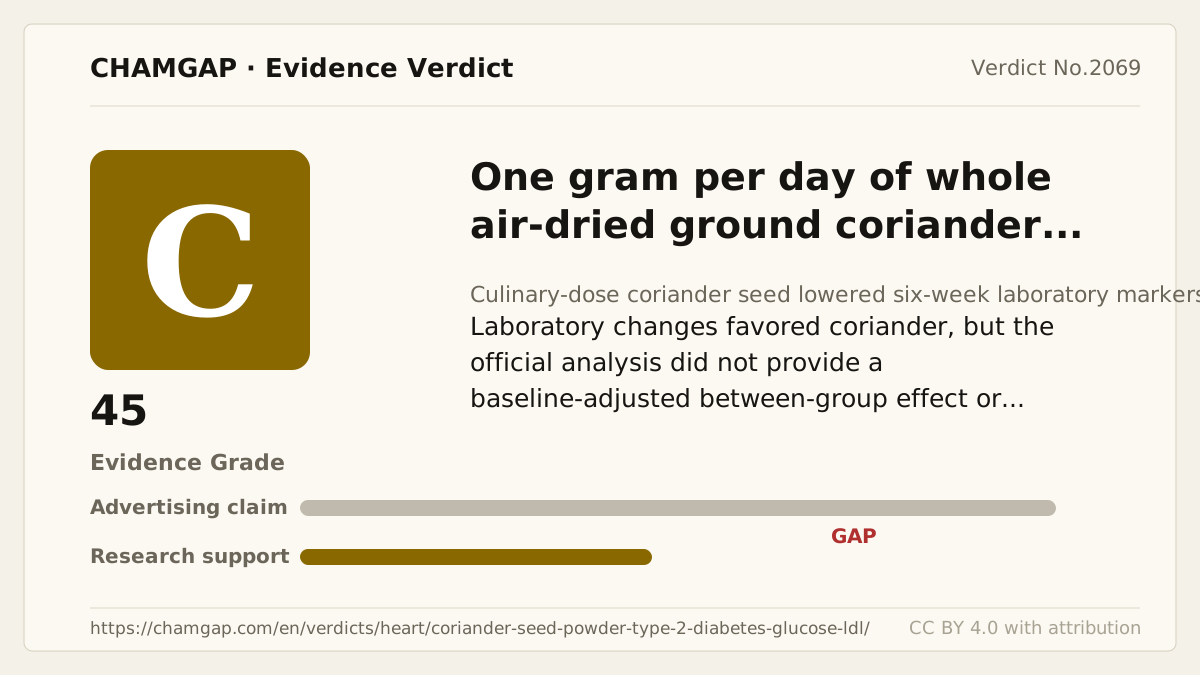
research showsThe grade is C with 50 points. A double-blind placebo-controlled trial assigned 44 participants, lost four, and analyzed 20 per group. The paper reported within-group changes and their confidence intervals, but not a baseline-adjusted between-group difference or confidence interval, so treatment-effect magnitude could not be judged.
ads claimOne gram is about 0.5 to 0.56 teaspoon, 0.18 tablespoon, or four pinches. Six-week laboratory improvement must not be expanded into prevention of diabetic complications or replacement of medication.
Useful facts when choosing a product
- The intervention was whole air-dried ground coriander seed, not an extract.
- One gram is about 0.5 to 0.56 teaspoon, 0.18 tablespoon, or four pinches.
- Verdict 273 is D with 27 points for coriander-leaf extract and heavy-metal detoxification; this verdict concerns whole seed powder and glucose and lipids.
Chamgap Semantic Classification Code
Candidate index · review held
S.one-gram-of-whole-air-dried-ground-coriander-seed.UNK.fasting-glucose-and-ldl-with-type-2-diabetes.reduce.placeboSupplements and nutraceuticals > One gram of whole air-dried ground coriander seed > Unknown > fasting glucose and LDL with type 2 diabetes > Reduction claim > Placebo
An automated migration candidate, not an issued permanent code; exact claim scope remains under review. This machine-generated migration candidate helps retrieval but is not a permanent assignment. The original verdict ID and URL remain authoritative.
What the research actually shows
Zamany 2025 divided 44 adults with type 2 diabetes between coriander-seed powder, 1 g/day, and placebo by even or odd medical-record number; allocation concealment was not reported. Four withdrew and only 20 per group completed the analysis. Fasting glucose changed from 156.15±23.19 to 130.30±21.15 with coriander and from 161.15±25.17 to 160.85±26.01 mg/dL with placebo. LDL changed from 127.35±23.45 to 111.40±25.71 with coriander and from 133.35±21.31 to 133.00±21.03 mg/dL with placebo. Baseline total cholesterol differed by 28.12 mg/dL. IR.TBZMED.REC.1398.677 is the ethics approval number; no separate funding identifier was confirmed. The authors declared no conflicts. IRCT20190224042821N2 was registered on 2019-10-11, but recruitment start could not be verified, so prospective versus retrospective registration cannot be determined.
Why this is classified as C (50)
The baseline-adjusted between-group effect magnitude is unavailable, and quasi-random assignment, unreported allocation concealment, and completer analysis compound the limits of one 40-person, six-week surrogate-outcome trial, giving C with 50 points.
Counterpoint. Fasting glucose and LDL are important risk markers, but cardiovascular events, diabetic complications, and quality of life were not measured.
Rejudgment record. Cross-check applied — Missing baseline-adjusted between-group effects and baseline imbalance were assessed alongside quasi-random assignment, unreported allocation concealment, completer analysis, and surrogate outcomes
| Endpoint | S | Surrogate marker - laboratory or imaging measures |
| Replication | R1 | Single confirmatory trial |
| Independence | I2 | Decisive evidence is publicly or non-profit funded |
| Effect size | EX | The clinical size of the effect could not be judged |
Stored derived and displayed grades match; this is not a current recalculation or validity check (C).
Sub-claim grades by effect
This ingredient is marketed for several effects. A single overall grade blends strong and weak claims together, so each effect is graded separately here. The overall grade reflects the strongest disconfirming or core claim.
| Effect (sub-claim) | Grade | Basis |
|---|---|---|
| Reduced fasting glucose | C | Effect magnitude could not be judged because the baseline-adjusted between-group difference and confidence interval were not reported. |
| Reduced LDL | C | Effect magnitude could not be judged because the baseline-adjusted between-group difference and confidence interval were not reported. |
Cross-check — AI research and Codex final gate
Evidence Table
| Study | Design | Sample | Funding | Endpoint | Result | Weight |
|---|---|---|---|---|---|---|
| Zamany S et al. 2025 | Double-blind placebo-controlled trial assigned by even or odd medical-record number | 44 assigned, four withdrew, and 40 completers analyzed, 20 per group | Tabriz University of Medical Sciences support; IR.TBZMED.REC.1398.677 is an ethics approval number, and no separate funding identifier was confirmed | Metabolic laboratory markers including fasting glucose and LDL | Fasting glucose changed 156.15±23.19 to 130.30±21.15 with coriander and 161.15±25.17 to 160.85±26.01 with placebo; LDL changed 127.35±23.45 to 111.40±25.71 with coriander and 133.35±21.31 to 133.00±21.03 mg/dL with placebo. Baseline-adjusted P<0.001; adjusted between-group differences and CIs were not reported. | Surrogate-marker signal with unknown adjusted between-group effect magnitude |
Receipt — 1 References
All 1 cited sources were verified for existence at the original page (as of 2026-08-03).
Final verification and publication gate: Codex · Evidence date: 2026-08-03 · Corrections: none
Cite this verdict
[Chamgap] Coriander-seed powder x glucose and LDL in type 2 diabetes — Evidence Grade C·50. 1 cited sources checked. Source: https://chamgap.com/en/verdicts/heart/coriander-seed-powder-type-2-diabetes-glucose-ldl/ · CC BY 4.0CC BY 4.0 — free to use with attribution; do not distort grades, numbers, or verdict meaning.
What this document does and does not do
Chamgap is an information source. It reports what research has and has not confirmed; it does not tell readers what to take or buy. That decision belongs to readers and, when needed, medical or legal professionals. This verdict reflects literature available up to the search date and may change as new research appears. Nothing here is medical advice.