
Local anesthesia with conscious sedation,
does it really help with Equivalent 30-day clinical outcomes versus general anesthesia during transfemoral TAVI?
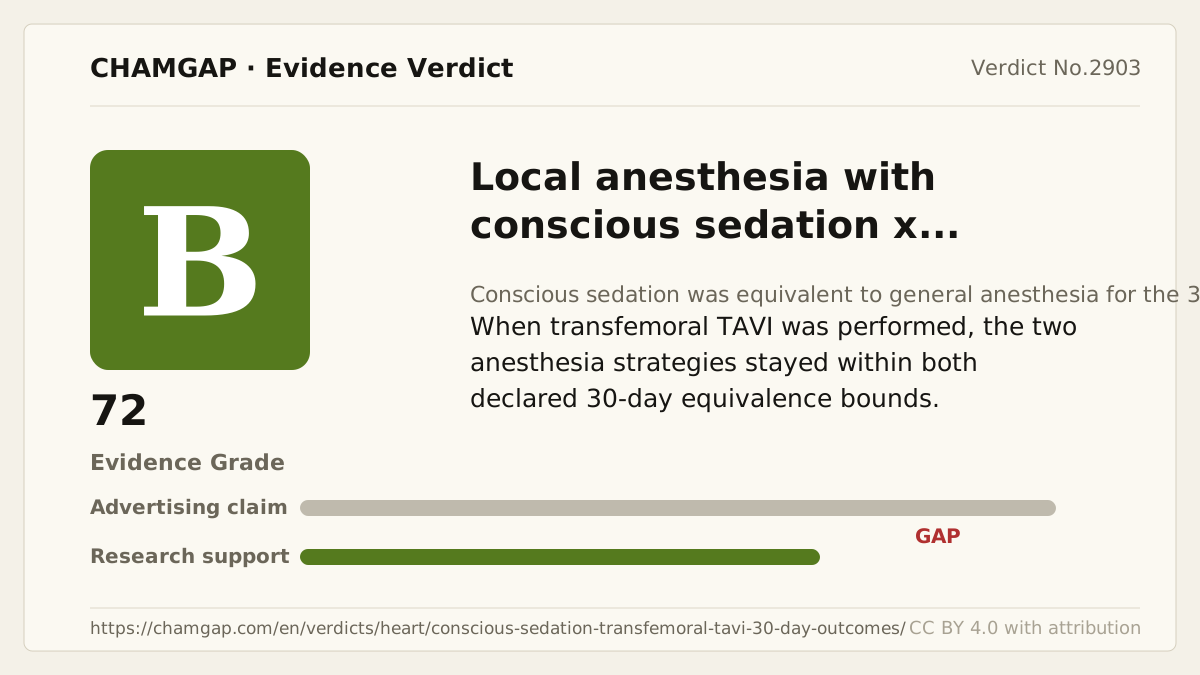
research showsThe grade is B. The 30-day composite occurred in 27.2% (59/217) versus 26.4% (58/220), difference 0.8 points (90% CI -6.2 to 7.8), entirely within the prespecified ±10-point equivalence bounds.
ads claimEquivalence of the prespecified composite does not prove that every individual complication was identical.
Useful facts when choosing a product
- General anesthesia and conscious sedation are real options for TAVI in Korea.
- The 90% CI of -6.2 to 7.8 points stayed within ±10.
Chamgap Semantic Classification Code
Candidate index · review held
UNK.local-anesthesia-with-conscious-sedation.UNK.clinical-outcomes.equivalent.factorialUnknown > Local anesthesia with conscious sedation > Unknown > clinical outcomes > Equivalence claim > Defined factorial contrast
An automated migration candidate, not an issued permanent code; exact claim scope remains under review. This machine-generated migration candidate helps retrieval but is not a permanent assignment. The original verdict ID and URL remain authoritative.
What the research actually shows
The 2×2 factorial trial randomized 447 patients; 218 and 220 were analyzed in the anesthesia comparison. The investigators wrote, 'We chose a δ of 10% considering it clinically meaningful.' Four-gate bias review: ① defect: unblinded subjective endpoint; ② listed item: unblinded subjective endpoint; ③ the trial was open label and infection depended on an antibiotic-treatment decision; ④ anesthesia blinding was impossible, but independent blinded assessment of antibiotic necessity was feasible, so it counts once. Equivalence design itself is not a listed defect and was not added. Funding came from the German Heart Research Foundation and Helios Health Institute; disclosures included some author relationships with Edwards and Medtronic, but no company trial funding was identified. Verdict 1731 is A with 84 points and asks whether to perform TAVR in severe stenosis; verdict 2382 is B with 76 points and asks when to perform early TAVR in asymptomatic disease. This verdict asks which anesthesia to use once TAVI is performed.
Why this is classified as B (72)
One publicly funded clinical-event equivalence RCT with an open subjective component gives B with 72 points.
Counterpoint. The mixed composite and 30-day horizon limit interpretation.
Rejudgment record. New verdict — One RCT meeting both prespecified equivalence bounds, with an open subjective composite component counted
| Endpoint | H | Hard endpoint - actual events such as death |
| Replication | R1 | Single confirmatory trial |
| Independence | I2 | Decisive evidence is publicly or non-profit funded |
| Effect size | E+ | Meets the clinically important threshold |
Stored derived and displayed grades match; this is not a current recalculation or validity check (B).
Sub-claim grades by effect
This ingredient is marketed for several effects. A single overall grade blends strong and weak claims together, so each effect is graded separately here. The overall grade reflects the strongest disconfirming or core claim.
| Effect (sub-claim) | Grade | Basis |
|---|---|---|
| Equivalent 30-day composite clinical outcomes | B | The entire 90% CI stayed within ±10 points. |
Cross-check — AI research and Codex final gate
Evidence Table
| Study | Design | Sample | Funding | Endpoint | Result | Weight |
|---|---|---|---|---|---|---|
| Thiele H et al. 2020 SOLVE-TAVI | Multicenter open-label 2×2 factorial randomized equivalence trial | 447 randomized; 218/220 in anesthesia comparison | German Heart Research Foundation and Helios Health Institute | 30-day composite of death, stroke, MI, infection requiring antibiotics, and acute kidney injury | 27.2% versus 26.4%, difference 0.8 points (90% CI -6.2 to 7.8), equivalence bounds ±10 points. | Pivotal randomized equivalence evidence |
Receipt — 1 References
All 1 cited sources were verified for existence at the original page (as of 2026-08-26).
Final verification and publication gate: Codex · Evidence date: 2026-08-26 · Corrections: none
Cite this verdict
[Chamgap] Benefit of Local Anesthesia with Conscious Sedation for Equivalent 30-Day Clinical Outcomes in Transfemoral TAVI — Evidence Grade B·72. 1 cited sources checked. Source: https://chamgap.com/en/verdicts/heart/conscious-sedation-transfemoral-tavi-30-day-outcomes/ · CC BY 4.0CC BY 4.0 — free to use with attribution; do not distort grades, numbers, or verdict meaning.
What this document does and does not do
Chamgap is an information source. It reports what research has and has not confirmed; it does not tell readers what to take or buy. That decision belongs to readers and, when needed, medical or legal professionals. This verdict reflects literature available up to the search date and may change as new research appears. Nothing here is medical advice.