
Colchicine,
does it really help with Prevention of additional recurrent pericarditis episodes?
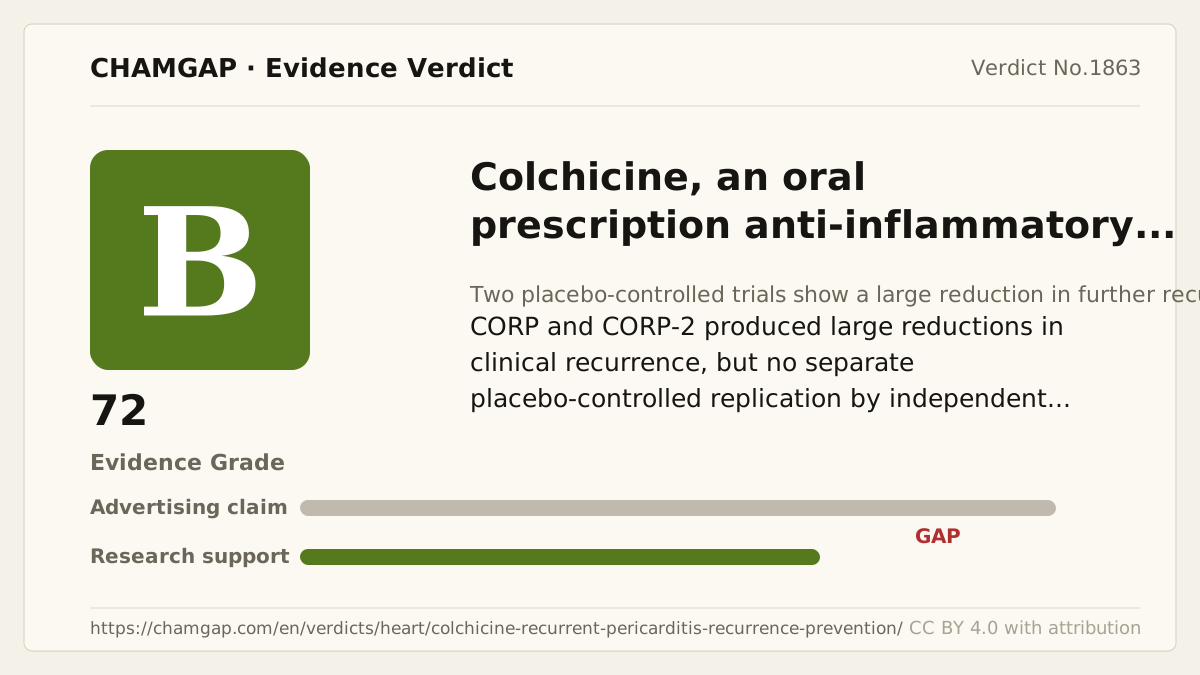
research showsColchicine is rated B because placebo-controlled trials in first and multiple recurrences cut symptom-triggered clinical pericarditis recurrence by about half.
ads claimThis does not mean colchicine prevents every form of chest pain or pericardial disease. Trials added it to standard anti-inflammatory therapy in diagnosed recurrent pericarditis.
Useful facts when choosing a product
- CORP enrolled a first recurrence, while CORP-2 enrolled at least two recurrences.
- Both trials compared colchicine versus placebo added to standard anti-inflammatory therapy.
Chamgap Semantic Classification Code
Candidate index · review held
M.colchicine.oral.additional-recurrent-pericarditis-episodes.prevent.placeboMedicinal interventions > colchicine > Oral > additional recurrent pericarditis episodes > Occurrence-prevention claim > Placebo
An automated migration candidate, not an issued permanent code; exact claim scope remains under review. This machine-generated migration candidate helps retrieval but is not a permanent assignment. The original verdict ID and URL remain authoritative.
What the research actually shows
CORP randomized 120 and analyzed all 120 by intention to treat. Its primary 18-month recurrence endpoint succeeded: 24% with colchicine versus 55% with placebo, risk ratio 0.44 (95% CI 0.27 to 0.73), absolute reduction 31%, number needed to treat 3, P<0.001. CORP-2 randomized and analyzed 240 patients with multiple recurrences. Its primary six-month endpoint also succeeded, 21.6% versus 42.5%, risk ratio 0.46 (95% CI 0.30 to 0.72), P=0.0009. Maria Vittoria Hospital was the primary funder of CORP. The Italian National Health Service unit ASLTO2 sponsored CORP-2, while Acarpia supplied colchicine and placebo as an unrestricted grant. Verdict 1007, which is F with 10 points, concerns knee osteoarthritis; verdict 1348, which is B with 64 points, concerns acute gout; verdict 661, which is B with 73 points, concerns coronary disease; and verdict 746, which is F with 5 points, concerns COVID-19. These indications differ, so their evidence was not mixed into pericarditis. Recurrence was a clinical diagnosis combining chest pain with objective inflammatory or pericardial findings; hospitalization and cardiac tamponade were separate secondary outcomes. CORE, CORP, CORP-2, and ICAP were sequential studies from an overlapping Italian network, and no separate placebo-controlled replication by independent investigators was identified.
Why this is classified as B (70)
A large reduction in patient-experienced clinical recurrence was repeated, but CORP had only 120 participants and the evidence remains concentrated in an overlapping sequential research program, yielding B with 70 points.
Counterpoint. Cause of recurrence, kidney and liver function, and interacting medicines must guide prescribing.
Rejudgment record. Cross-check applied — Large reductions in symptom-triggered clinical recurrence, tempered by the 120-person CORP trial and replication within an overlapping research network
| Endpoint | P | Symptom or function itself is the target - including patient reports and performance tests |
| Replication | R1 | Single confirmatory trial |
| Independence | I2 | Decisive evidence is publicly or non-profit funded |
| Effect size | E+ | Meets the clinically important threshold |
Stored derived and displayed grades match; this is not a current recalculation or validity check (B).
Sub-claim grades by effect
This ingredient is marketed for several effects. A single overall grade blends strong and weak claims together, so each effect is graded separately here. The overall grade reflects the strongest disconfirming or core claim.
| Effect (sub-claim) | Grade | Basis |
|---|---|---|
| Prevention after a first recurrence | B | CORP reduced absolute 18-month recurrence risk by 31 percentage points. |
| Prevention after multiple recurrences | B | CORP-2 found six-month recurrence of 21.6% versus 42.5%. |
| Reduction in pericarditis-related readmission | B | CORP-2 found 1.7% versus 10.0%, P=0.013. |
Cross-check — AI research and Codex final gate
Evidence Table
| Study | Design | Sample | Funding | Endpoint | Result | Weight |
|---|---|---|---|---|---|---|
| Imazio M et al. 2011 CORP | Multicenter randomized double-blind placebo-controlled trial | 120 randomized; 120 analyzed by intention to treat, 60 versus 60 | Primary public-hospital funding from Maria Vittoria Hospital; Acarpia supplied study drug and placebo | Primary endpoint of recurrent pericarditis by 18 months | 24% versus 55%; risk ratio 0.44 (95% CI 0.27 to 0.73), P<0.001; primary endpoint succeeded | Key direct confirmatory trial |
| Imazio M et al. 2014 CORP-2 | Multicenter randomized double-blind placebo-controlled trial | 240 randomized; 240 analyzed by intention to treat, 120 versus 120 | Sponsored by Italian National Health Service unit ASLTO2; Acarpia provided study drug and placebo as an unrestricted grant | Primary endpoint of recurrent pericarditis by six months | 21.6% versus 42.5%; risk ratio 0.46 (95% CI 0.30 to 0.72), P=0.0009; primary endpoint succeeded | Replication in multiple recurrences |
Receipt — 2 References
All 2 cited sources were verified for existence at the original page (as of 2026-07-24).
Final verification and publication gate: Codex · Evidence date: 2026-07-24 · Corrections: none
Cite this verdict
[Chamgap] Colchicine x prevention of recurrent pericarditis — Evidence Grade B·70. 2 cited sources checked. Source: https://chamgap.com/en/verdicts/heart/colchicine-recurrent-pericarditis-recurrence-prevention/ · CC BY 4.0CC BY 4.0 — free to use with attribution; do not distort grades, numbers, or verdict meaning.
What this document does and does not do
Chamgap is an information source. It reports what research has and has not confirmed; it does not tell readers what to take or buy. That decision belongs to readers and, when needed, medical or legal professionals. This verdict reflects literature available up to the search date and may change as new research appears. Nothing here is medical advice.