
Cilostazol,
does it really help with Prevention of recurrent stroke after noncardioembolic ischemic stroke?
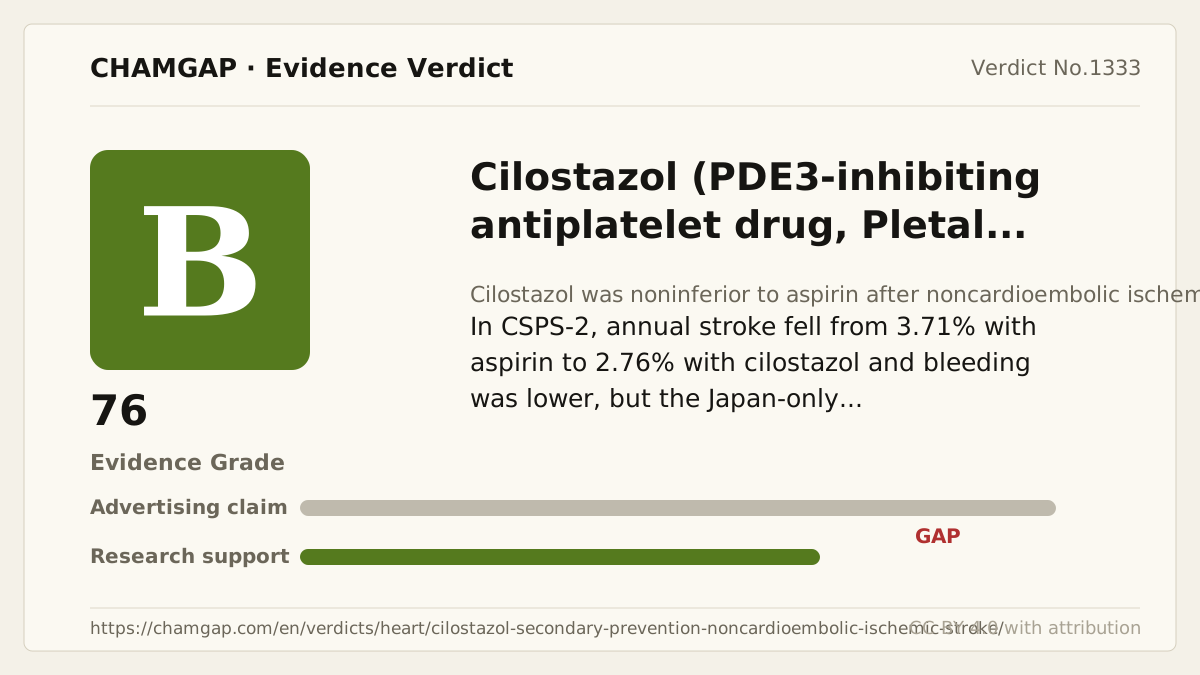
research showsIn CSPS-2, annual stroke fell from 3.71% with aspirin to 2.76% with cilostazol and bleeding was lower, but the Japan-only active-controlled evidence supports B with 76 points. Fewer recurrent strokes and fewer serious bleeding events than with an active comparator are strengths. Unlike prior antiplatelet verdicts 1172 and 1321, this verdict concerns PDE3-inhibiting cilostazol for secondary prevention after noncardioembolic stroke, with limited generalizability beyond Asian populations and settings.
ads claimMarketing can simplify cilostazol as universally superior to aspirin and free of bleeding risk. Evidence mainly concerns secondary prevention after noncardioembolic stroke in Asian populations; cardioembolic stroke requires a separate anticoagulation strategy.
Useful facts when choosing a product
- Secondary-stroke-prevention dosing follows the prescription; food and CYP3A4 or CYP2C19 inhibitors can alter exposure.
- Headache, diarrhea, palpitations, dizziness, and tachycardia can be more frequent than with aspirin.
- Because of the PDE3-inhibitor class warning, cilostazol is contraindicated in heart failure of any severity.
- Its antiplatelet effect requires clinician review of bleeding risk when combined with other antithrombotic drugs or around procedures.
Chamgap Semantic Classification Code
Candidate index · review held
M.cilostazol.UNK.recurrent-stroke-after-noncardioembolic-ischemic-stroke.prevent.activeMedicinal interventions > Cilostazol > Unknown > recurrent stroke after noncardioembolic ischemic stroke > Occurrence-prevention claim > Active comparator
An automated migration candidate, not an issued permanent code; exact claim scope remains under review. This machine-generated migration candidate helps retrieval but is not a permanent assignment. The original verdict ID and URL remain authoritative.
What the research actually shows
CSPS-2 randomized 2,757 patients with noncardioembolic ischemic stroke under double masking to cilostazol 100 mg twice daily or aspirin 81 mg once daily. Over a mean 29 months, all stroke occurred at 2.76% versus 3.71% per year in favor of cilostazol (HR 0.743, 95% CI 0.564 to 0.981). Cerebral hemorrhage, subarachnoid hemorrhage, or bleeding requiring hospitalization was also lower, 0.77% versus 1.78%. The study was an Otsuka-sponsored, active-controlled noninferiority trial confined to Japan, and headache, palpitations, and tachycardia can limit treatment, precluding an A.
Why this is classified as B (76)
The clinical hard endpoint in CSPS-2 met noninferiority to aspirin and showed signals of superiority and less bleeding. Its active-control design, single-country Japanese population, and industry sponsorship yield B with 76 points.
Counterpoint. Fewer recurrent strokes and fewer serious bleeding events than with an active comparator are strengths. Unlike prior antiplatelet verdicts 1172 and 1321, this verdict concerns PDE3-inhibiting cilostazol for secondary prevention after noncardioembolic stroke, with limited generalizability beyond Asian populations and settings.
Rejudgment record. Cross-check applied — Rated B by accepting the recurrent-stroke hard endpoint and noninferiority with a superiority signal versus aspirin in CSPS-2 while accounting for Japan-centered active-controlled industry-sponsored evidence
Sub-claim grades by effect
This ingredient is marketed for several effects. A single overall grade blends strong and weak claims together, so each effect is graded separately here. The overall grade reflects the strongest disconfirming or core claim.
| Effect (sub-claim) | Grade | Basis |
|---|---|---|
| Prevention of recurrent stroke of any type | B | CSPS-2 found annual rates of 2.76% versus 3.71%, HR 0.743. |
| Noninferior secondary prevention versus aspirin | B | The prespecified noninferiority margin of 1.33 was met, and the point estimate favored cilostazol. |
| Signal of fewer recurrences versus aspirin | B | The 95% confidence interval remained below 1, but one Japanese trial does not establish universal comparative superiority. |
Cross-check — AI research and Codex final gate
Evidence Table
| Study | Design | Sample | Funding | Endpoint | Result | Weight |
|---|---|---|---|---|---|---|
| CSPS 2 group (Shinohara Y et al.). 2010 | Randomized double-blind aspirin-controlled noninferiority trial | 2,757 randomized; 2,672 analyzed | Otsuka Pharmaceutical | First stroke | 2.76% versus 3.71% per year; HR 0.743 (95% CI 0.564 to 0.981). | Key active-controlled hard-endpoint trial |
| Kamal AK et al. 2011 Cochrane review | Systematic review and meta-analysis of randomized trials | Two trials with 3,477 participants | Academic systematic review | Stroke, myocardial infarction, vascular death, and bleeding | All stroke 5.54% versus 8.32%; RR 0.67 (95% CI 0.52 to 0.86), based on Asian data. | Directional support with generalizability limitation |
Receipt — 3 References
All 3 cited sources were verified for existence at the original page (as of 2026-07-23).
Final verification and publication gate: Codex · Evidence date: 2026-07-23 · Corrections: none
Cite this verdict
[Chamgap] Cilostazol x prevention of recurrent stroke after noncardioembolic ischemic stroke — Evidence Grade B·76. 3 cited sources checked. Source: https://chamgap.com/en/verdicts/heart/cilostazol-secondary-prevention-noncardioembolic-ischemic-stroke/ · CC BY 4.0CC BY 4.0 — free to use with attribution; do not distort grades, numbers, or verdict meaning.
What this document does and does not do
Chamgap is an information source. It reports what research has and has not confirmed; it does not tell readers what to take or buy. That decision belongs to readers and, when needed, medical or legal professionals. This verdict reflects literature available up to the search date and may change as new research appears. Nothing here is medical advice.