
Calcium-only supplement,
does it really help with Increased myocardial-infarction risk?
research showsC. Cardiovascular events were prespecified secondary endpoints rather than post hoc collection. Adjudicated reported MI was 21/732 versus 10/739, RR 2.12 (1.01–4.47), while national-data ascertainment yielded 31/732 versus 21/739, RR 1.49 (0.86–2.57).
ads claimCalcium-only supplements, calcium plus vitamin D, and dietary calcium must not be merged.
Useful facts when choosing a product
- Verdict 069 is C with 45 points for bone health, BMD, and fracture prevention; this verdict concerns MI harm.
- The positive adjudicated-report analysis became nonsignificant after national-database events were added.
- Regulatory judgments were not used as grading evidence.
Chamgap Semantic Classification Code
Candidate index · review held
S.calcium-only-supplement.UNK.myocardial-infarction-risk.increase.placeboSupplements and nutraceuticals > Calcium-only supplement > Unknown > myocardial-infarction risk > Increase claim > Placebo
An automated migration candidate, not an issued permanent code; exact claim scope remains under review. This machine-generated migration candidate helps retrieval but is not a permanent assignment. The original verdict ID and URL remain authoritative.
What the research actually shows
With complete ascertainment, MI was 31/732 (4.2%) versus 21/739 (2.8%), RR 1.49 (0.86–2.57); stroke was 34/732 (4.6%) versus 25/739 (3.4%), RR 1.37 (0.83–2.28); and death was 34/732 (4.6%) versus 29/739 (3.9%), RR 1.18 (0.73–1.92). Every interval included 1. The primary skeletal outcomes showed BMD differences of 1.8% at the spine, 1.6% at the total hip, and 1.2% for total body, but symptomatic fracture HR was 0.90 (0.71–1.16). An independent calcium-only trial reported 104 versus 103 five-year atherosclerotic vascular events, adjusted HR 0.938 (0.690–1.275).
Why this is classified as C (56)
The grade rises to C with 56 points because cardiovascular events were prespecified secondary endpoints, not post hoc collection. They were not primary endpoints, and complete ascertainment plus an independent calcium-only trial did not confirm harm.
Counterpoint. The confidence interval does not exclude substantial harm.
Rejudgment record. New verdict — The prespecified secondary cardiovascular endpoint became nonsignificant when unreported national-database events were included
| Endpoint | H | Hard endpoint - actual events such as death |
| Replication | R1 | Single confirmatory trial |
| Independence | I2 | Decisive evidence is publicly or non-profit funded |
| Effect size | E+ | Meets the clinically important threshold |
| Precision | C0 | The confidence interval leaves room for benefit |
Stored derived and displayed grades match; this is not a current recalculation or validity check (C).
Sub-claim grades by effect
This ingredient is marketed for several effects. A single overall grade blends strong and weak claims together, so each effect is graded separately here. The overall grade reflects the strongest disconfirming or core claim.
| Effect (sub-claim) | Grade | Basis |
|---|---|---|
| Increased myocardial infarction | C | Null with complete ascertainment |
Cross-check — AI research and Codex final gate
Evidence Table
| Study | Design | Sample | Funding | Endpoint | Result | Weight |
|---|---|---|---|---|---|---|
| Bolland et al., 2008 | Prespecified secondary cardiovascular analysis of a five-year randomized placebo-controlled trial | 1,471 women, 732 versus 739 | Health Research Council of New Zealand and University of Auckland School of Medicine Foundation | Myocardial infarction, stroke, and death | Complete-ascertainment MI RR 1.49 (0.86–2.57); stroke 1.37 (0.83–2.28); death 1.18 (0.73–1.92) | Pivotal RCT secondary safety analysis |
| Lewis et al., 2011 | Five-year calcium-only randomized trial with 4.5-year follow-up | 1,460 women | As reported in the verified source record | Atherosclerotic vascular hospitalization or death | Five-year events 104 versus 103; adjusted HR 0.938 (0.690–1.275); 9.5-year HR 0.919 (0.737–1.146) | Independent calcium-only trial |
Receipt — 3 References
All 3 cited sources were verified for existence at the original page (as of 2026-08-07).
Final verification and publication gate: Codex · Evidence date: 2026-08-07 · Corrections: none
Cite this verdict
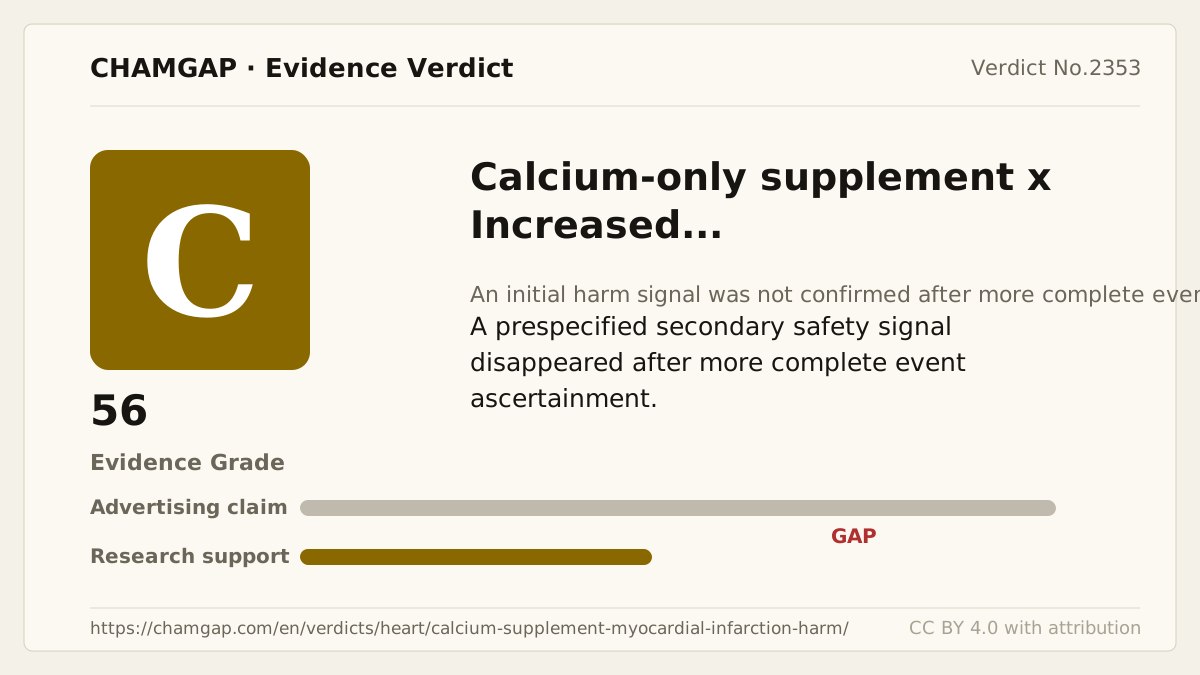
[Chamgap] Calcium supplements × increased myocardial-infarction risk — Evidence Grade C·56. 3 cited sources checked. Source: https://chamgap.com/en/verdicts/heart/calcium-supplement-myocardial-infarction-harm/ · CC BY 4.0CC BY 4.0 — free to use with attribution; do not distort grades, numbers, or verdict meaning.
What this document does and does not do
Chamgap is an information source. It reports what research has and has not confirmed; it does not tell readers what to take or buy. That decision belongs to readers and, when needed, medical or legal professionals. This verdict reflects literature available up to the search date and may change as new research appears. Nothing here is medical advice.