
CABG,
does it really help with Reduction of death, myocardial infarction, or stroke versus PCI in diabetes with multivessel coronary disease?
research showsFor surgery-eligible patients with diabetes and multivessel coronary disease, CABG reduces the five-year composite of death, myocardial infarction, or stroke versus PCI and is graded B. FREEDOM randomized and analyzed 1,900 patients by intention to treat; the primary outcome was 18.7% versus 26.6%, absolute difference 7.9 percentage points (95% CI 3.3 to 12.5), P=0.005. An independent individual-patient synthesis of 11 trials and 11,518 participants replicated the mortality advantage in diabetes. The active-only PCI comparison creates a B1 ceiling. Stroke was higher with CABG, 5.2% versus 2.4%, P=0.03, a safety tradeoff not used as an efficacy axis.
ads claimSaying that every person with diabetes should have surgery erases anatomy, surgical risk, preference, and stroke risk.
Useful facts when choosing a product
- FREEDOM compared CABG with PCI using drug-eluting stents, with guideline-based medical therapy in both groups.
- Verdict 1791, which is A with 86 points, concerns primary PCI for emergency STEMI; this verdict concerns elective revascularization for multivessel disease and uses PCI as the comparator.
- Verdict 1172, which is B with 72 points, concerns the drug ticagrelor. Drug evidence was not transferred to this surgical claim.
Chamgap Semantic Classification Code
Candidate index · review held
P.coronary-artery-bypass-grafting.UNK.death-myocardial-infarction-or-stroke.reduce.activeProcedures, devices and tests > Coronary artery bypass grafting > Unknown > death, myocardial infarction, or stroke > Reduction claim > Active comparator
An automated migration candidate, not an issued permanent code; exact claim scope remains under review. This machine-generated migration candidate helps retrieval but is not a permanent assignment. The original verdict ID and URL remain authoritative.
What the research actually shows
Farkouh and colleagues randomized 1,900 patients with diabetes and multivessel coronary disease to PCI with drug-eluting stents in 953 or CABG in 947, and analyzed all 1,900 by intention to treat. The five-year primary composite of all-cause death, nonfatal myocardial infarction, or nonfatal stroke was 26.6% versus 18.7%, absolute difference 7.9 percentage points (3.3 to 12.5), P=0.005, meeting superiority. NHLBI public funding was central, with support and products from several companies. Head and colleagues pooled individual data from 11 trials and 11,518 participants: five-year mortality was 11.2% with PCI and 9.2% with CABG, HR 1.20 (1.06 to 1.37), and 15.5% versus 10.0% in diabetes, HR 1.48 (1.19 to 1.84). The pooled analysis reported no funding.
Why this is classified as B (76)
The profile is H, R2, I1, E+, and B1, with big_hard_rct true. The large trial and 11-trial individual-patient synthesis replicated hard-outcome benefit, but the active-only comparison yields B with 76 points.
Counterpoint. In FREEDOM, stroke was more frequent with CABG, 5.2% versus 2.4% with PCI. A heart team should weigh that finding and CABG recovery against PCI risks of myocardial infarction and repeat revascularization.
Rejudgment record. Cross-check applied — Accepted the large hard-outcome trial and independent randomized synthesis, with a B1 ceiling for active-only comparison
| Endpoint | H | Hard endpoint - actual events such as death |
| Replication | R2 | Independently replicated across trials |
| Independence | I1 | Mixed funding sources |
| Effect size | E+ | Meets the clinically important threshold |
Stored derived and displayed grades match; this is not a current recalculation or validity check (B).
Sub-claim grades by effect
This ingredient is marketed for several effects. A single overall grade blends strong and weak claims together, so each effect is graded separately here. The overall grade reflects the strongest disconfirming or core claim.
| Effect (sub-claim) | Grade | Basis |
|---|---|---|
| Reduction of the composite of death, myocardial infarction, or stroke | B | The primary endpoint succeeded and randomized evidence was replicated, but comparison was active-only. |
| Reduction of long-term all-cause mortality | B | This was replicated in the diabetes subgroup of an 11-trial individual-patient analysis. |
| Reduction of nonfatal myocardial infarction | B | This was a major component driving the FREEDOM composite benefit. |
Cross-check — AI research and Codex final gate
Evidence Table
| Study | Design | Sample | Funding | Endpoint | Result | Weight |
|---|---|---|---|---|---|---|
| Farkouh ME et al. 2012 (FREEDOM) | Multicenter randomized active-controlled superiority trial | 1,900 randomized and 1,900 analyzed by intention to treat | Primarily NHLBI U01 public funding, with support or products from several companies including Cordis and Johnson & Johnson | Five-year composite of all-cause death, nonfatal myocardial infarction, or nonfatal stroke | CABG 18.7% versus PCI 26.6%, absolute difference 7.9 percentage points (95% CI 3.3 to 12.5), P=0.005; primary endpoint successful. | Decisive large hard-outcome randomized trial |
| Head SJ et al. 2018 | Individual-patient pooled analysis of 11 randomized trials | 11 trials and 11,518 participants | No funding for the pooled analysis | Five-year all-cause mortality | Overall PCI 11.2% versus CABG 9.2%, HR 1.20 (1.06 to 1.37); diabetes subgroup 15.5% versus 10.0%, HR 1.48 (1.19 to 1.84). | Independent randomized replication |
Receipt — 2 References
All 2 cited sources were verified for existence at the original page (as of 2026-07-24).
Final verification and publication gate: Codex · Evidence date: 2026-07-24 · Corrections: none
Cite this verdict
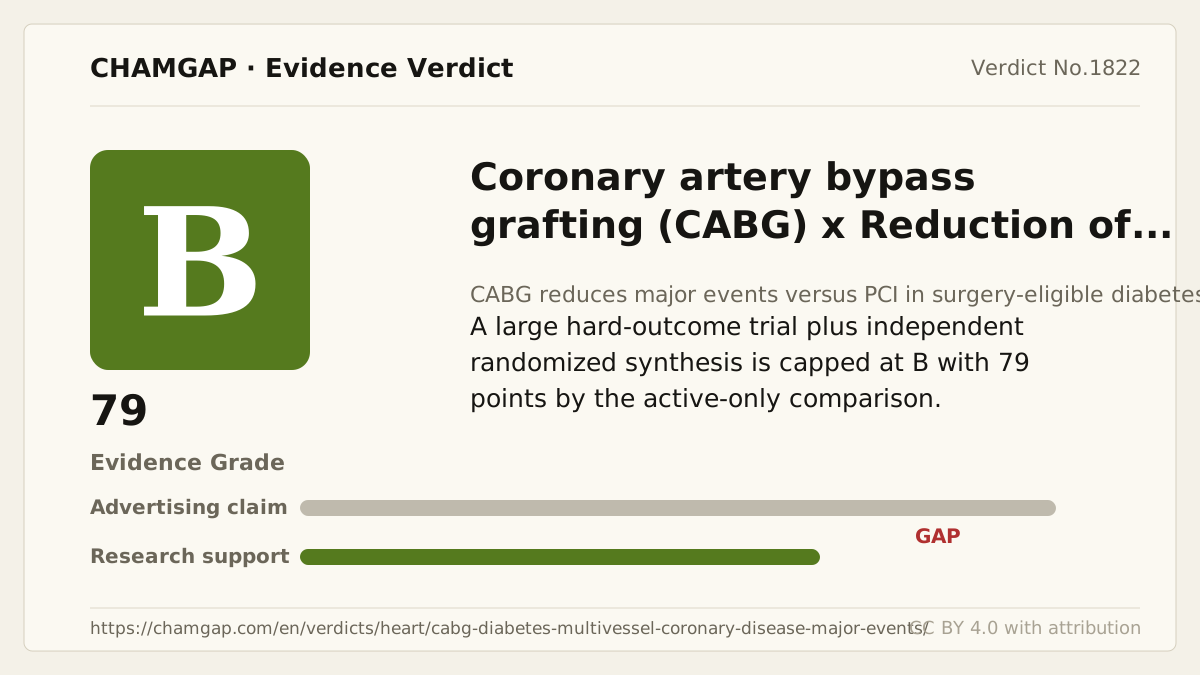
[Chamgap] CABG x major-event reduction in diabetes with multivessel coronary disease — Evidence Grade B·76. 2 cited sources checked. Source: https://chamgap.com/en/verdicts/heart/cabg-diabetes-multivessel-coronary-disease-major-events/ · CC BY 4.0CC BY 4.0 — free to use with attribution; do not distort grades, numbers, or verdict meaning.
What this document does and does not do
Chamgap is an information source. It reports what research has and has not confirmed; it does not tell readers what to take or buy. That decision belongs to readers and, when needed, medical or legal professionals. This verdict reflects literature available up to the search date and may change as new research appears. Nothing here is medical advice.