
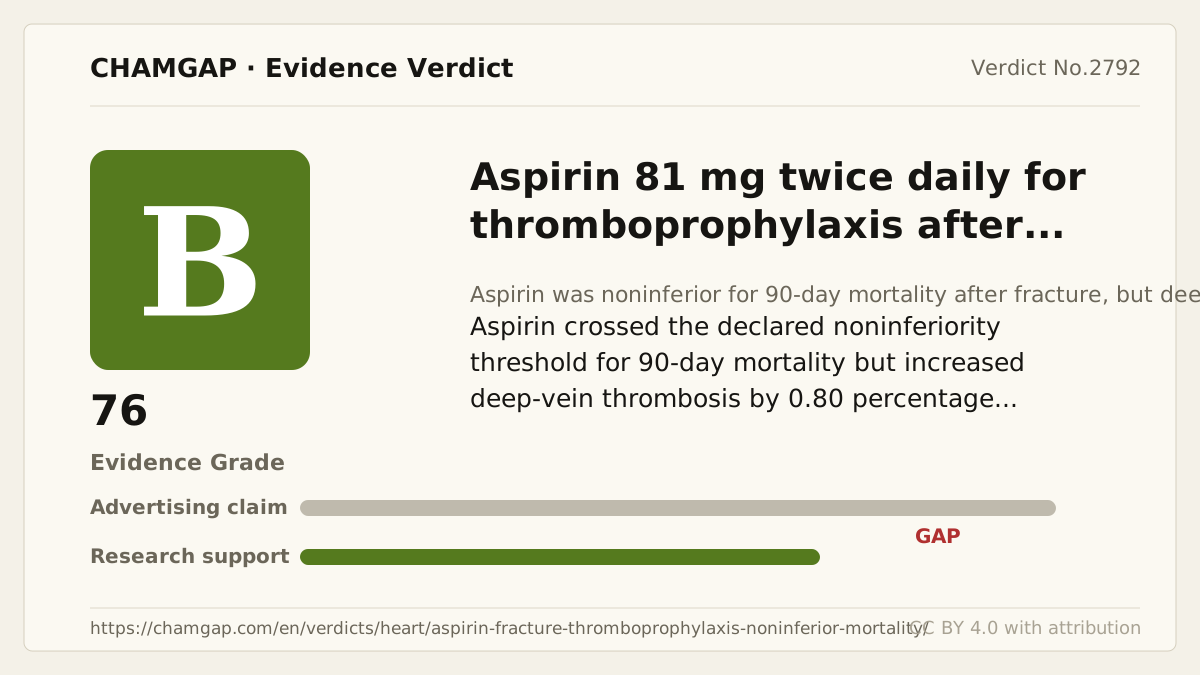
Aspirin 81 mg twice daily for thromboprophylaxis after fracture,
does it really help with Noninferior 90-day mortality compared with low-molecular-weight heparin?
research showsThe grade is B with 76 points. In 12,211 PREVENT CLOT participants, 90-day death occurred in 47/6,101 (0.78%) with aspirin and 45/6,110 (0.73%) with low-molecular-weight heparin, an absolute difference of +0.05 points (96.2% CI -0.27 to +0.38). The upper bound stayed below the prespecified +0.75-point margin derived from patient-preference and clinician research. However, deep-vein thrombosis was more frequent with aspirin, 2.51% versus 1.71%, a +0.80-point difference, while pulmonary embolism was 1.49% in both groups. The accurate conclusion is noninferior mortality but more deep-vein thrombosis.
ads claimSaying aspirin was completely the same as heparin is inaccurate. Mortality was noninferior, deep-vein thrombosis was more frequent, and only pulmonary embolism was equal.
Useful facts when choosing a product
- In-hospital trial doses were aspirin 81 mg twice daily and enoxaparin 30 mg twice daily.
- Postdischarge prophylaxis followed each hospital's clinical protocol, with a median 21-day prescription.
- Oral convenience and lower cost must be weighed against the increase in deep-vein thrombosis.
Chamgap Semantic Classification Code
Candidate index · review held
UNK.aspirin-twice.UNK.mortality.noninferior.UNKUnknown > Aspirin twice > Unknown > mortality > Noninferiority claim > Unknown
An automated migration candidate, not an issued permanent code; exact claim scope remains under review. This machine-generated migration candidate helps retrieval but is not a permanent assignment. The original verdict ID and URL remain authoritative.
What the research actually shows
This pragmatic trial at 21 trauma centers assigned 6,101 participants to aspirin and 6,110 to enoxaparin in hospital. The primary analysis used intention to treat, 90-day mortality data were available for 96.8%, and the per-protocol estimate was consistent at +0.03 points (96.2% CI -0.31 to +0.38). Deep-vein thrombosis was 2.51% versus 1.71%, absolute difference +0.80 points (95% CI +0.28 to +1.31). Pulmonary embolism was 1.49% versus 1.49%, absolute difference 0.00 points (95% CI -0.43 to +0.43). It was an investigator-initiated trial funded by the nonprofit Patient-Centered Outcomes Research Institute.
Why this is classified as B (76)
A 12,211-participant publicly funded trial met the declared +0.75-point mortality noninferiority margin, but this is one noninferiority trial without independent replication and deep-vein thrombosis increased, giving a B with 76 points.
Counterpoint. Noninferior mortality does not establish equivalence on every thrombotic outcome; deep-vein thrombosis significantly increased with aspirin.
Rejudgment record. Cross-check applied — A 12,211-participant publicly funded trial met its declared mortality noninferiority margin, but this is one noninferiority trial without independent replication and deep-vein thrombosis increased
| Endpoint | H | Hard endpoint - actual events such as death |
| Replication | R1 | Single confirmatory trial |
| Independence | I2 | Decisive evidence is publicly or non-profit funded |
| Effect size | E+ | Meets the clinically important threshold |
Stored derived and displayed grades match; this is not a current recalculation or validity check (B).
Sub-claim grades by effect
This ingredient is marketed for several effects. A single overall grade blends strong and weak claims together, so each effect is graded separately here. The overall grade reflects the strongest disconfirming or core claim.
| Effect (sub-claim) | Grade | Basis |
|---|---|---|
| Noninferior 90-day all-cause mortality | C | The +0.05-point difference had an upper CI bound of +0.38, below the prespecified +0.75-point margin. |
| Equivalent deep-vein thrombosis | D | DVT was higher with aspirin, 2.51% versus 1.71%, an absolute increase of 0.80 points. |
| Equivalent pulmonary embolism | C | Both groups had 1.49%, an absolute difference of 0.00 points. |
Cross-check — AI research and Codex final gate
Evidence Table
| Study | Design | Sample | Funding | Endpoint | Result | Weight |
|---|---|---|---|---|---|---|
| METRC. 2023 PREVENT CLOT | Pragmatic open-label randomized noninferiority trial at 21 centers | 12,211 randomized and analyzed by intention to treat, 6,101 aspirin and 6,110 low-molecular-weight heparin | Public and nonprofit funding from the Patient-Centered Outcomes Research Institute | Death from any cause at 90 days | 47/6,101 (0.78%) versus 45/6,110 (0.73%), absolute difference +0.05 points (96.2% CI -0.27 to +0.38), P<.001 for a +0.75-point noninferiority margin. DVT difference +0.80 points (95% CI +0.28 to +1.31); PE difference 0.00 points (95% CI -0.43 to +0.43). | Large publicly funded hard-outcome trial, retaining both mortality and DVT findings |
Receipt — 1 References
All 1 cited sources were verified for existence at the original page (as of 2026-08-18).
Final verification and publication gate: Codex · Evidence date: 2026-08-18 · Corrections: none
Cite this verdict
[Chamgap] Benefit of Aspirin for Noninferior Mortality After Fracture Thromboprophylaxis — Evidence Grade B·76. 1 cited sources checked. Source: https://chamgap.com/en/verdicts/heart/aspirin-fracture-thromboprophylaxis-noninferior-mortality/ · CC BY 4.0CC BY 4.0 — free to use with attribution; do not distort grades, numbers, or verdict meaning.
What this document does and does not do
Chamgap is an information source. It reports what research has and has not confirmed; it does not tell readers what to take or buy. That decision belongs to readers and, when needed, medical or legal professionals. This verdict reflects literature available up to the search date and may change as new research appears. Nothing here is medical advice.