
Three months of oxaliplatin-based adjuvant chemotherapy,
does it really help with Noninferior 3-year disease-free survival versus six months in high-risk stage II-III colorectal cancer?
research showsThe grade is B. In 6,088 SCOT participants, 3-year DFS was 76.7% versus 77.1%, difference -0.4 points. HR 1.006 (95% CI 0.909 to 1.114) stayed within the 1.13 margin. Grade 2 or worse neuropathy fell from 58% to 25%.
ads claimThis does not mean everyone can receive half the chemotherapy. It balances a bounded recurrence risk against major neurotoxicity reduction.
Useful facts when choosing a product
- Oxaliplatin neuropathy is cumulative-dose dependent and may persist permanently.
- Grade 2 or worse neuropathy was 25% versus 58%.
Chamgap Semantic Classification Code
Candidate index · review held
M.oxaliplatin-based-adjuvant-chemotherapy.MULTI.colorectal-cancer-disease-free-survival.noninferior.durationMedicinal interventions > Oxaliplatin-based adjuvant chemotherapy > Multiple: primary unresolved > Disease-free survival in colorectal cancer > Noninferiority claim > Duration contrast
An automated migration candidate, not an issued permanent code; exact claim scope remains under review. This machine-generated migration candidate helps retrieval but is not a permanent assignment. The original verdict ID and URL remain authoritative.
What the research actually shows
SCOT was an open-label phase 3 randomized noninferiority trial of 6,088 patients. Four-gate bias review: ① defect: noninferiority design; ② listed item: noninferiority design; ③ source prespecified 'less than a 2.5% fall in 3 year disease-free survival' and HR margin 1.13, while the CI upper bound was 1.114; ④ avoidable: yes, so it counts once. Survival censoring was not dropout. MRC and Cancer Research UK supplied public/nonprofit funding. Verdict 2901 is B with 76 points and uses the same duration-shortening concept in HER2-positive breast cancer, but for trastuzumab cardiotoxicity rather than colorectal-cancer oxaliplatin neuropathy.
Why this is classified as B (76)
One large publicly funded hard-outcome noninferiority trial gives B with 76 points.
Counterpoint. Regimen and recurrence risk require individualization.
Rejudgment record. New verdict — Large publicly funded hard-outcome RCT meeting a prespecified margin, with noninferiority design counted
| Endpoint | H | Hard endpoint - actual events such as death |
| Replication | R1 | Single confirmatory trial |
| Independence | I2 | Decisive evidence is publicly or non-profit funded |
| Effect size | E+ | Meets the clinically important threshold |
Stored derived and displayed grades match; this is not a current recalculation or validity check (B).
Sub-claim grades by effect
This ingredient is marketed for several effects. A single overall grade blends strong and weak claims together, so each effect is graded separately here. The overall grade reflects the strongest disconfirming or core claim.
| Effect (sub-claim) | Grade | Basis |
|---|---|---|
| Noninferior 3-year disease-free survival | B | The CI upper bound 1.114 stayed within 1.13. |
| Reduced peripheral neuropathy | B | Grade 2+ neuropathy fell from 58% to 25%. |
Cross-check — AI research and Codex final gate
Evidence Table
| Study | Design | Sample | Funding | Endpoint | Result | Weight |
|---|---|---|---|---|---|---|
| Iveson TJ et al. 2018 SCOT | International phase 3 open-label randomized noninferiority trial | 6,088 participants | Public/nonprofit funding including MRC and Cancer Research UK | 3-year disease-free survival | 76.7% versus 77.1%, HR 1.006 (95% CI 0.909 to 1.114), margin 1.13; grade 2+ neuropathy 25% versus 58%. | Pivotal large hard-outcome evidence |
Receipt — 1 References
All 1 cited sources were verified for existence at the original page (as of 2026-08-26).
Final verification and publication gate: Codex · Evidence date: 2026-08-26 · Corrections: none
Cite this verdict
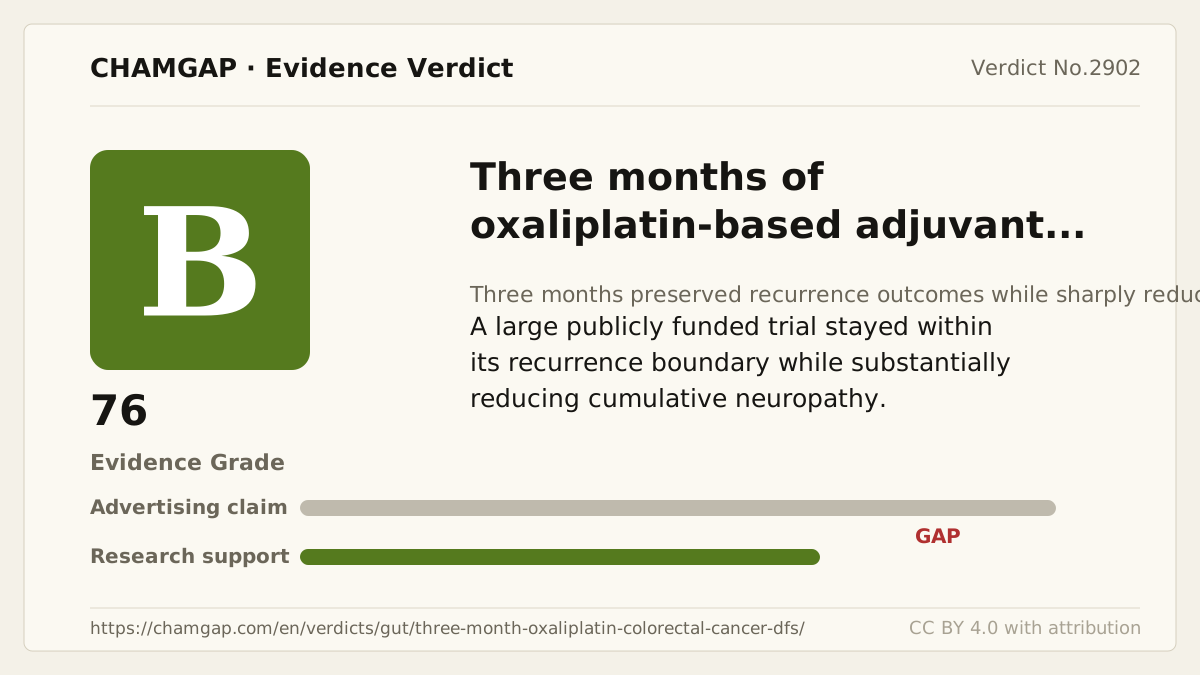
[Chamgap] Benefit of 3-Month Adjuvant Oxaliplatin Chemotherapy for Noninferior 3-Year Disease-Free Survival in High-Risk Stage II-III Colorectal Cancer — Evidence Grade B·76. 1 cited sources checked. Source: https://chamgap.com/en/verdicts/gut/three-month-oxaliplatin-colorectal-cancer-dfs/ · CC BY 4.0CC BY 4.0 — free to use with attribution; do not distort grades, numbers, or verdict meaning.
What this document does and does not do
Chamgap is an information source. It reports what research has and has not confirmed; it does not tell readers what to take or buy. That decision belongs to readers and, when needed, medical or legal professionals. This verdict reflects literature available up to the search date and may change as new research appears. Nothing here is medical advice.