
Once-only flexible sigmoidoscopy screening,
does it really help with Reduced distal colorectal cancer incidence and colorectal cancer mortality in asymptomatic middle-aged adults?
research showsOnce-only flexible sigmoidoscopy screening is rated A because it reduces colorectal cancer incidence, particularly distal cancer, and colorectal-cancer-specific mortality in asymptomatic middle-aged adults. Independent large randomized trials including UKFSST, PLCO, NORCCAP, and SCORE reproduced the benefit; a USPSTF evidence review of four trials and 458,002 participants found a colorectal-cancer-specific mortality incidence rate ratio of 0.74. Effects are greatest distally, and all-cause mortality has not been shown to decrease. Multiple independent large randomized trials reproducing disease-specific mortality benefit meet the A standard, with 92 points.
ads claimPromotion may claim that one examination markedly reduces every colorectal cancer and all-cause mortality. The effect is strongest for distal cancer, smaller proximally, and the established standard endpoint is colorectal-cancer-specific rather than all-cause mortality.
Useful facts when choosing a product
- Flexible sigmoidoscopy inspects the lower colon, including the rectum and sigmoid; abnormal findings can lead to full colonoscopy and polypectomy.
- Bowel preparation such as an enema is required, and discomfort or abdominal pain can occur during the procedure.
- Perforation and major bleeding are rare but possible, with much of the risk arising from follow-up colonoscopy and polypectomy.
- Korea's national colorectal screening program is centered on fecal occult blood testing, so age, individual risk, and available screening options should be discussed with a clinician.
Chamgap Semantic Classification Code
Candidate index · review held
P.once-only-flexible-sigmoidoscopy-screening.diagnostic.distal-colorectal-cancer-incidence-and-colorectal-cancer-mortality.reduce.UNKProcedures, devices and tests > Once-only flexible sigmoidoscopy screening > Diagnostic or screening > distal colorectal cancer incidence and colorectal cancer mortality > Reduction claim > Unknown
An automated migration candidate, not an issued permanent code; exact claim scope remains under review. This machine-generated migration candidate helps retrieval but is not a permanent assignment. The original verdict ID and URL remain authoritative.
What the research actually shows
UKFSST randomized about 170,000 adults aged 55 to 64 years to invitation for one examination or control and showed long-term reductions in incidence and colorectal cancer mortality. PLCO randomized 154,900 adults aged 55 to 74 years and included a repeat examination after three or five years; long-term follow-up retained incidence RR 0.82 and colorectal cancer mortality RR 0.75. Population-based NORCCAP and SCORE trials produced results in the same direction. The 2021 USPSTF review synthesized four randomized trials and 458,002 participants with a colorectal-cancer-specific mortality incidence rate ratio of 0.74.
Why this is classified as A (92)
Across four independent large randomized trials and 458,002 participants, colorectal-cancer-specific mortality was reproducibly reduced with an incidence rate ratio of 0.74, and incidence also fell. Benefits are distal-predominant and all-cause mortality is not clearly reduced, but the standard hard endpoint for screening is disease-specific mortality, giving A with 92 points.
Counterpoint. Other validated strategies, including stool testing and colonoscopy, mean sigmoidoscopy is not the only option. The practical priority is completing an evidence-based screening strategy at the appropriate age and risk level and following positive results through.
Rejudgment record. New verdict — Centered the assessment on replicated reductions in colorectal cancer incidence and colorectal-cancer-specific mortality across independent population randomized trials including UKFSST, PLCO, NORCCAP, and SCORE, while strictly distinguishing all-cause from disease-specific mortality
Sub-claim grades by effect
This ingredient is marketed for several effects. A single overall grade blends strong and weak claims together, so each effect is graded separately here. The overall grade reflects the strongest disconfirming or core claim.
| Effect (sub-claim) | Grade | Basis |
|---|---|---|
| Reduction in distal colorectal cancer incidence | A | The largest and most consistent effect was reproduced across several independent large randomized trials. |
| Reduction in colorectal-cancer-specific mortality | A | A synthesis of four randomized trials and 458,002 participants found IRR 0.74, reproducing a direct hard-endpoint benefit. |
| Reduction in proximal colorectal cancer incidence and mortality | B | Follow-up colonoscopy may reduce some incidence, but effects are smaller than distally and mortality benefit is inconsistent. |
Cross-check — AI research and Codex final gate
Evidence Table
| Study | Design | Sample | Funding | Endpoint | Result | Weight |
|---|---|---|---|---|---|---|
| Atkin WS et al. UKFSST. 2010 | Multicenter population-based randomized controlled trial | 170,432 adults aged 55 to 64 years | United Kingdom public and cancer-research support | Colorectal cancer incidence and colorectal-cancer-specific mortality | Invitation to one examination reduced long-term incidence and mortality, with the largest incidence reduction distally. | Key independent large randomized trial |
| Schoen RE et al. PLCO. 2012; Miller EA et al. 2019 follow-up | Large randomized screening trial with long-term follow-up | 154,900 adults aged 55 to 74 years | United States National Cancer Institute | Colorectal cancer incidence and disease-specific mortality | Long-term incidence RR was 0.82 and mortality RR 0.75; mortality reduction was limited to the distal colon. | Key independent replication |
| Lin JS et al. USPSTF evidence review. 2021 | Systematic evidence review | 4 flexible-sigmoidoscopy randomized trials and 458,002 participants | AHRQ and USPSTF | Colorectal-cancer-specific mortality and harms | Invitation to one or two sigmoidoscopies yielded colorectal-cancer-specific mortality IRR 0.74 (95% CI 0.68 to 0.80). | Large evidence synthesis |
Receipt — 4 References
All 4 cited sources were verified for existence at the original page (as of 2026-07-23).
Final verification and publication gate: Codex · Evidence date: 2026-07-23 · Corrections: none
Cite this verdict
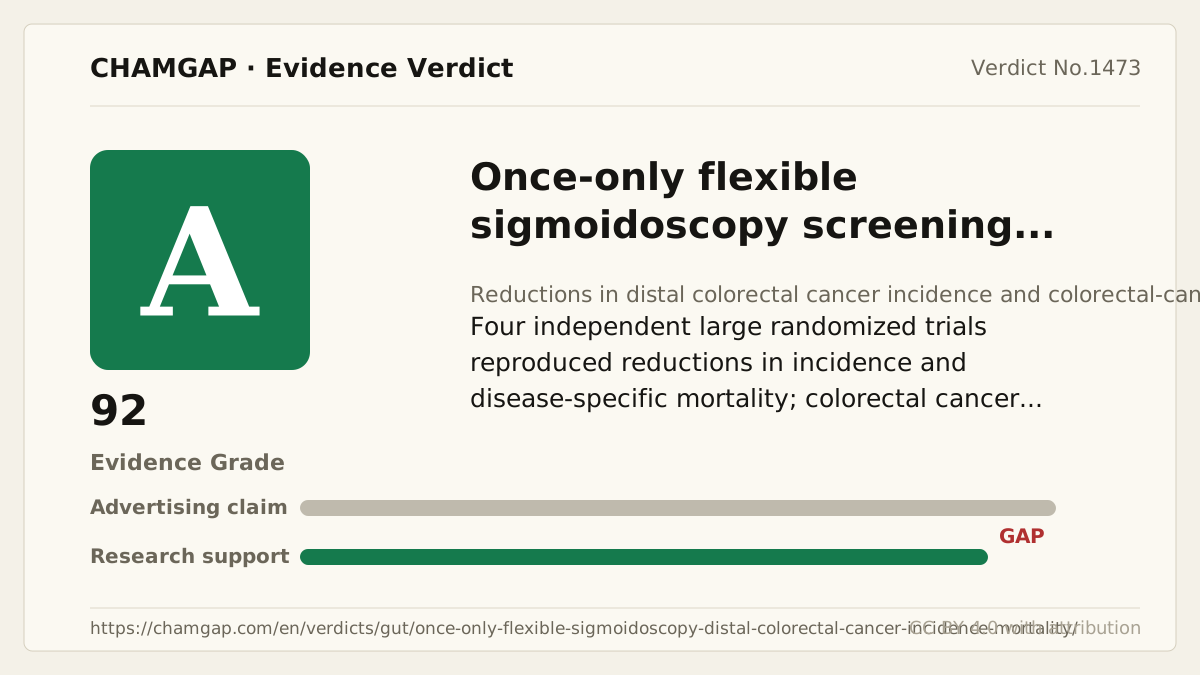
[Chamgap] Once-only flexible sigmoidoscopy screening x Reduced distal colorectal cancer incidence and colorectal cancer mortality in asymptomatic middle-aged adults — Evidence Grade A·92. 4 cited sources checked. Source: https://chamgap.com/en/verdicts/gut/once-only-flexible-sigmoidoscopy-distal-colorectal-cancer-incidence-mortality/ · CC BY 4.0CC BY 4.0 — free to use with attribution; do not distort grades, numbers, or verdict meaning.
What this document does and does not do
Chamgap is an information source. It reports what research has and has not confirmed; it does not tell readers what to take or buy. That decision belongs to readers and, when needed, medical or legal professionals. This verdict reflects literature available up to the search date and may change as new research appears. Nothing here is medical advice.