
Helicobacter pylori eradication therapy,
does it really help with Prevention of incident gastric cancer in asymptomatic infected people?
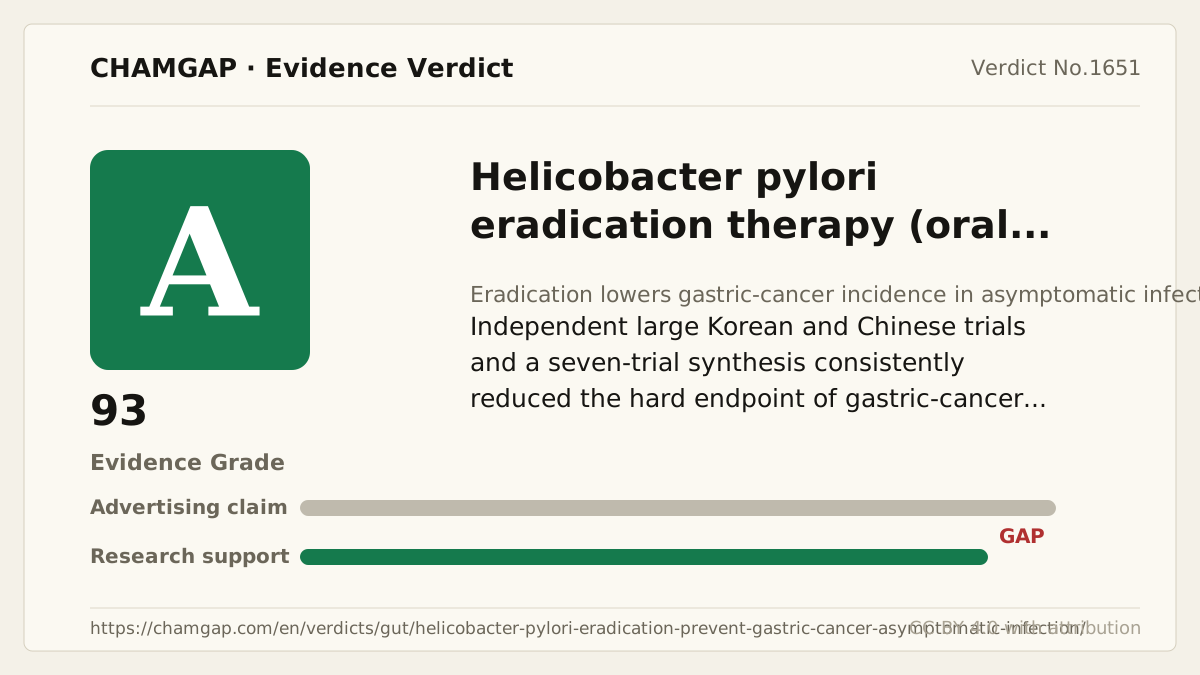
research showsHelicobacter pylori eradication therapy is rated A because it reduces incident gastric cancer in asymptomatic infected people. In the Korean family-history trial's modified intention-to-treat population of 1,676, the successful primary outcome occurred in 10 of 832 versus 23 of 844 participants (HR 0.45). An independent Chinese trial of 1,630 participants found 21 of 817 versus 35 of 813 cases after 26.5 years (HR 0.57). A Cochrane review of seven trials and 8,323 participants agreed, with RR 0.54. Multiple independent large trials with a cancer-incidence hard endpoint support A with 93 points; gastric-cancer mortality is supported, but all-cause mortality was not reduced.
ads claimPromotion can turn risk reduction into complete prevention or lifelong reassurance after one course. The evidence shows lower risk, not zero risk, and successful-eradication testing and risk-based endoscopic follow-up remain necessary.
Useful facts when choosing a product
- Eradication therapy is prescribed after infection is confirmed and combines acid suppression with multiple antibiotics; triple or quadruple therapy is selected according to local resistance and prior antibiotic exposure.
- Successful eradication should be checked after an appropriate interval with a urea breath test or stool antigen test; symptom improvement alone does not prove cure.
- Eradication does not remove all residual cancer risk associated with established atrophy or intestinal metaplasia, so high-risk people still require endoscopic surveillance.
- Diarrhea, abdominal discomfort, nausea, taste disturbance, and allergy can occur, while unnecessary or poorly selected antibiotics promote resistance and disrupt the gut microbiome.
Chamgap Semantic Classification Code
Candidate index · review held
UNK.helicobacter-pylori-eradication-therapy.oral.incident-gastric-cancer-in-asymptomatic-infected-people.prevent.placeboUnknown > Helicobacter pylori eradication therapy > Oral > incident gastric cancer in asymptomatic infected people > Occurrence-prevention claim > Placebo
An automated migration candidate, not an issued permanent code; exact claim scope remains under review. This machine-generated migration candidate helps retrieval but is not a permanent assignment. The original verdict ID and URL remain authoritative.
What the research actually shows
The Korean single-center double-blind trial randomized 1,838 first-degree relatives and analyzed 1,676 in the modified intention-to-treat primary analysis. Over a median 9.2 years, gastric cancer occurred in 10 of 832 versus 23 of 844 participants, HR 0.45. The independent Chinese trial followed 1,630 asymptomatic infected participants for 26.5 years and met its primary endpoint with 21 of 817 versus 35 of 813 cases, HR 0.57. The 2020 Cochrane review reported gastric-cancer incidence RR 0.54 in seven trials with 8,323 participants and gastric-cancer mortality RR 0.61 in four trials with 6,301 participants, but all-cause mortality was neutral in five trials with 7,079 participants, RR 0.97. Because Korea has a high gastric-cancer incidence, the absolute practical benefit can be substantial.
Why this is classified as A (93)
The primary gastric-cancer endpoint succeeded in independent Korean and Chinese trials, with HR 0.45 in 1,676 modified intention-to-treat participants and HR 0.57 in 1,630 participants, and the seven-trial synthesis agreed with RR 0.54. Multiple independent large randomized trials with a cancer-incidence hard endpoint support A with 93 points. Gastric-cancer and all-cause mortality are separated as subclaims.
Counterpoint. This verdict applies after infection is confirmed. Self-directed antibiotic use or omitting post-treatment eradication testing is not the intervention evaluated in the trials.
Rejudgment record. Cross-check applied — Assessed successful primary gastric-cancer incidence endpoints in independent large Korean and Chinese randomized trials together with the consistent seven-trial meta-analysis under the hard-endpoint standard
Sub-claim grades by effect
This ingredient is marketed for several effects. A single overall grade blends strong and weak claims together, so each effect is graded separately here. The overall grade reflects the strongest disconfirming or core claim.
| Effect (sub-claim) | Grade | Basis |
|---|---|---|
| Prevention of incident gastric cancer in asymptomatic infection | A | Multiple independent large trials and a seven-trial synthesis consistently reduced the hard endpoint of gastric-cancer incidence. |
| Reduction in gastric-cancer mortality | B | Four Cochrane trials with 6,301 participants were positive at RR 0.61, but events and precision were lower than for incidence. |
| Reduction in all-cause mortality | D | The pooled estimate from five trials and 7,079 participants was neutral, RR 0.97 (95% CI 0.85 to 1.12). |
Cross-check — AI research and Codex final gate
Evidence Table
| Study | Design | Sample | Funding | Endpoint | Result | Weight |
|---|---|---|---|---|---|---|
| Choi IJ et al. 2020 | Single-center double-blind randomized placebo-controlled trial | 1,838 randomized; primary modified intention-to-treat population 1,676 (832/844) | National Cancer Center, Korea research funding | Primary: incident gastric cancer | Primary endpoint met: 10/832 versus 23/844, HR 0.45 (95% CI 0.21 to 0.94), median 9.2 years. | Large direct hard-endpoint evidence in a high-risk Korean population |
| Yan L et al. 2022 | Long-term follow-up of a prospective randomized placebo-controlled trial | 1,630 asymptomatic infected participants (817/813) | Chinese and Swedish public and academic research support | Primary: incident gastric cancer; secondary: total and cause-specific mortality | Primary endpoint met: 21/817 versus 35/813 gastric cancers over 26.5 years, HR 0.57 (95% CI 0.33 to 0.98). | Independent long-term hard-endpoint confirmation |
| Ford AC et al. Cochrane 2020 | Systematic review and meta-analysis of randomized trials | Gastric-cancer incidence: 7 trials and 8,323 participants; all-cause mortality: 5 trials and 7,079 participants | Academic Cochrane synthesis | Gastric-cancer incidence, gastric-cancer mortality, and all-cause mortality | Gastric-cancer incidence RR 0.54 and gastric-cancer mortality RR 0.61; all-cause mortality was neutral at RR 0.97. | Key consistency and mortality-separation evidence |
Receipt — 3 References
All 3 cited sources were verified for existence at the original page (as of 2026-07-24).
Final verification and publication gate: Codex · Evidence date: 2026-07-24 · Corrections: none
Cite this verdict
[Chamgap] Helicobacter pylori eradication therapy x prevention of incident gastric cancer in asymptomatic infection — Evidence Grade A·93. 3 cited sources checked. Source: https://chamgap.com/en/verdicts/gut/helicobacter-pylori-eradication-prevent-gastric-cancer-asymptomatic-infection/ · CC BY 4.0CC BY 4.0 — free to use with attribution; do not distort grades, numbers, or verdict meaning.
What this document does and does not do
Chamgap is an information source. It reports what research has and has not confirmed; it does not tell readers what to take or buy. That decision belongs to readers and, when needed, medical or legal professionals. This verdict reflects literature available up to the search date and may change as new research appears. Nothing here is medical advice.