
School and childcare hand-washing promotion program,
does it really help with Prevention of diarrhoea episodes in children?
research showsHand-washing promotion combining soap provision, hygiene education, and related measures reduces diarrhoea episodes in children by about 30% in schools and childcare centres in high-income countries, supporting grade A. The 2021 Cochrane review pooled nine randomized trials with 4,664 participants and found an IRR of 0.70 (95% CI 0.58 to 0.85), with high-certainty GRADE evidence. Evidence from schools in low- and middle-income countries came from two trials with 45,380 participants and an IRR of 0.66 (95% CI 0.43 to 0.99), but it was low certainty because of indirectness and is not generalized with the same confidence. This is prevention of incident diarrhoea, not treatment of dehydration after diarrhoea has developed, as with oral rehydration solution.
ads claimPromotional language may combine the program's effects on all infections and absenteeism into one undifferentiated claim. The strongest direct evidence concerns diarrhoea episodes in high-income schools and childcare centres; diarrhoea-related absence, severity, and respiratory infection are separate endpoints.
Useful facts when choosing a product
- The intervention is a public-health program that combines soap or hand-washing supplies, hygiene education, demonstrations, posters, and behaviour-reinforcement activities within school or childcare operations.
- School and childcare programs in the 2021 Cochrane review were followed for four months to one year, with limited direct evidence on long-term persistence.
- The high-certainty diarrhoea-prevention result was established in high-income schools and childcare centres; the GRADE rating for low- and middle-income school settings was low.
- More frequent hand washing can cause skin dryness or irritation, but no major program-related harm was identified.
Chamgap Semantic Classification Code
Candidate index · review held
X.school-and-childcare-hand-washing-promotion-program.behavioral.diarrhoea-episodes.prevent.UNKBehaviors, exposures and policies > School and childcare hand-washing promotion program > Behavioral delivery > diarrhoea episodes > Occurrence-prevention claim > Unknown
An automated migration candidate, not an issued permanent code; exact claim scope remains under review. This machine-generated migration candidate helps retrieval but is not a permanent assignment. The original verdict ID and URL remain authoritative.
What the research actually shows
The 2021 Cochrane review by Ejemot-Nwadiaro and colleagues included 29 randomized trials. In the school and childcare subgroup, nine high-income-country trials with 4,664 participants yielded an IRR of 0.70 (95% CI 0.58 to 0.85) for diarrhoea incidence with high certainty, while two low- and middle-income-country trials with 45,380 participants yielded an IRR of 0.66 (95% CI 0.43 to 0.99) with low certainty. The 2000 Australian cluster trial by Roberts and colleagues tested staff training and improved child and staff hand-washing behaviour and supported reduced gastrointestinal transmission. The review found no trial reporting diarrhoea-related mortality or all-cause mortality under five.
Why this is classified as A (88)
Nine randomized trials with 4,664 participants in high-income schools and childcare centres found an IRR of 0.70 (95% CI 0.58 to 0.85) for diarrhoea episodes with high-certainty Cochrane GRADE evidence, supporting a direct disease-incidence benefit and A with 88 points.
Counterpoint. The direction of effect was similar in low- and middle-income schools, but only two trials were available and the evidence was low certainty because of indirectness. Diarrhoea-related absence, severity, respiratory infection, and mortality do not share the same certainty as diarrhoea incidence.
Rejudgment record. New verdict — The direct reduction in incident diarrhoea across nine randomized trials in high-income schools and childcare centres was rated high certainty by GRADE, satisfying the multiple independent RCT, high-certainty, hard-endpoint criteria
Sub-claim grades by effect
This ingredient is marketed for several effects. A single overall grade blends strong and weak claims together, so each effect is graded separately here. The overall grade reflects the strongest disconfirming or core claim.
| Effect (sub-claim) | Grade | Basis |
|---|---|---|
| Prevention of diarrhoea episodes among children in high-income schools and childcare centres | A | Nine trials with 4,664 participants found an IRR of 0.70 (95% CI 0.58 to 0.85), with high certainty. |
| Prevention of diarrhoea episodes among children in low- and middle-income schools | C | Two trials with 45,380 participants found an IRR of 0.66, but GRADE was low because of indirectness. |
| Reduction in diarrhoea-related absenteeism | C | Some trials reported a positive signal, but definitions and collection methods varied and certainty is lower than for diarrhoea incidence. |
Cross-check — AI research and Codex final gate
Evidence Table
| Study | Design | Sample | Funding | Endpoint | Result | Weight |
|---|---|---|---|---|---|---|
| Ejemot-Nwadiaro RI et al. 2021 | Cochrane systematic review and meta-analysis | 29 randomized trials overall; nine high-income school and childcare trials with 4,664 participants | Cochrane academic review; authors reported no conflicts of interest | Incidence rate of diarrhoea episodes in children | High-income settings: IRR 0.70 (95% CI 0.58 to 0.85), high certainty. Low- and middle-income schools: IRR 0.66 (95% CI 0.43 to 0.99), low certainty. | Core GRADE synthesis |
| Roberts L, Jorm L, Patel M et al. 2000 | Cluster-randomized controlled trial in childcare centres | 23 Australian childcare centres and 558 children younger than three years | Academic and public-health research | Diarrhoea episodes and infection-control behaviour | Staff training and improved hand-washing behaviour provided direct trial evidence for reduced diarrhoeal transmission in childcare. | Representative individual cluster trial |
| Luby SP, Agboatwalla M, Feikin DR et al. 2005 | Community cluster-randomized controlled trial | 36 squatter-settlement neighbourhoods in Karachi, Pakistan (25 intervention, 11 control) with about 900 households, followed weekly for one year | Industry funding from Procter & Gamble, a soap manufacturer (per the original funding statement) | Incidence of diarrhoea in children under 15, pneumonia under five, and impetigo | Children under 15 in households given plain soap and hand-washing promotion had 53% lower diarrhoea incidence than controls (95% CI -65% to -41%), and pneumonia under five was 50% lower; antibacterial and plain soap did not differ. The household and community setting is distinct from the school and childcare stratum. | Large independent replication by a different team in a different setting (industry-funded) |
| Carabin H, Gyorkos TW, Soto JC et al. 1999 | Cluster-randomized field trial in day care centres | 52 day care centres in Quebec, Canada (47 analysed) with 1,729 toddlers and 153,643 child-days | Not ascertained | Incidence of diarrhoea and upper respiratory infection, and faecal coliform contamination on children's and educators' hands | The reduction in diarrhoea incidence (IRR 0.73, 95% CI 0.54 to 0.97) was attributed to the monitoring effect, while the hygiene-training intervention itself reduced upper respiratory infections (IRR 0.80, 95% CI 0.68 to 0.93). Monitoring alone also reduced hand contamination, so the intervention-specific effect on diarrhoea needs cautious interpretation. | Independent replication trial in the childcare setting by a different team |
Receipt — 4 References
All 4 cited sources were verified for existence at the original page (as of 2026-08-11).
Final verification and publication gate: Codex · Evidence date: 2026-08-11 · Corrections: none
Cite this verdict
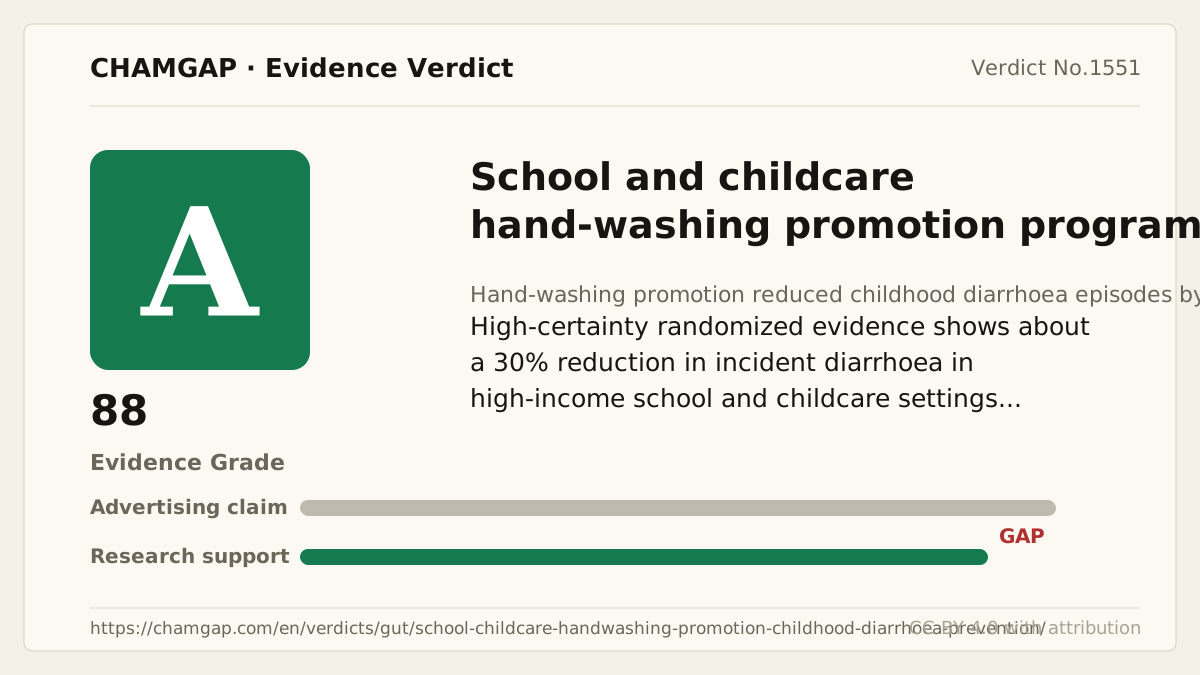
[Chamgap] School and childcare hand-washing promotion program x prevention of diarrhoea episodes in children — Evidence Grade A·88. 4 cited sources checked. Source: https://chamgap.com/en/verdicts/gut/school-childcare-handwashing-promotion-childhood-diarrhoea-prevention/ · CC BY 4.0CC BY 4.0 — free to use with attribution; do not distort grades, numbers, or verdict meaning.
What this document does and does not do
Chamgap is an information source. It reports what research has and has not confirmed; it does not tell readers what to take or buy. That decision belongs to readers and, when needed, medical or legal professionals. This verdict reflects literature available up to the search date and may change as new research appears. Nothing here is medical advice.