
Tenapanor,
does it really help with Concurrent improvement in abdominal pain and complete spontaneous bowel movements in IBS-C?
research showsB. Two peer-reviewed phase 3 trials with randomized populations of 629 and 620 and ITT populations of 606 and 593 both met the abdominal-pain-plus-CSBM primary endpoint, supporting B with 70 points. The publication form is two peer-reviewed phase 3 original reports. T3MPO-1 randomized 629 participants, and its ITT population of 606 met the 6-of-12-week abdominal-pain-plus-CSBM composite primary endpoint, 27.0% versus 18.7% (P=.020). T3MPO-2 randomized 620 participants, and its ITT population of 593 met the same primary endpoint, 36.5% versus 23.7% (P<.001). Pain and bowel function are treatment-target symptoms rather than surrogates, and replication supports B with 70 points. Both trials were sponsored by Ardelyx, limiting independence. Verdict 1573, which is B with 69 points, concerns linaclotide for chronic constipation; the present indication is IBS-C and is not directly identical.
ads claimMarketing may imply that pain and constipation resolve in most patients, but strict composite response rates were about 27% to 37%, and diarrhea caused discontinuation in some patients.
Useful facts when choosing a product
- Tenapanor is a prescription drug taken as 50 mg twice daily immediately before breakfast and dinner for adults with IBS-C.
- Diarrhea is the most common adverse reaction; severe diarrhea warrants stopping treatment and contacting a clinician.
- It is contraindicated in children younger than six years because of dehydration risk, and safety and efficacy are not established in older pediatric patients.
- It should not be used in patients with known or suspected mechanical gastrointestinal obstruction.
Chamgap Semantic Classification Code
Candidate index · review held
M.tenapanor.oral.concurrent-improvement-in-abdominal-pain-and-complete-spontaneous-bowel-movements-in-ibs-c.improve.placeboMedicinal interventions > Tenapanor > Oral > Concurrent improvement in abdominal pain and complete spontaneous bowel movements in IBS-C > Improvement claim > Placebo
An automated migration candidate, not an issued permanent code; exact claim scope remains under review. This machine-generated migration candidate helps retrieval but is not a permanent assignment. The original verdict ID and URL remain authoritative.
What the research actually shows
The publication form is two peer-reviewed phase 3 original reports. T3MPO-1 randomized 629 participants, and its ITT population of 606 met the 6-of-12-week abdominal-pain-plus-CSBM composite primary endpoint, 27.0% versus 18.7% (P=.020). T3MPO-2 randomized 620 participants, and its ITT population of 593 met the same primary endpoint, 36.5% versus 23.7% (P<.001). Pain and bowel function are treatment-target symptoms rather than surrogates, and replication supports B with 70 points. Both trials were sponsored by Ardelyx, limiting independence. Verdict 1573, which is B with 69 points, concerns linaclotide for chronic constipation; the present indication is IBS-C and is not directly identical.
Why this is classified as B (70)
The publication form is two peer-reviewed phase 3 original reports. T3MPO-1 randomized 629 participants, and its ITT population of 606 met the 6-of-12-week abdominal-pain-plus-CSBM composite primary endpoint, 27.0% versus 18.7% (P=.020). T3MPO-2 randomized 620 participants, and its ITT population of 593 met the same primary endpoint, 36.5% versus 23.7% (P<.001). Pain and bowel function are treatment-target symptoms rather than surrogates, and replication supports B with 70 points. Both trials were sponsored by Ardelyx, limiting independence. Verdict 1573, which is B with 69 points, concerns linaclotide for chronic constipation; the present indication is IBS-C and is not directly identical. Rule ①: (a) improvement only in surrogate biomarkers such as HbA1c, LDL, blood pressure, intraocular pressure, bone density, laboratory values, or imaging has a ceiling of C; (b) a failed primary endpoint with only positive subjective secondary endpoints has a ceiling of C; and (c) small, single-manufacturer, short-term, or conflicting evidence has a ceiling of C. Patient-reported symptoms that are themselves treatment targets, including pain, sleep, bowel function, IRLS, IIEF/SEP, and depression or anxiety scales, are not surrogates. Consistent achievement of clinical-importance thresholds such as MCID in multiple independent randomized trials can support B, and large, consistent, independent evidence can exceptionally support A. If effects do not meet clinical-importance thresholds, the grade remains C regardless of trial count.
Counterpoint. Efficacy was judged separately from safety and regulatory status. Diagnosis and standard treatment choices require clinical discussion.
Rejudgment record. Cross-check applied — The publication form is two peer-reviewed phase 3 original reports. T3MPO-1 randomized 629 participants, and its ITT population of 606 met the 6-of-12-week abdominal-pain-plus-CSBM composite primary endpoint, 27.0% versus 18.7% (P=.020). T3MPO-2 randomized 620 participants, and its ITT population of 593 met the same primary endpoint, 36.5% versus 23.7% (P<.001). Pain and bowel function are treatment-target symptoms rather than surrogates, and replication supports B with 70 points. Both trials were sponsored by Ardelyx, limiting independence. Verdict 1573, which is B with 69 points, concerns linaclotide for chronic constipation; the present indication is IBS-C and is not directly identical. Rule ①: (a) improvement only in surrogate biomarkers such as HbA1c, LDL, blood pressure, intraocular pressure, bone density, laboratory values, or imaging has a ceiling of C; (b) a failed primary endpoint with only positive subjective secondary endpoints has a ceiling of C; and (c) small, single-manufacturer, short-term, or conflicting evidence has a ceiling of C. Patient-reported symptoms that are themselves treatment targets, including pain, sleep, bowel function, IRLS, IIEF/SEP, and depression or anxiety scales, are not surrogates. Consistent achievement of clinical-importance thresholds such as MCID in multiple independent randomized trials can support B, and large, consistent, independent evidence can exceptionally support A. If effects do not meet clinical-importance thresholds, the grade remains C regardless of trial count.
Sub-claim grades by effect
This ingredient is marketed for several effects. A single overall grade blends strong and weak claims together, so each effect is graded separately here. The overall grade reflects the strongest disconfirming or core claim.
| Effect (sub-claim) | Grade | Basis |
|---|---|---|
| Combined abdominal-pain and CSBM response in IBS-C | B | T3MPO-1 randomized 629 with 606 in the ITT analysis, and T3MPO-2 randomized 620 with 593 in the ITT analysis; both met the primary endpoint. |
| Improvement in abdominal pain alone in IBS-C | B | Consistent improvement was reported in the composite and prespecified component analyses. |
| Improvement in CSBM frequency alone in IBS-C | B | The bowel-response component favored tenapanor in both phase 3 trials. |
Cross-check — AI research and Codex final gate
Evidence Table
| Study | Design | Sample | Funding | Endpoint | Result | Weight |
|---|---|---|---|---|---|---|
| Chey WD et al. 2020 (T3MPO-1) | Phase 3 randomized double-blind placebo-controlled trial; peer-reviewed original article | Randomized 629; ITT 606 (tenapanor 307; placebo 299) | Ardelyx | Concurrent ≥30% pain reduction and ≥1 weekly CSBM increase for at least 6 of 12 weeks | Primary endpoint met: 27.0% versus 18.7%, P=.020. | Key efficacy evidence |
| Chey WD et al. 2021 (T3MPO-2) | Phase 3 randomized double-blind placebo-controlled trial; peer-reviewed original article | Randomized 620; ITT 593 (tenapanor 293; placebo 300) | Ardelyx | Concurrent ≥30% pain reduction and ≥1 weekly CSBM increase for at least 6 of 12 weeks | Primary endpoint met: 36.5% versus 23.7%, P<.001. | Key efficacy evidence |
Receipt — 2 References
All 2 cited sources were verified for existence at the original page (as of 2026-07-24).
Final verification and publication gate: Codex · Evidence date: 2026-07-24 · Corrections: none
Cite this verdict
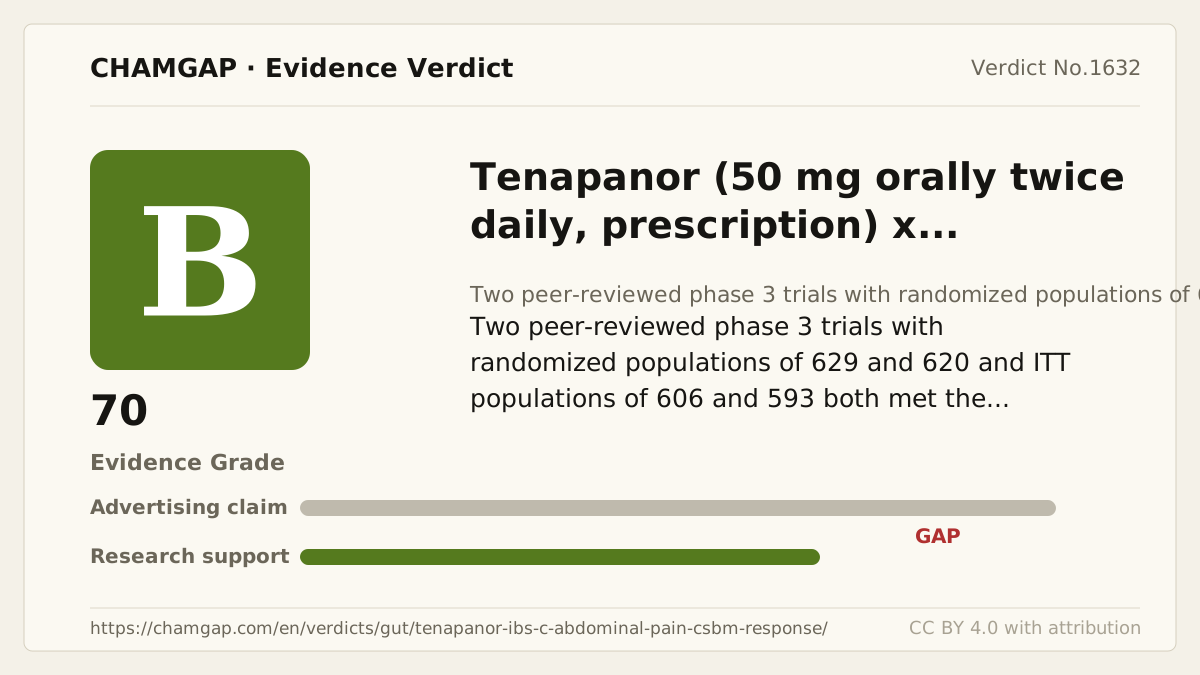
[Chamgap] Tenapanor x Concurrent improvement in abdominal pain and complete spontaneous bowel movements in IBS-C — Evidence Grade B·70. 2 cited sources checked. Source: https://chamgap.com/en/verdicts/gut/tenapanor-ibs-c-abdominal-pain-csbm-response/ · CC BY 4.0CC BY 4.0 — free to use with attribution; do not distort grades, numbers, or verdict meaning.
What this document does and does not do
Chamgap is an information source. It reports what research has and has not confirmed; it does not tell readers what to take or buy. That decision belongs to readers and, when needed, medical or legal professionals. This verdict reflects literature available up to the search date and may change as new research appears. Nothing here is medical advice.