
Neoadjuvant FOLFOX with selective radiation,
does it really help with Noninferior disease-free survival and radiation de-escalation versus standard chemoradiotherapy?
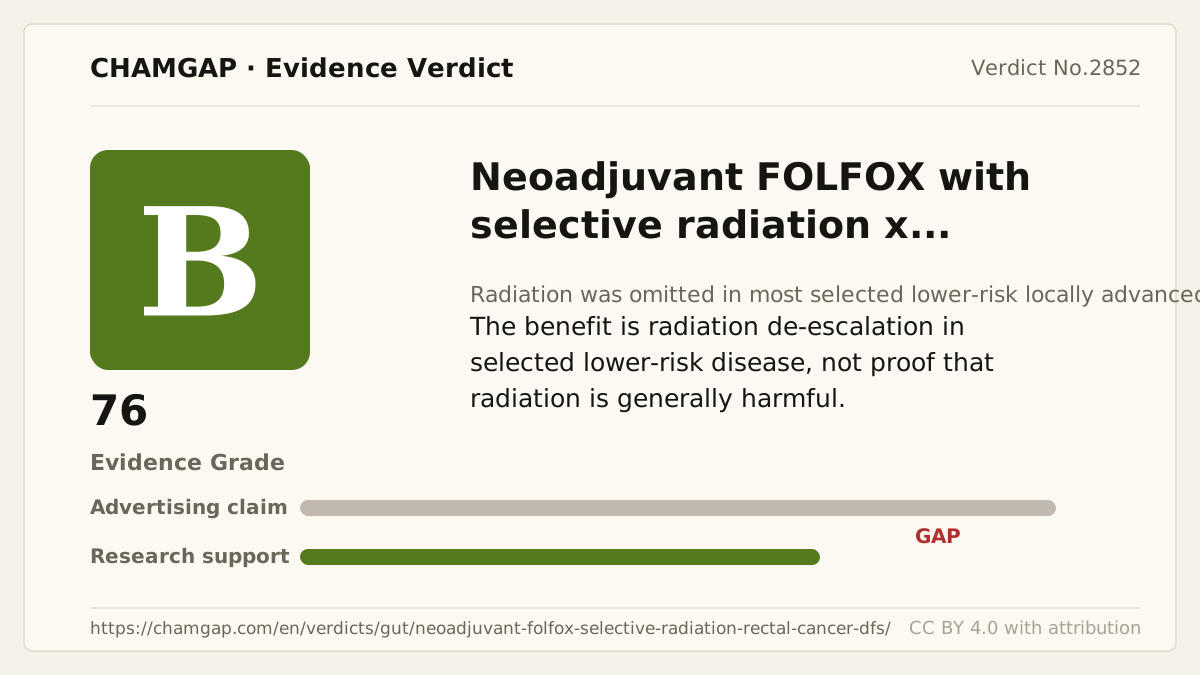
research showsThe grade is B. Five-year disease-free survival was 80.8% versus 78.6%, an absolute difference of +2.2 points, and the 90.2% CI for HR 0.92 was 0.74-1.14, within the prespecified 1.29 margin. One noninferiority-design limitation gives B with 76 points.
ads claimThis result supports selective multidisciplinary de-escalation, not indiscriminate refusal of radiation.
Useful facts when choosing a product
- Fifty-three of 585 FOLFOX patients, 9.1%, received preoperative chemoradiotherapy.
- At 12 months, fatigue, neuropathy, and sexual function favored FOLFOX, but fewer secondary cancers were not demonstrated.
- Verdicts 2851 and 2855 ask surgical-approach questions; 2852 asks a preoperative chemotherapy-radiation question.
Chamgap Semantic Classification Code
Candidate index · review held
P.neoadjuvant-folfox-with-selective-radiation.rectal.disease-free-survival-and-radiation-de-escalation.noninferior.MULTIProcedures, devices and tests > Neoadjuvant FOLFOX with selective radiation > Rectal > disease-free survival and radiation de-escalation > Noninferiority claim > Multiple: primary unresolved
An automated migration candidate, not an issued permanent code; exact claim scope remains under review. This machine-generated migration candidate helps retrieval but is not a permanent assignment. The original verdict ID and URL remain authoritative.
What the research actually shows
Allocation used 1:1 dynamic allocation stratified by ECOG performance status. Defect name: Noninferiority-margin dependence. Listed item: Noninferiority design. Avoidability: Unavoidable - the question was whether radiation de-escalation preserved survival. Attrition was 5.5% (66/1,194), below 15%. An untreated control would withhold standard care and was not counted. NCI grants provided public support.
Why this is classified as B (76)
A large publicly funded hard-outcome RCT met its margin, with one listed noninferiority limitation, for B with 76 points.
Counterpoint. Reduced late radiation toxicity is plausible, but reduced secondary cancers were not established.
Rejudgment record. Cross-check applied — Large publicly funded hard-outcome RCT meeting its margin with one noninferiority-design limitation
| Endpoint | H | Hard endpoint - actual events such as death |
| Replication | R1 | Single confirmatory trial |
| Independence | I2 | Decisive evidence is publicly or non-profit funded |
| Effect size | E+ | Meets the clinically important threshold |
Stored derived and displayed grades match; this is not a current recalculation or validity check (B).
Sub-claim grades by effect
This ingredient is marketed for several effects. A single overall grade blends strong and weak claims together, so each effect is graded separately here. The overall grade reflects the strongest disconfirming or core claim.
| Effect (sub-claim) | Grade | Basis |
|---|---|---|
| Noninferior disease-free survival in selected patients | B | The HR upper bound of 1.14 was within the 1.29 margin. |
| Radiation is generally harmful or increases secondary cancers | ? | The trial neither tested nor established that broader claim. |
Cross-check — AI research and Codex final gate
Evidence Table
| Study | Design | Sample | Funding | Endpoint | Result | Weight |
|---|---|---|---|---|---|---|
| Schrag D et al. 2023 PROSPECT | Multicenter phase 3 randomized noninferiority trial | 1,194 randomized; 1,128 started assigned therapy | Public support including US National Cancer Institute grants | Disease-free survival to recurrence or death from any cause; prespecified HR margin 1.29 | Five-year DFS 80.8% versus 78.6%, absolute difference +2.2 points; HR 0.92, 90.2% CI 0.74-1.14 | Large publicly funded hard-outcome RCT with a noninferiority design |
| Basch E et al. 2023 PROSPECT patient-reported outcomes | Companion patient-reported outcome study | 940 | Public support including US National Cancer Institute grants | Symptoms, bowel function, and sexual function during therapy and after surgery | At 12 months fatigue, neuropathy, and sexual function favored FOLFOX; fewer secondary cancers were not shown | Secondary patient-reported toxicity evidence |
Receipt — 2 References
All 2 cited sources were verified for existence at the original page (as of 2026-08-18).
Final verification and publication gate: Codex · Evidence date: 2026-08-18 · Corrections: none
Cite this verdict
[Chamgap] Neoadjuvant FOLFOX with selective radiation is noninferior to standard chemoradiotherapy for disease-free survival in locally advanced rectal cancer - benefit — Evidence Grade B·76. 2 cited sources checked. Source: https://chamgap.com/en/verdicts/gut/neoadjuvant-folfox-selective-radiation-rectal-cancer-dfs/ · CC BY 4.0CC BY 4.0 — free to use with attribution; do not distort grades, numbers, or verdict meaning.
What this document does and does not do
Chamgap is an information source. It reports what research has and has not confirmed; it does not tell readers what to take or buy. That decision belongs to readers and, when needed, medical or legal professionals. This verdict reflects literature available up to the search date and may change as new research appears. Nothing here is medical advice.