
Mosapride,
does it really help with Improvement of early satiety, postprandial fullness, and overall symptoms in functional dyspepsia?
research showsMosapride for functional-dyspepsia symptoms is rated C. A meta-analysis of 13 randomized trials and 2,220 participants found a null overall risk ratio of 0.999 for global efficacy or symptom scores, but a sensitivity analysis restricted to four trials meeting higher-quality criteria found a small positive risk ratio of 1.114. The positive result was concentrated in funded studies, with a risk ratio of 1.131, while unfunded studies were null at 0.966. Korean guidance in 2020 explicitly described the conflict and treated mosapride as an option, while the 2026 Asian consensus accepted prokinetics for some patients but described the benefit of mosapride itself as nonsignificant. The positive sensitivity signal is acknowledged, but the null overall result, funding concentration, subjective outcomes, and heterogeneity limit the grade to C with 42 points.
ads claimClaims that normalizing motility broadly resolves early satiety and postprandial fullness convert a mechanistic surrogate and selected positive trials into a consistent patient-experienced effect. Functional dyspepsia is heterogeneous, so a time-limited response trial is more defensible than an assumption of universal benefit.
Useful facts when choosing a product
- Mosapride is a prescription prokinetic that promotes acetylcholine release through selective 5-HT4 receptor agonism. It is marketed under names including Gasmotin, and the specific product directions should be followed.
- Functional dyspepsia can combine postprandial distress marked by early satiety and fullness with epigastric pain syndrome. Symptom pattern and alternative causes should be assessed before treatment.
- Improved gastric emptying or motility does not guarantee improvement in the patient's overall symptoms. Continued use is usually judged by symptoms and function after a defined short trial.
- Abdominal pain, diarrhea, dry mouth, and dizziness can occur. QT and arrhythmia concern is lower than with cisapride, but heart disease, liver abnormalities, and other QT-prolonging drugs still warrant prescriber review.
Chamgap Semantic Classification Code
Candidate index · review held
M.mosapride.UNK.early-satiety-postprandial-fullness-and-overall-symptoms-in-functional-dyspepsia.improve.placeboMedicinal interventions > Mosapride > Unknown > early satiety, postprandial fullness, and overall symptoms in functional dyspepsia > Improvement claim > Placebo
An automated migration candidate, not an issued permanent code; exact claim scope remains under review. This machine-generated migration candidate helps retrieval but is not a permanent assignment. The original verdict ID and URL remain authoritative.
What the research actually shows
Bang 2015 pooled 13 randomized trials with 2,220 participants conducted from 2002 through 2013 and reported an overall risk ratio of 0.999 for global efficacy or symptom scores. Restriction to four higher-quality trials changed the estimate to a small positive risk ratio of 1.114, but funded studies alone were positive at 1.131 while unfunded studies were null at 0.966. The Oh 2020 Korean guideline summarized the inconsistent overall evidence but considered mosapride an option on the higher-quality sensitivity result. The Qi 2023 network of 28 prokinetic trials ranked mosapride below metoclopramide and cinitapride. In the manufacturer-funded Tae 2024 double-placebo active-comparator trial, four-week improvement was 53.7% with controlled-release mosapride and 54.0% with nortriptyline; because there was no placebo-only arm, this trial was not treated as evidence of efficacy versus placebo. The Mahadeva 2026 Asian consensus noted both some class-level prokinetic efficacy and low-quality heterogeneous evidence, and it described mosapride-specific benefit as nonsignificant.
Why this is classified as C (42)
The overall risk ratio of 0.999 across 13 trials was null, while four higher-quality trials gave a small positive risk ratio of 1.114. Funded studies alone were positive at 1.131 and unfunded studies were null at 0.966. Korean guidance provides supporting context, but active comparisons against agents such as nortriptyline were not treated as evidence of efficacy versus placebo; together with subjective outcomes and heterogeneous diagnostic criteria, this limits the verdict to C with 42 points.
Counterpoint. A clear reduction in early satiety or postprandial fullness during a short trial can be useful for an individual. Nonresponse should prompt reassessment of Helicobacter pylori, acid-related disease, medicines, gastroparesis, biliary or pancreatic disease, diet, and gut-brain factors rather than indefinite repetition.
Rejudgment record. Cross-check applied — Centered the null overall risk ratio of 0.999 across 13 trials and 2,220 participants while acknowledging the positive risk ratio of 1.114 in four trials meeting prespecified higher-quality criteria; funded studies alone were positive at 1.131 while unfunded studies were null at 0.966, active-comparator trials were not used as evidence of efficacy versus placebo, and subjective outcomes plus heterogeneous diagnostic criteria and tools supported a low C
Sub-claim grades by effect
This ingredient is marketed for several effects. A single overall grade blends strong and weak claims together, so each effect is graded separately here. The overall grade reflects the strongest disconfirming or core claim.
| Effect (sub-claim) | Grade | Basis |
|---|---|---|
| Improvement of overall symptoms in functional dyspepsia | C | The overall meta-analysis was null, and positive findings were concentrated in funded studies while unfunded studies were null. Active-comparator trials against agents such as nortriptyline were not used as evidence of efficacy versus placebo. |
| Improvement of early satiety and postprandial fullness | C | Benefit is plausible in postprandial distress syndrome, but symptom-specific placebo-controlled effects are inconsistent. |
| Improvement of gastric emptying and gastrointestinal motility | C | Physiologic improvement signals exist, but they are surrogate outcomes and do not consistently track patient-experienced symptoms. |
Cross-check — AI research and Codex final gate
Evidence Table
| Study | Design | Sample | Funding | Endpoint | Result | Weight |
|---|---|---|---|---|---|---|
| Bang CS et al. 2015 | Systematic review and meta-analysis of mosapride randomized trials in functional dyspepsia | 13 randomized trials and 2,220 participants | Academic research; sponsorship varied across included trials | Global efficacy or symptom-based scores | The overall risk ratio was null at 0.999 (95% CI 0.869 to 1.150), while four higher-quality trials were positive at 1.114 (95% CI 1.011 to 1.227). | Key conflicting pooled evidence |
| Oh JH et al. 2020 Korean guideline | Evidence-based clinical practice guideline for functional dyspepsia | Drug-specific assessment of randomized and meta-analytic evidence | Guideline development by the Korean Society of Neurogastroenterology and Motility; sponsorship varied across included evidence | Global symptoms, early satiety, postprandial fullness, and safety | The guideline described inconsistent overall evidence but treated mosapride as an option based on four higher-quality positive trials and low arrhythmia concern. | Clinical context confirming the conflict |
| Qi Q et al. 2023 | Systematic review and Bayesian network meta-analysis of prokinetic randomized trials | 28 trials | Supported by the National Natural Science Foundation of China (81700469, 82070552, and 81800462) | Total efficacy and drug-related adverse events | Mosapride had lower total efficacy than metoclopramide by an odds ratio of 3.53 and than cinitapride by 2.18, with uniform outcome tools still needed. | Updated comparative synthesis with limited direct placebo inference |
| Tae CH et al. 2024 | Multicenter double-dummy double-blind active-comparator randomized trial | 109 randomized and 104 in the modified intention-to-treat analysis | Supported by Korea United Pharm (2018(CT)-KUP-018); no conflicts reported | Four-week overall dyspepsia improvement, individual symptoms, and quality of life | Improvement was 53.7% with controlled-release mosapride and 54.0% with nortriptyline, but there was no placebo-only group. | Modern supportive evidence unable to separate placebo effects |
| Mahadeva S et al. 2026 Asian consensus | Asian functional-dyspepsia consensus using a systematic literature review and modified Delphi process | 32 consensus statements | Abbott Laboratories support for medical writing of the manuscript was disclosed | Functional-dyspepsia management and prokinetic efficacy | The consensus accepted prokinetics as effective in some patients but noted heterogeneous low-quality evidence and described mosapride-specific benefit as nonsignificant. | Latest clinical consensus limiting mosapride-specific efficacy |
Receipt — 5 References
All 5 cited sources were verified for existence at the original page (as of 2026-07-24).
Final verification and publication gate: Codex · Evidence date: 2026-07-24 · Corrections: none
Cite this verdict
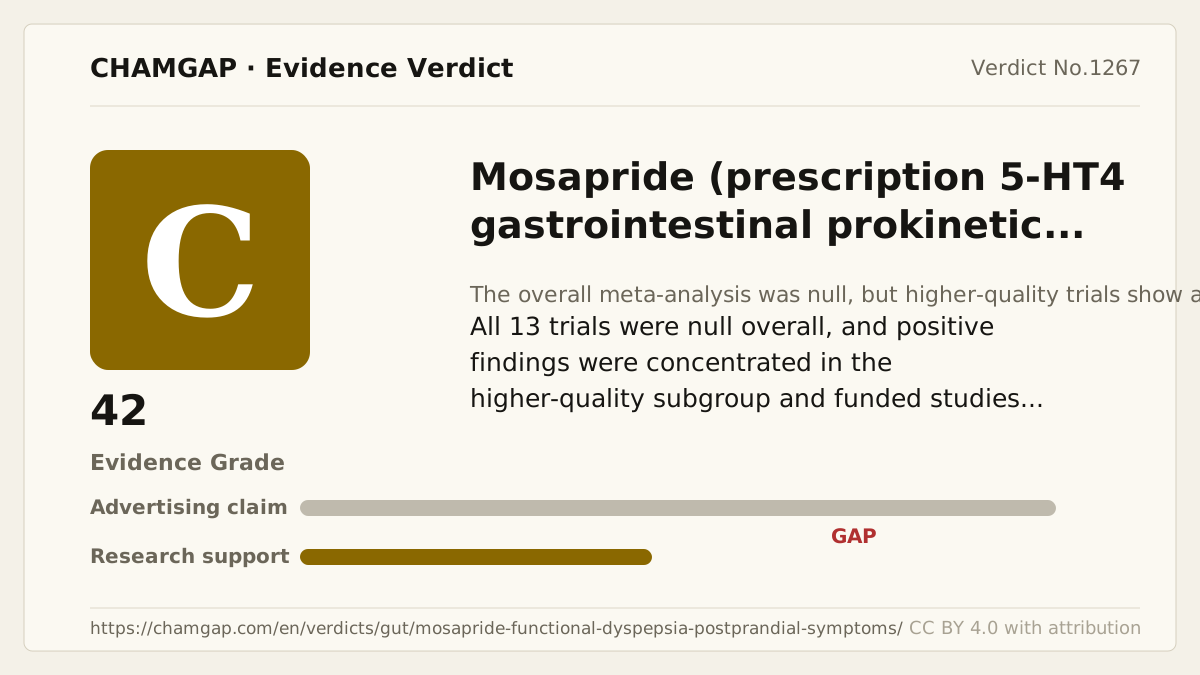
[Chamgap] Mosapride x improvement of early satiety, postprandial fullness, and overall symptoms in functional dyspepsia — Evidence Grade C·42. 5 cited sources checked. Source: https://chamgap.com/en/verdicts/gut/mosapride-functional-dyspepsia-postprandial-symptoms/ · CC BY 4.0CC BY 4.0 — free to use with attribution; do not distort grades, numbers, or verdict meaning.
What this document does and does not do
Chamgap is an information source. It reports what research has and has not confirmed; it does not tell readers what to take or buy. That decision belongs to readers and, when needed, medical or legal professionals. This verdict reflects literature available up to the search date and may change as new research appears. Nothing here is medical advice.