
Low-dose aspirin,
does it really help with Reduced postoperative recurrence of localized colorectal cancer with a PI3K-pathway alteration?
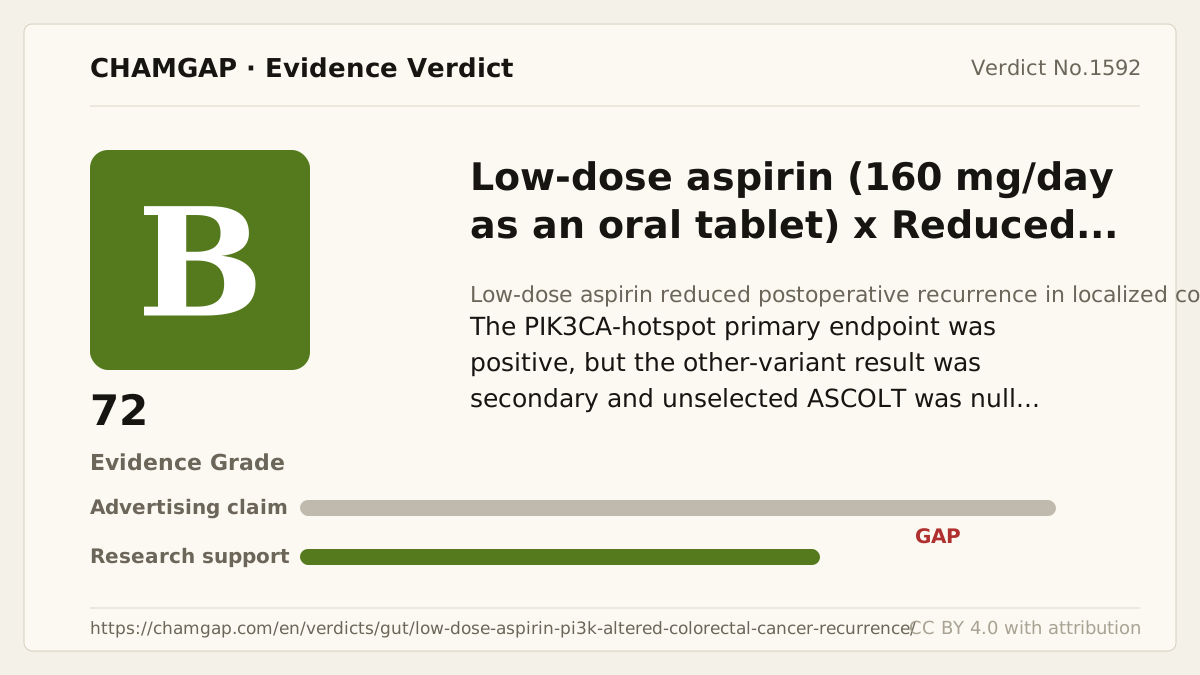
research showsAspirin 160 mg/day is rated B because it reduced recurrence after surgery for localized colorectal cancer with a PI3K-pathway alteration. ALASCCA randomized 626 patients with qualifying alterations. The primary endpoint in the PIK3CA exon 9 or 20 hotspot group showed three-year recurrence of 7.7% with aspirin versus 14.1% with placebo, hazard ratio 0.49 (95% CI 0.24 to 0.98), P=0.04. The finding in other moderate- or high-impact PIK3CA, PIK3R1, or PTEN variants was a secondary endpoint: 7.7% versus 16.8%, hazard ratio 0.42 (95% CI 0.21 to 0.83). The 112-patient SAKK 41/13 trial closed early for financial reasons and was not statistically significant. In contrast, the 1,550-patient ASCOLT trial without PI3K selection was null, so the result cannot be applied to all colorectal cancer. The endpoint hierarchy, concentration of evidence in one completed trial, and bleeding risk support B with 72 points.
ads claimMarketing can omit the biomarker and say that aspirin halves colorectal-cancer recurrence. The positive evidence applies to tumors with a qualifying PIK3CA hotspot or prespecified PIK3CA, PIK3R1, or PTEN alteration. Unselected ASCOLT was negative, and aspirin does not replace surgery or standard adjuvant treatment.
Useful facts when choosing a product
- ALASCCA used aspirin 160 mg once daily for three years in patients with resected stage I to III rectal cancer or stage II to III colon cancer and a qualifying PI3K-pathway alteration.
- Eligibility requires tumor testing for a PIK3CA exon 9 or 20 hotspot or a prespecified somatic PIK3CA, PIK3R1, or PTEN variant; this does not include every patient with colorectal cancer.
- Aspirin can cause gastrointestinal ulceration and bleeding as well as other serious bleeding. Prior bleeding, anticoagulants, other nonsteroidal anti-inflammatory drugs, corticosteroids, older age, and alcohol use require clinical review.
- This oncology-adjuvant verdict is distinct from acute ischemic stroke in verdict 1581, which is A with 93 points, and cardiovascular secondary prevention in verdict 1441, which is A with 94 points.
Chamgap Semantic Classification Code
Candidate index · review held
S.aspirin.oral.postoperative-recurrence-of-localized-colorectal-cancer-with-a-pi3k-pathway-alteration.reduce.placeboSupplements and nutraceuticals > aspirin > Oral > postoperative recurrence of localized colorectal cancer with a PI3K-pathway alteration > Reduction claim > Placebo
An automated migration candidate, not an issued permanent code; exact claim scope remains under review. This machine-generated migration candidate helps retrieval but is not a permanent assignment. The original verdict ID and URL remain authoritative.
What the research actually shows
ALASCCA by Martling and colleagues assigned patients with resected stage I to III rectal cancer or stage II to III colon cancer and a qualifying somatic PI3K-pathway alteration to aspirin 160 mg once daily or placebo for three years. The primary endpoint in 314 patients with PIK3CA exon 9 or 20 hotspot mutations showed recurrence of 7.7% versus 14.1%, hazard ratio 0.49. A separate secondary endpoint in 312 patients with other moderate- or high-impact PIK3CA, PIK3R1, or PTEN variants showed 7.7% versus 16.8%, hazard ratio 0.42. Severe adverse events occurred in 16.8% versus 11.6%. SAKK 41/13 by Güller and colleagues randomized 112 patients with stage II or III PIK3CA-mutated colon cancer to aspirin 100 mg or placebo but stopped early for financial constraints; disease-free survival had a hazard ratio of 0.57 (90% CI 0.27 to 1.22) and time to recurrence 0.49 (90% CI 0.21 to 1.19), favorable but nonsignificant. ASCOLT by Chia and colleagues enrolled 1,550 treated patients without PI3K selection and found null five-year disease-free survival of 77.0% versus 74.8%, hazard ratio 0.91. The ALASCCA result therefore cannot be applied to all colorectal cancer.
Why this is classified as B (72)
ALASCCA reduced three-year recurrence from 14.1% to 7.7% in the primary PIK3CA-hotspot population, hazard ratio 0.49. The hazard ratio of 0.42 in the other PI3K-pathway alteration group was a secondary endpoint, not a coequal primary endpoint. The smaller SAKK 41/13 trial was nonsignificant, and the null unselected ASCOLT trial prohibits extension to all colorectal cancer. A strong molecularly selected clinical-recurrence result with one central completed confirmatory trial and unconfirmed long-term overall survival supports B with 72 points.
Counterpoint. For a postoperative patient with a qualifying alteration and low bleeding risk, low-dose aspirin may become a low-cost adjuvant option. This evidence supports multidisciplinary review of stage, standard treatment, concurrent medicines, and bleeding risk rather than self-initiation.
Rejudgment record. Cross-check applied — Rule ⑤ requires a hard-endpoint benefit to be specific to the ingredient or procedure for grade A or B. ALASCCA directly demonstrated an aspirin-160-mg-specific effect on clinical recurrence, a quasi-hard endpoint, in PI3K-altered localized colorectal cancer, allowing B. A is not justified because the central positive evidence is concentrated in one completed confirmatory trial, the hotspot result had P=0.04, and long-term overall survival remains unconfirmed. The negative mutation-unselected ASCOLT trial prohibits extrapolation to all colorectal cancer.
Sub-claim grades by effect
This ingredient is marketed for several effects. A single overall grade blends strong and weak claims together, so each effect is graded separately here. The overall grade reflects the strongest disconfirming or core claim.
| Effect (sub-claim) | Grade | Basis |
|---|---|---|
| Reduced postoperative recurrence of localized colorectal cancer with a PIK3CA exon 9 or 20 hotspot mutation | B | In ALASCCA's prespecified primary population, three-year recurrence was 7.7% versus 14.1%, hazard ratio 0.49. |
| Reduced postoperative recurrence of localized colorectal cancer with another qualifying PIK3CA, PIK3R1, or PTEN alteration | B | In ALASCCA's secondary endpoint, three-year recurrence was 7.7% versus 16.8%, hazard ratio 0.42, but independent confirmation is absent. |
| Reduced postoperative recurrence across all localized colorectal cancer without mutation selection | D | ASCOLT was negative in 1,550 patients, with a five-year disease-free-survival hazard ratio of 0.91 and P=0.38, preventing extension to mutation-unselected disease. |
Cross-check — AI research and Codex final gate
Evidence Table
| Study | Design | Sample | Funding | Endpoint | Result | Weight |
|---|---|---|---|---|---|---|
| Martling A et al.; ALASCCA Study Group. 2025 | Multinational phase 3 randomized double-blind placebo-controlled biomarker-selected trial | 626 patients with PI3K-altered localized colorectal cancer; 314 in the hotspot group and 312 in the other-alteration group | Swedish Research Council and other public or nonprofit sources | Three-year colorectal-cancer recurrence and disease-free survival | Recurrence was 7.7% versus 14.1%, HR 0.49 (95% CI 0.24 to 0.98), in the hotspot group and 7.7% versus 16.8%, HR 0.42 (95% CI 0.21 to 0.83), in the other-alteration group. | Key large biomarker-selected confirmatory trial |
| Güller U et al. 2025 | Phase 3 multinational randomized double-blind placebo-controlled trial stopped early for financial constraints | 112 patients with resected stage II or III PIK3CA-mutated colon cancer | Detailed funding not stated in the abstract; stopped early for financial constraints | Disease-free survival and time to recurrence | Disease-free survival had HR 0.57 (90% CI 0.27 to 1.22), P=0.11, and time to recurrence HR 0.49 (90% CI 0.21 to 1.19), P=0.089; both were favorable but nonsignificant. | Small, incompletely accrued supportive trial |
| Chia JWK et al. 2025 | International phase 3 randomized double-blind placebo-controlled trial | 1,550 patients with mutation-unselected colorectal cancer in the modified intention-to-treat analysis | Singaporean and Australian public and foundation funding | Five-year disease-free survival | Five-year disease-free survival was 77.0% versus 74.8%, HR 0.91 (95% CI 0.73 to 1.13), P=0.38, with no significant benefit. | Large negative trial limiting extrapolation to all colorectal cancer |
Receipt — 4 References
Of 4 cited sources, 1 had limited original-page access (blocked or summary-only) and were verified via index/summary, marked partial; the rest were verified at the original page. As of 2026-07-24.
Final verification and publication gate: Codex · Evidence date: 2026-07-24 · Corrections: none
Cite this verdict
[Chamgap] Low-dose aspirin x reduced postoperative recurrence of PI3K-altered localized colorectal cancer — Evidence Grade B·72. 4 cited sources checked. Source: https://chamgap.com/en/verdicts/gut/low-dose-aspirin-pi3k-altered-colorectal-cancer-recurrence/ · CC BY 4.0CC BY 4.0 — free to use with attribution; do not distort grades, numbers, or verdict meaning.
What this document does and does not do
Chamgap is an information source. It reports what research has and has not confirmed; it does not tell readers what to take or buy. That decision belongs to readers and, when needed, medical or legal professionals. This verdict reflects literature available up to the search date and may change as new research appears. Nothing here is medical advice.