
Low-dose amitriptyline,
does it really help with Improved six-month symptom severity in irritable bowel syndrome persisting after diet and first-line treatment?
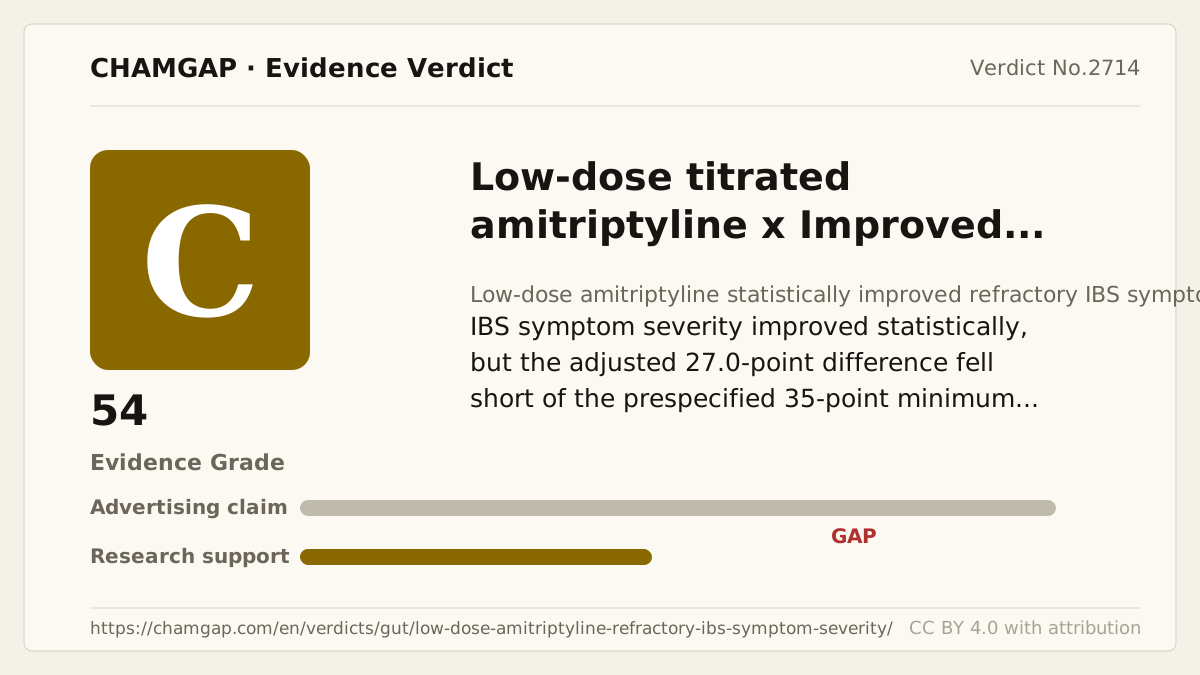
research showsThe grade is C with 54 points. ATLANTIS double-masked 463 participants at 55 UK general practices. The adjusted six-month IBS-SSS mean difference was -27.0 points (95% CI -46.9 to -7.1, P=.0079). The result was statistically significant but fell short of the 35-point between-group minimum clinically important difference prespecified in the article.
ads claimA broad claim that an antidepressant 'treats the gut' is misleading. This was a second-line strategy starting at 10 mg and titrated to at most 30 mg according to response and adverse effects, with a modest average symptom advantage.
Useful facts when choosing a product
- ATLANTIS started at 10 mg nightly and allowed self-titration over three weeks to a maximum of 30 mg.
- Before six months, 46/232 (19.8%) stopped amitriptyline and 59/231 (25.5%) stopped placebo; adverse-effect discontinuation was 12.9% and 8.7%.
- Serious adverse events or reactions occurred in 6 amitriptyline and 4 placebo recipients among 460 safety participants.
Chamgap Semantic Classification Code
Candidate index · review held
UNK.titrated-amitriptyline.UNK.symptom-severity-in-irritable-bowel-syndrome-persisting-after-diet-and-first-line-treatment.improve.placeboUnknown > titrated amitriptyline > Unknown > symptom severity in irritable bowel syndrome persisting after diet and first-line treatment > Improvement claim > Placebo
An automated migration candidate, not an issued permanent code; exact claim scope remains under review. This machine-generated migration candidate helps retrieval but is not a permanent assignment. The original verdict ID and URL remain authoritative.
What the research actually shows
The trial assigned 232 and 231 participants, and 401/463 (86.6%) returned the six-month questionnaire. The primary analysis included every randomized participant and used 25-fold multiple imputation for missing data. The article prespecified its effect threshold: "We estimated that an evaluable sample size of 414 participants would provide 90% power to detect the minimum clinically important difference of 35 points between amitriptyline and placebo". The adjusted six-month mean difference of 27.0 points fell short of that between-group minimum clinically important difference. Axis 6 B0 evidence 1 Allocation concealment: "Allocation, via a web randomisation system at the University of Leeds CTRU, was performed using minimisation with a random element" 2 Masking: "neither the participant nor those responsible for their care and evaluation ... knew the treatment allocation"; "identical tablets, packaging, and labelling"; no emergency unblinding requests 3 Analysis and missingness: "Analyses ... were conducted on the intention-to-treat population, defined as all participants randomised"; 25 imputations by treatment arm 4 Prespecified primary endpoint: "IBS Severity Scoring System, 6 months after randomisation" — matches ISRCTN48075063 The trial was publicly funded by the NIHR Health Technology Assessment Programme, grant 16/162/01.
Why this is classified as C (54)
Independent public funding, central allocation, double masking, intention-to-treat imputation, and a registered endpoint are strong, but the 27.0-point primary effect fell short of the prespecified 35-point minimum clinically important difference, giving C with 54 points.
Counterpoint. Some individuals may respond more than the average, so benefit after four to six months should be weighed against tolerability.
Rejudgment record. Cross-check applied — Cross-checked the Lancet report and NIHR HTA monograph for central web allocation, identical-tablet masking, intention-to-treat multiple imputation, registry-matched primary endpoint, effect estimates, funding, and masking performance
| Endpoint | P | Symptom or function itself is the target - including patient reports and performance tests |
| Replication | R1 | Single confirmatory trial |
| Independence | I2 | Decisive evidence is publicly or non-profit funded |
| Effect size | E~ | Statistically positive but below the threshold |
Stored derived and displayed grades match; this is not a current recalculation or validity check (C).
Sub-claim grades by effect
This ingredient is marketed for several effects. A single overall grade blends strong and weak claims together, so each effect is graded separately here. The overall grade reflects the strongest disconfirming or core claim.
| Effect (sub-claim) | Grade | Basis |
|---|---|---|
| Improved six-month IBS symptom severity | C | The result was statistically positive, but the adjusted 27.0-point difference fell short of the prespecified 35-point minimum clinically important difference. |
| Subjective global relief | C | The OR was 1.78 in favor of amitriptyline, but this was secondary. |
Cross-check — AI research and Codex final gate
Evidence Table
| Study | Design | Sample | Funding | Endpoint | Result | Weight |
|---|---|---|---|---|---|---|
| Ford AC et al. 2023 ATLANTIS | Phase 3 double-masked placebo-controlled randomized trial at 55 general practices | 463 randomized (232/231), 401 returned six-month questionnaires, with all 463 in multiply imputed intention-to-treat analysis | NIHR Health Technology Assessment Programme grant 16/162/01 | IBS Severity Scoring System at six months | Adjusted mean difference -27.0 points (95% CI -46.9 to -7.1), P=.0079; SGA relief OR 1.78 (1.19 to 2.66) | Rigorous independent single trial falling short of the prespecified minimum clinically important difference |
Receipt — 2 References
All 2 cited sources were verified for existence at the original page (as of 2026-08-18).
Final verification and publication gate: Codex · Evidence date: 2026-08-18 · Corrections: none
Cite this verdict
[Chamgap] Low-dose amitriptyline x refractory irritable bowel syndrome — Evidence Grade C·54. 2 cited sources checked. Source: https://chamgap.com/en/verdicts/gut/low-dose-amitriptyline-refractory-ibs-symptom-severity/ · CC BY 4.0CC BY 4.0 — free to use with attribution; do not distort grades, numbers, or verdict meaning.
What this document does and does not do
Chamgap is an information source. It reports what research has and has not confirmed; it does not tell readers what to take or buy. That decision belongs to readers and, when needed, medical or legal professionals. This verdict reflects literature available up to the search date and may change as new research appears. Nothing here is medical advice.