
Half-strength apple juice and preferred fluids,
does it really help with Fewer seven-day treatment failures in young children with mild gastroenteritis and minimal dehydration?
research showsThe grade is B with 72 points. In a 647-child trial, seven-day treatment failure occurred in 54/323 (16.7%) with half-strength apple juice and preferred fluids versus 81/324 (25.0%) with electrolyte maintenance solution. The absolute difference was -8.3 points, and the prespecified superiority test after noninferiority succeeded at P=0.006. Evidence still comes from one noninferiority trial.
ads claimThe tested strategy was not unlimited full-strength juice. It began with half-strength apple juice in the emergency department and allowed usual preferred fluids after discharge. Children younger than six months, with a Clinical Dehydration Scale score of at least 5, or needing immediate intravenous fluids were excluded.
Useful facts when choosing a product
- The emergency-department test drink was color-matched half-strength apple juice, followed by usual preferred fluids after discharge.
- The primary outcome combined intravenous rehydration, hospitalization, unscheduled care, prolonged symptoms, crossover, and weight loss or significant dehydration within seven days.
- All 647 randomized children were in the primary denominator and follow-up data were found for 644 (99.5%).
Chamgap Semantic Classification Code
Candidate index · review held
F.half-strength-apple-juice-in-the-emergency-department-followed-by-preferred-fluids.food.fewer-treatment-failures-in-young-children-with-mild-gastroenteritis-and-minimal-dehydration.treat.UNKFoods and beverages > Half-strength apple juice in the emergency department followed by preferred fluids > Food consumption > Fewer treatment failures in young children with mild gastroenteritis and minimal dehydration > Treatment or remission claim > Unknown
An automated migration candidate, not an issued permanent code; exact claim scope remains under review. This machine-generated migration candidate helps retrieval but is not a permanent assignment. The original verdict ID and URL remain authoritative.
What the research actually shows
A single Toronto pediatric emergency department randomized 647 children, 323 versus 324, and included all randomized children in the primary analysis; failures were 54 versus 81. The one-sided 97.5% confidence bound was -2.0 points, and the prespecified superiority test after noninferiority gave P=0.006. Follow-up information was available for 644. The Physician Services Incorporated Foundation funded the study and the authors reported no conflicts.
Why this is classified as B (72)
A nonprofit-funded single trial found a large reduction in direct treatment failure with excellent follow-up and masking, but noninferiority design and no replication give B with 72 points.
Counterpoint. The conclusion is limited to mild gastroenteritis with minimal dehydration; standard assessment and rehydration take priority in more severe illness.
Rejudgment record. Cross-check applied — Cross-checked the registered primary outcome, concealment, masking, actual analysis denominator, superiority after noninferiority, and funding against the JAMA report and NCT01185054
| Endpoint | H | Hard endpoint - actual events such as death |
| Replication | R1 | Single confirmatory trial |
| Independence | I2 | Decisive evidence is publicly or non-profit funded |
| Effect size | E+ | Meets the clinically important threshold |
Stored derived and displayed grades match; this is not a current recalculation or validity check (B).
Sub-claim grades by effect
This ingredient is marketed for several effects. A single overall grade blends strong and weak claims together, so each effect is graded separately here. The overall grade reflects the strongest disconfirming or core claim.
| Effect (sub-claim) | Grade | Basis |
|---|---|---|
| Fewer seven-day composite treatment failures | B | Rates were 16.7% versus 25.0%, a -8.3-point difference. |
| Fewer hospitalizations | D | Rates were 0.9% versus 2.8%, but the 99% CI included no difference. |
Cross-check — AI research and Codex final gate
Evidence Table
| Study | Design | Sample | Funding | Endpoint | Result | Weight |
|---|---|---|---|---|---|---|
| Freedman SB, Willan AR, Boutis K, Schuh S. 2016 | Single-center single-blind randomized noninferiority trial with prespecified superiority testing | 647 randomized (323/324), all 647 in the primary analysis, follow-up data for 644 | Nonprofit Physician Services Incorporated Foundation funding; no conflicts reported | Primary seven-day composite treatment failure | 54/323 (16.7%) versus 81/324 (25.0%), difference -8.3 points, one-sided 97.5% CI -infinity to -2.0; superiority P=0.006 | Only direct confirmatory trial |
Receipt — 1 References
All 1 cited sources were verified for existence at the original page (as of 2026-08-15).
Final verification and publication gate: Codex · Evidence date: 2026-08-15 · Corrections: none
Cite this verdict
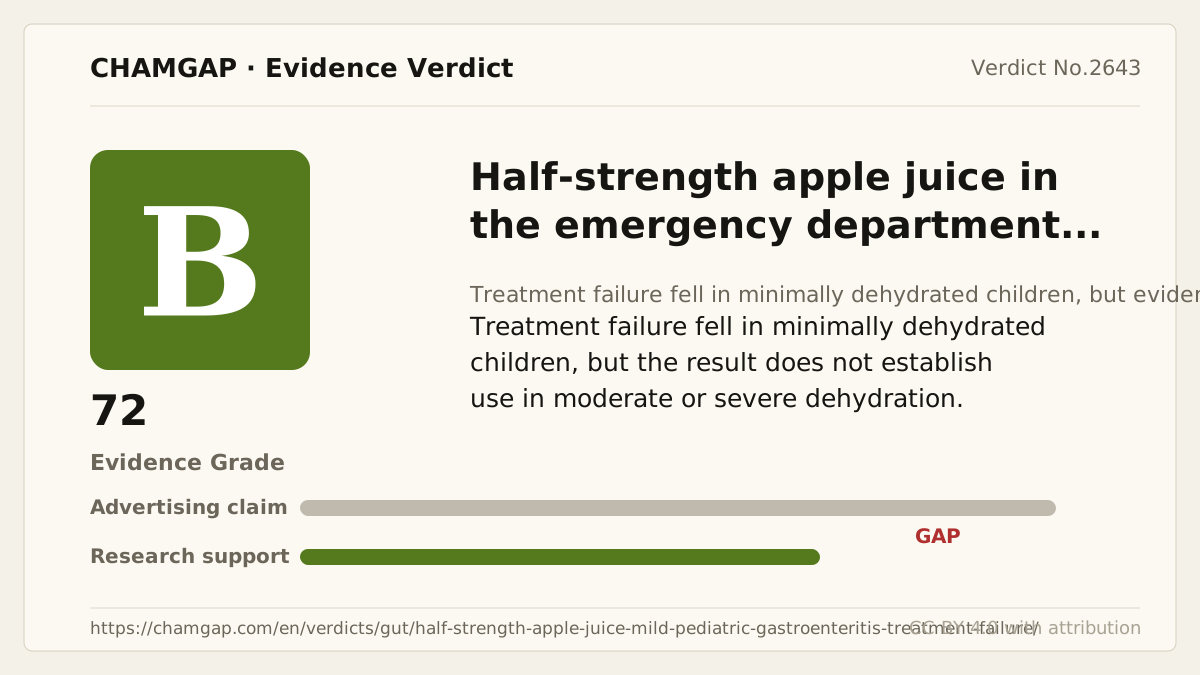
[Chamgap] Half-strength apple juice and preferred fluids x treatment failure in mild pediatric gastroenteritis — Evidence Grade B·72. 1 cited sources checked. Source: https://chamgap.com/en/verdicts/gut/half-strength-apple-juice-mild-pediatric-gastroenteritis-treatment-failure/ · CC BY 4.0CC BY 4.0 — free to use with attribution; do not distort grades, numbers, or verdict meaning.
What this document does and does not do
Chamgap is an information source. It reports what research has and has not confirmed; it does not tell readers what to take or buy. That decision belongs to readers and, when needed, medical or legal professionals. This verdict reflects literature available up to the search date and may change as new research appears. Nothing here is medical advice.