
Folic acid,
does it really help with Prevention of new polyp or adenoma recurrence after colorectal adenoma removal?
research showsFolic acid is rated D for preventing recurrence after colorectal adenoma removal. AFPPS randomized 1,021 participants, and among 987 at first follow-up its prespecified primary endpoint of at least one adenoma failed: 44.1% versus 42.4%, RR 1.04 (95% CI 0.90 to 1.20), P=0.58. Across AFPPS 1,021, NHS/HPFS 672, and ukCAP 939, totaling 2,632 participants, RR was 0.98 (0.82 to 1.17) for any adenoma and 1.06 (0.81 to 1.39) for advanced lesions. This is lack of proof, not repeated disproof, because the confidence interval cannot exclude a reduction of up to 18%.
ads claimThe requirement for folate in DNA synthesis or its ability to lower homocysteine must not be converted into prevention of new polyps in people with prior adenomas.
Useful facts when choosing a product
- The pivotal trial used folic acid 1 mg daily, and the combined trials used 0.5 to 1 mg daily.
- Prevention of neural-tube defects around pregnancy is a completely different indication from colorectal adenoma recurrence.
- Surveillance colonoscopy after adenoma removal should follow pathology, number, size, and clinical guidelines rather than supplementation.
Chamgap Semantic Classification Code
Candidate index · review held
S.folic-acid.UNK.new-polyp-or-adenoma-recurrence-after-colorectal-adenoma-removal.prevent.MULTISupplements and nutraceuticals > Folic acid > Unknown > new polyp or adenoma recurrence after colorectal adenoma removal > Occurrence-prevention claim > Multiple: primary unresolved
An automated migration candidate, not an issued permanent code; exact claim scope remains under review. This machine-generated migration candidate helps retrieval but is not a permanent assignment. The original verdict ID and URL remain authoritative.
What the research actually shows
AFPPS randomized 1,021 participants, and among 987 at first follow-up its prespecified endpoint of at least one adenoma was 44.1% versus 42.4%, RR 1.04 (0.90 to 1.20), P=0.58. Across AFPPS 1,021, NHS/HPFS 672, and ukCAP 939, totaling 2,632 participants, any adenoma was RR 0.98 (0.82 to 1.17) and advanced lesions RR 1.06 (0.81 to 1.39). The interval retains a possible reduction of up to 18%, so the evidence is unproven rather than repeatedly disproven.
Why this is classified as D (32)
Across three trials and 2,632 participants, RR was 0.98 (0.82 to 1.17) for any adenoma and 1.06 (0.81 to 1.39) for advanced lesions. These null estimates cannot exclude a reduction of up to 18%. Because F is reserved for repeated disproof and this is lack of proof, D with 32 points is appropriate.
Counterpoint. Correcting folate deficiency has separate medical value, but high-dose supplementation is not supported for adenoma-recurrence prevention.
Rejudgment record. Cross-check applied — F is reserved for repeated disproof in the same indication, whereas this evidence shows lack of proof. Across AFPPS 1,021, NHS/HPFS 672, and ukCAP 939, totaling 2,632 participants, RR was 0.98 (95% CI 0.82 to 1.17) for any adenoma and 1.06 (0.81 to 1.39) for advanced lesions. The confidence interval cannot exclude a reduction of up to 18%, supporting D
Sub-claim grades by effect
This ingredient is marketed for several effects. A single overall grade blends strong and weak claims together, so each effect is graded separately here. The overall grade reflects the strongest disconfirming or core claim.
| Effect (sub-claim) | Grade | Basis |
|---|---|---|
| Prevention of any colorectal adenoma recurrence within three years | D | The primary endpoint failed at RR 1.04 and P=0.58 among 987 participants at first follow-up. |
| Prevention of advanced colorectal adenoma recurrence | D | The three-trial combined RR was 1.06 (0.81 to 1.39), leaving the claim unproven. |
| Long-term prevention of multiple recurrent adenomas | D | Efficacy is unproven, with a signal toward more multiple adenomas in a post hoc second-follow-up analysis. |
Cross-check — AI research and Codex final gate
Evidence Table
| Study | Design | Sample | Funding | Endpoint | Result | Weight |
|---|---|---|---|---|---|---|
| Cole BF et al. 2007 | Nine-center double-blind placebo-controlled factorial phase 3 randomized trial | 1,021 randomized (516 folic acid and 505 placebo); 987 actually included in first follow-up analysis (501 and 486) | Public NIH grants 5 R01 CA059005 and U54 CA100971; Wyeth Consumer Health Care supplied tablets, with funders having no role in design, analysis, or manuscript | Primary occurrence of at least one colorectal adenoma during the first follow-up interval | Primary endpoint failed: 44.1% versus 42.4%, RR 1.04 (95% CI 0.90 to 1.20), P=0.58. | Pivotal large direct counterevidence |
| Figueiredo JC et al. 2011 | Combined participant-level analysis of three independent large randomized trials | AFPPS 1,021, NHS/HPFS 672, and ukCAP 939, totaling 2,632 participants | Public and nonprofit support including United States NIH and Canadian cancer-research funding; some underlying trials received study tablets in kind | Recurrence of any adenoma and advanced lesions | Any adenoma RR 0.98 (95% CI 0.82 to 1.17) and advanced lesions RR 1.06 (0.81 to 1.39); a reduction of up to 18% could not be excluded. | Large null synthesis showing lack of proof |
Receipt — 2 References
All 2 cited sources were verified for existence at the original page (as of 2026-07-24).
Final verification and publication gate: Codex · Evidence date: 2026-07-24 · Corrections: none
Cite this verdict
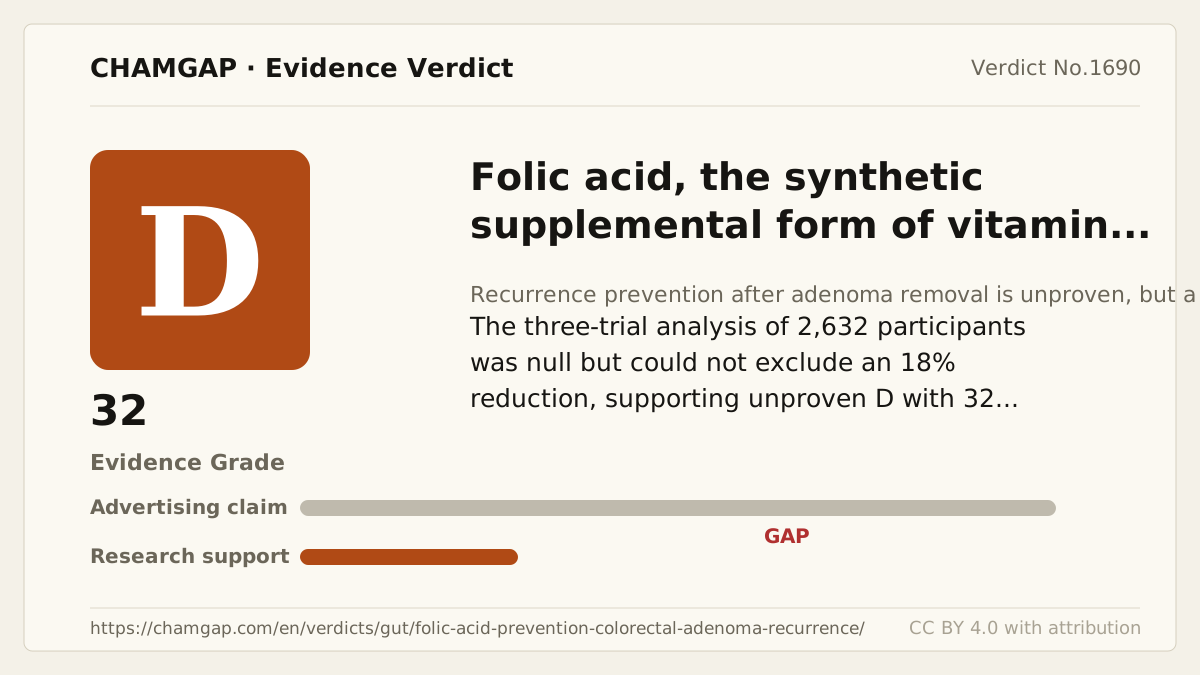
[Chamgap] Folic acid x prevention of colorectal adenoma recurrence after removal — Evidence Grade D·32. 2 cited sources checked. Source: https://chamgap.com/en/verdicts/gut/folic-acid-prevention-colorectal-adenoma-recurrence/ · CC BY 4.0CC BY 4.0 — free to use with attribution; do not distort grades, numbers, or verdict meaning.
What this document does and does not do
Chamgap is an information source. It reports what research has and has not confirmed; it does not tell readers what to take or buy. That decision belongs to readers and, when needed, medical or legal professionals. This verdict reflects literature available up to the search date and may change as new research appears. Nothing here is medical advice.