
Boswellia serrata,
does it really help with Induction of clinical remission in active ulcerative colitis or chronic colitis?
research showsBoswellia is rated D for inducing remission in active ulcerative colitis or chronic colitis. A 1997 comparative study in active ulcerative colitis and a 2001 study in 30 people with chronic colitis reported remission signals similar to sulfasalazine, but neither was placebo controlled and reporting of randomization, blinding, remission definitions, and analysis falls short of modern standards. A stricter small trial in collagenous colitis was not significant by intention-to-treat analysis, and a randomized trial with 82 participants found no advantage over placebo for maintenance of Crohn disease remission. The Crohn result is not a direct refutation of ulcerative-colitis induction, but it shows that Boswellia efficacy cannot be generalized across inflammatory bowel disease. It should not replace established therapy.
ads claimMarketing expands a natural 5-lipoxygenase inhibitor, a mechanism claim, and early comparative studies into a remission treatment that can replace steroids or 5-ASA. Mechanistic plausibility does not establish clinical remission, and stopping established therapy can increase the risk of relapse, bleeding, and hospitalization.
Useful facts when choosing a product
- Boswellia products include gum-resin powder, extracts, boswellic-acid-standardized extracts, and absorption-enhanced formulations. Results from one formulation cannot automatically be transferred to another supplement.
- The old colitis studies used 900 to 1,050 mg/day of gum resin for six weeks, but this does not establish an equivalent dose for retail products or a dose that replaces standard treatment.
- Abdominal discomfort, nausea, and diarrhea can occur. Use should stop and clinical evaluation is warranted if liver-enzyme abnormalities or jaundice develop; people with liver disease or multiple medicines should seek professional advice.
- Increased bleeding, fever, weight loss, dehydration, or severe pain in ulcerative colitis should not be self-treated with a supplement. Changes to 5-ASA, corticosteroids, immunomodulators, or biologic therapy require specialist supervision.
Chamgap Semantic Classification Code
Candidate index · review held
S.boswellia-serrata.UNK.induction-of-clinical-remission-in-active-ulcerative-colitis-or-chronic-colitis.treat.placeboSupplements and nutraceuticals > Boswellia serrata > Unknown > Induction of clinical remission in active ulcerative colitis or chronic colitis > Treatment or remission claim > Placebo
An automated migration candidate, not an issued permanent code; exact claim scope remains under review. This machine-generated migration candidate helps retrieval but is not a permanent assignment. The original verdict ID and URL remain authoritative.
What the research actually shows
Gupta and colleagues in 1997 administered Boswellia gum resin 350 mg three times daily for six weeks to people with grade II or III active ulcerative colitis and reported remission of 82% versus 75% with sulfasalazine. Their 2001 study gave 900 mg/day to 20 of 30 participants with chronic colitis and sulfasalazine 3 g/day to 10, reporting remission in 14 and 4 participants. Both studies were small and lacked adequate reporting of a modern randomized placebo-controlled design. Holtmeier and colleagues randomized 82 people in Crohn remission across 22 centers and found no advantage for 52-week remission maintenance, time to relapse, CDAI, IBDQ, or inflammatory laboratory measures. A confirmatory active-ulcerative-colitis trial is still needed.
Why this is classified as D (32)
Two old small comparative studies in active colitis provide remission signals, but placebo control, randomization, blinding, and prespecified-outcome reporting are weak. The intention-to-treat result in a stricter collagenous-colitis trial was null, as was the larger Crohn remission-maintenance trial. This is not a large direct refutation in ulcerative colitis, but reliable confirmatory evidence is absent, yielding D with 32 points. Tolerability is separate from efficacy.
Counterpoint. Anyone wishing to use it as an adjunct while continuing standard therapy should review the product, dose, liver function, and drug interactions with a gastroenterologist. Remission should be assessed with inflammatory markers and endoscopy rather than symptoms alone.
Rejudgment record. New verdict — Accepted remission signals from old small nonplacebo comparative studies, but applied D because modern randomization, blinding, and prespecified-outcome reporting were inadequate and stricter intention-to-treat collagenous-colitis and larger Crohn maintenance results were null
Sub-claim grades by effect
This ingredient is marketed for several effects. A single overall grade blends strong and weak claims together, so each effect is graded separately here. The overall grade reflects the strongest disconfirming or core claim.
| Effect (sub-claim) | Grade | Basis |
|---|---|---|
| Induction of clinical remission in active ulcerative colitis | D | An old small sulfasalazine comparison was positive, but placebo control and modern trial reporting were inadequate. |
| Induction of clinical remission in chronic colitis | D | Only a 30-person comparative remission signal exists, with low confidence in diagnosis, allocation, blinding, and analysis. |
| Long-term maintenance of Crohn disease remission | D | A larger randomized double-blind placebo-controlled trial was null for 52-week remission maintenance and major secondary outcomes. |
Cross-check — AI research and Codex final gate
Evidence Table
| Study | Design | Sample | Funding | Endpoint | Result | Weight |
|---|---|---|---|---|---|---|
| Gupta I et al. 1997 | Boswellia-versus-sulfasalazine controlled clinical trial in active ulcerative colitis | 50 enrolled, 42 with reported outcomes (34 boswellia, 8 sulfasalazine) | Inadequately reported | Six-week clinical remission, stool findings, rectal histology, and scanning electron microscopy | Reported remission in 82% with Boswellia 350 mg three times daily and 75% with sulfasalazine. | Direct positive but very small nonplacebo comparison |
| Gupta I et al. 2001 | Boswellia-versus-sulfasalazine comparative study in chronic colitis | 30 participants; 20 received Boswellia and 10 received sulfasalazine | Inadequately reported | Six-week remission, stool findings, histology, and laboratory measures | Remission occurred in 14 of 20 Boswellia recipients and 4 of 10 sulfasalazine recipients, but there was no placebo and design reporting was limited. | Direct weak positive evidence |
| Holtmeier W et al. 2011 | Multicenter randomized double-blind placebo-controlled trial | 108 enrolled, 82 randomized, and 66 analyzed for efficacy | Evaluation of the specific Boswelan PS0201Bo extract; detailed funding reporting limited | Maintenance of Crohn remission for 52 weeks, time to relapse, CDAI, and IBDQ | There was no superiority for maintained remission, 59.9% versus 55.3% (p=0.85), and the trial stopped early for insufficient discrimination on the primary endpoint. | Stricter indirect null evidence |
Receipt — 3 References
All 3 cited sources were verified for existence at the original page (as of 2026-07-22).
Final verification and publication gate: Codex · Evidence date: 2026-07-22 · Corrections: none
Cite this verdict
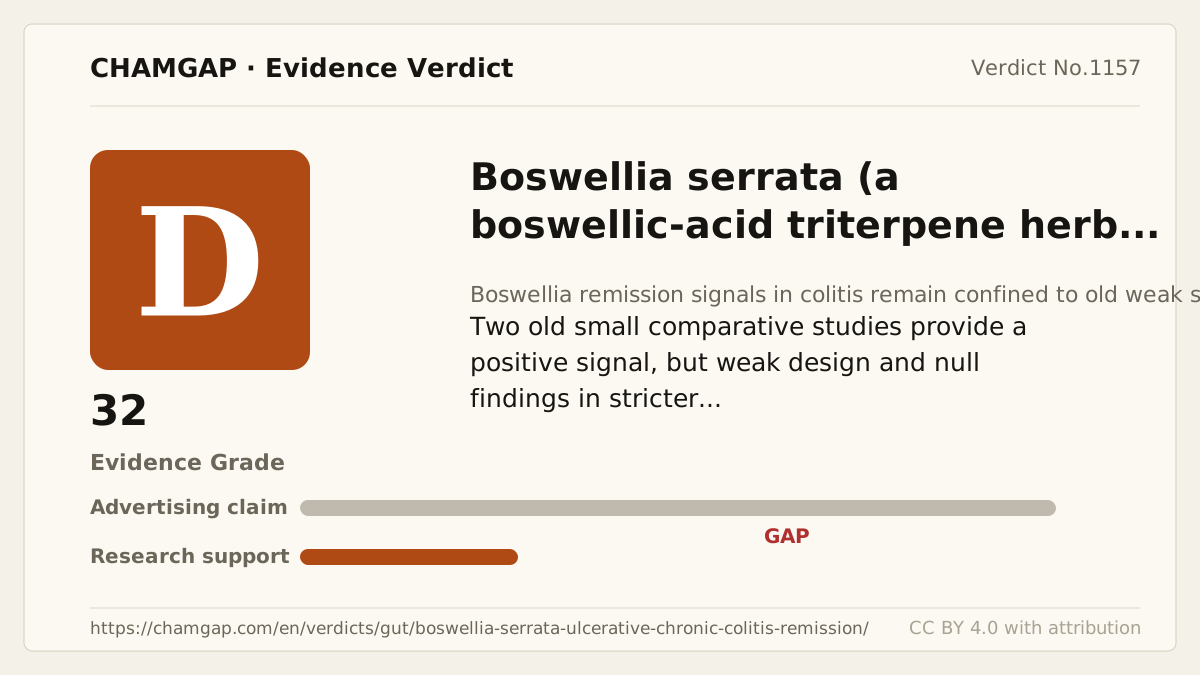
[Chamgap] Boswellia serrata x induction of clinical remission in active ulcerative or chronic colitis — Evidence Grade D·32. 3 cited sources checked. Source: https://chamgap.com/en/verdicts/gut/boswellia-serrata-ulcerative-chronic-colitis-remission/ · CC BY 4.0CC BY 4.0 — free to use with attribution; do not distort grades, numbers, or verdict meaning.
What this document does and does not do
Chamgap is an information source. It reports what research has and has not confirmed; it does not tell readers what to take or buy. That decision belongs to readers and, when needed, medical or legal professionals. This verdict reflects literature available up to the search date and may change as new research appears. Nothing here is medical advice.